DNREC Menu

Largemouth bass are the most popular freshwater sportfish in Delaware. They inhabit the freshwater portions of many tidal rivers and streams across the state. The DNREC Division of Fish and Wildlife monitors the status of tidal bass populations in several key river systems including the Nanticoke River, Broadkill River and Marshyhope Creek.
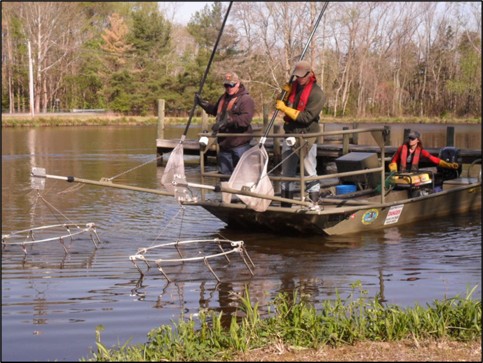
Bass populations are surveyed in the fall using boat electrofishing. The data collected is used to evaluate population abundance, the size distribution of the population and body condition.
Abundance is estimated using mark-recapture methods that involve marking fish by implanting them with passive integrated transponder (PIT) tags and hole punching the caudal fin to identify captures. These marked fish are released and after two weeks, biologists attempt to find the marked fish, along with newly captured fish.
The recaptures are then used to calculate estimate the fish population. Abundance is also measured as Catch Per Unit Effort (CPUE) and reported as the number of bass caught per electrofishing hour (bass/hour).
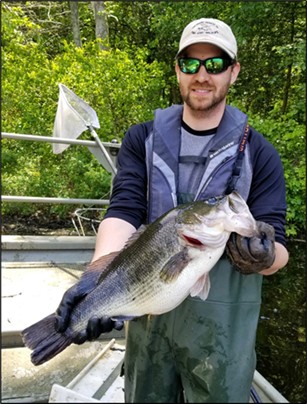
Bass, like other members of the sunfish family, are nest builders. Nesting is difficult in tidal river systems due to a limited amount of suitable habitat for nesting, heavy siltation, water flow and tidal flux.
Silt can coat the eggs and smother them. Nests built at high tide can be left high and dry during extreme low tides.
Abundance and age data indicate that year-class strength (number of fish produced each year) can be extremely variable.
To supplement natural reproduction, the division stocks advanced fingerling bass (3 to 5 inches long) into the Nanticoke and Broadkill River systems. Fingerling bass are grown to size at the Division of Fish and wildlife fish hatchery, located on the Nanticoke River. Once these fish reach 100 millimeters (about 4 inches) they are tagged and transported to the rivers for stocking.
Along with passive integrated transponder tagging, the division monitors bass populations through various other types of tagging projects.

Special research tagging includes bass that are surgically implanted with acoustic tags that transmit a code unique to each fish. The tags are detected by acoustic receivers placed throughout the river system on docks, piers, submersed structure, etc.
The data from the receivers and from manual tracking provides information on seasonal and migratory movements. In addition to providing location data, the acoustic tags also provide temperature and depth data.
Bass with implanted acoustic transmitters are externally tagged near the dorsal fine with an orange “Research” T-bar anchor tag. Anglers should immediately release these tagged fish in the location they were caught and report the catch and release to the Division of Fish and Wildlife.
Periodically, legal size bass (greater than 12 inches) are externally tagged with yellow “Reward” T-bar tags to assess angler behavior (seasonal activity, boat vs. shore angling, release rates, etc.) and fish movement. These tags each have a four-digit number. Anglers who report their catch receive an exclusive reward.
Reporting tagged bass is just one way that anglers can contribute to the division’s tidal bass management program.
Largemouth bass with “Reward” tags can be reported to the division at 302-735-2977 or using the online submission form at: de.gov/basstagreturns.
Tidal river Largemouth Bass populations receive heavy fishing pressure. The division’s research along with data provided by anglers helps determine management needs. The main objective of these efforts is to maintain a sustainable bass population that fills an ecological niche and provides satisfactory angling opportunities.
For more information on the tidal largemouth bass surveys contact DNREC Fisheries Biologist Zach Ramsey at (302) 735-2977 or zachary.ramsey@delaware.gov.
Related Topics: fish and wildlife, habitat, largemouth bass, monitoring, research, speacies
Delaware's Governor
State Agencies
Elected Officials
General Assembly
Delaware Courts
State Employees
Cities & Towns
Delaware State Code
State Regulations
Business First Steps
Phone Directory
Locations Directory
Public Meetings
Voting & Elections
Transparency
Health Insurance
Tax Center
Personal Income Tax
Privacy Policy
Weather & Travel
Contact Us
Corporations
Franchise Tax
Gross Receipts Tax
Withholding Tax
Delaware Topics
Help Center
Mobile Apps
E-mail / Text Alerts
Social Media


Built by the Government Information Center
©MMXXVI Delaware.gov