DNREC Menu

The DNREC Division of Fish and Wildlife uses electrofishing to safely sample fish populations in a variety of water bodies. Electrofishing is one of the most efficient sampling methods available to fisheries biologists.
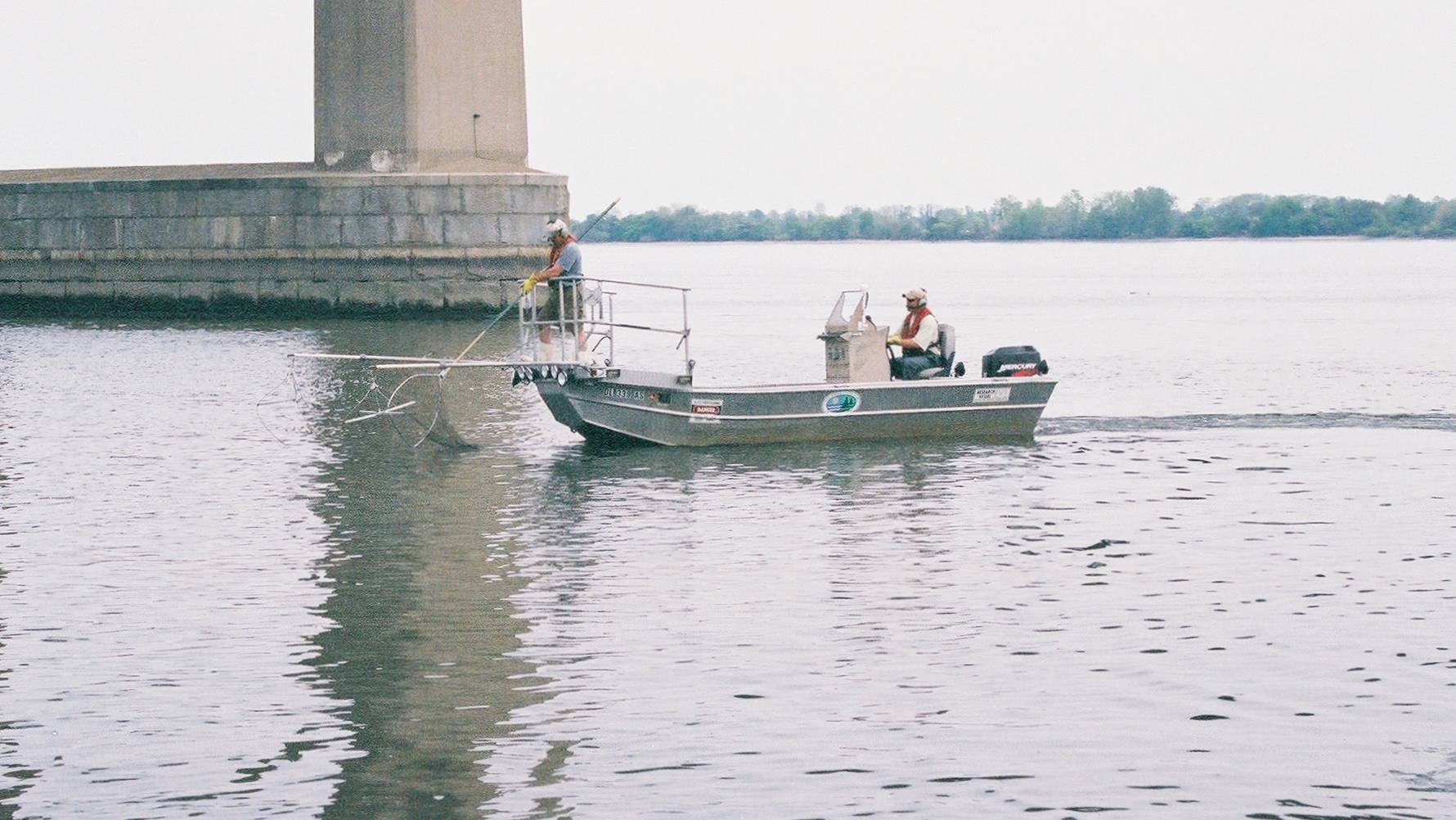
Electrofishing uses an electric current to temporarily stun fish. This lets biologists sample and survey fish populations with minimal disturbance and risk to the fish.
Electrofishing, done properly by trained crews, protects fish and helps biologists gather useful data. It is only allowed for use by permitted researchers in Delaware.
For more information, please contact Fisheries Biologist Mike Steiger at Michael.Steiger@delaware.gov or 302-735-2966.
On the Division’s electrofishing boats, a generator powers a specialized electric unit. It has variable voltage and amperage adjustments, pulse-width indicators and a timer.
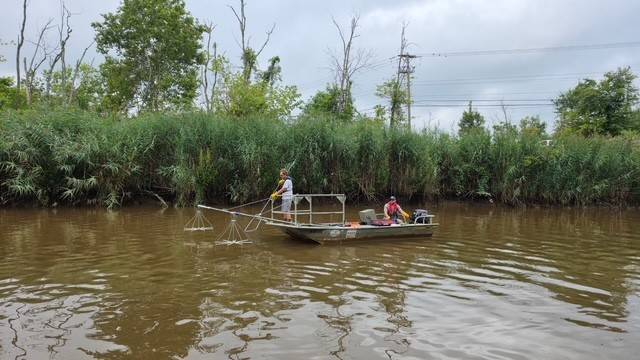
Crews operate the unit using a foot pedal wired to the unit and to a set of anodes (positive current) that hang off the bow of the boat. Current is delivered into the water through the anodes. The metal hull of the boat acts as the cathode (negative current) to complete the circuit.
Pulsed, direct electric current causes galvanotaxis in fish. This is the involuntary muscle movement that causes the fish to swim toward the anode. Crews on the bow of the boat quickly net the fish and place them in an aerated on-board livewell. Within a few minutes, fish typically return to their normal state.
Biologists record length and weight measurements and note markings, wounds or other abnormalities. For some research projects, a few scales are taken to determine the age of the fish. For some, fish are tagged to examine fish movement and angler catches.
The fish are then released back into the water.
Electrofishing can also be useful for managing invasive catfish, which can compete with native fish for food and habitat. Some invasive catfish species can grow large, reproduce successfully and become difficult to control once they become established.
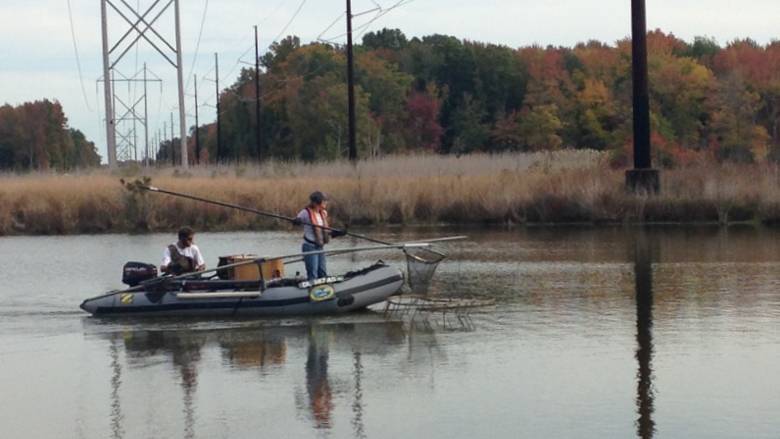
Fisheries managers can use low-frequency electrofishing as a tool to target and collect these fish. During low-frequency electrofishing, trained crews use the electrical field to temporarily stun invasive catfish and collect them with dip nets.
The captured fish are identified, measured and removed from the water when regulations and management plans allow. This approach helps biologists learn more about the number, size and distribution of invasive catfish while also reducing their numbers in targeted areas.
Electrofishing is usually most effective as part of a larger management program because it may not remove every invasive fish from a water body.
Because not every fish in a water body can be collected, electrofishing provides a sample rather than a complete count of the fish population. It is also most effective in freshwater because saltier water conducts electricity differently and can make the equipment less effective or unsafe to operate.
Despite these limitations, electrofishing is a valuable tool for fisheries management. It allows biologists to study fish abundance, species composition, size, age and population structure while having a relatively small impact on the overall fish population.
When used with other management methods, including low-frequency electrofishing to target invasive catfish, it can also help protect native fish communities and improve the health of Delaware’s freshwater ecosystems.
Related Topics: dfw, electrofishing, fish and wildlife, fishing, freshwater, outdoors and recreation, research, science, wildlife
Delaware's Governor
State Agencies
Elected Officials
General Assembly
Delaware Courts
State Employees
Cities & Towns
Delaware State Code
State Regulations
Business First Steps
Phone Directory
Locations Directory
Public Meetings
Voting & Elections
Transparency
Health Insurance
Tax Center
Personal Income Tax
Privacy Policy
Weather & Travel
Contact Us
Corporations
Franchise Tax
Gross Receipts Tax
Withholding Tax
Delaware Topics
Help Center
Mobile Apps
E-mail / Text Alerts
Social Media


Built by the Government Information Center
©MMXXVI Delaware.gov