DNREC Menu

The Striped bass, locally known as the Rockfish, is one of the most important fish species along the Atlantic Coast, supporting valuable commercial and recreational fisheries. The DNREC Division of Fish and Wildlife monitors the Delaware River Striped bass population to gather important information that can be used to improve management of the Striped bass fishery.
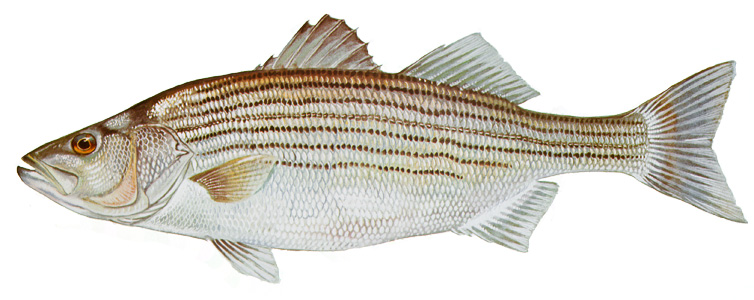
Striped bass are native to coastal rivers and waters along the Atlantic Coast from the St. Lawrence River, in Canada, to the St. John’s River, in Florida, and in the Gulf of Mexico from western Florida to Louisiana. They have also been introduced along the Pacific Coast and in many rivers, lakes and reservoirs throughout the U.S. and Europe.
Striped bass are anadromous, meaning they use freshwater rivers for spawning and marine environments for growth and migration. Along with the Chesapeake Bay and Hudson River, the Delaware River is one of the main producer areas for Striped bass along the Atlantic Coast.
Spawning is triggered by increased water temperatures during spring (57 to 68 degrees) which cause Striped bass to ascend the freshwater portion of tidal rivers for spawning. In the Delaware River, the main spawning grounds are located between Wilmington, Delaware, and Marcus Hook, Pennsylvania. Spawning also occurs above Marcus Hook and in the C&D Canal.
Spawning areas are restricted to catch and release fishing from April 1 to May 31 and anglers using natural baits must use non-offset circle hooks.
To monitor the Delaware River Striped bass population, the DNREC biologists conduct surveys on the main spawning grounds during the spring, using an electrofishing boat to catch and sample the fish.
All sexually mature fish captured are measured for length. Several scales are removed from each fish to estimate age and growth. All fish 16 inches or longer are tagged prior to release.
Since 1991, more than 10,500 Striped bass have been sampled, ranging from 7 to 48 inches in size and 2 to 19 years in age. On average, spawning males are typically much smaller in size and younger in age than females.
Nineteen percent of the fish that were tagged have been recaptured; recreational anglers reported most (80%) of the tag returns. Delaware River fish have been recaptured from North Carolina to Maine with most fish caught in waters of New Jersey (34%), Maryland (21%), Delaware (14%) and Massachusetts (8%).
Anglers should look for reward tags on Striped bass they catch and write down the tag number and phone number printed on tag.

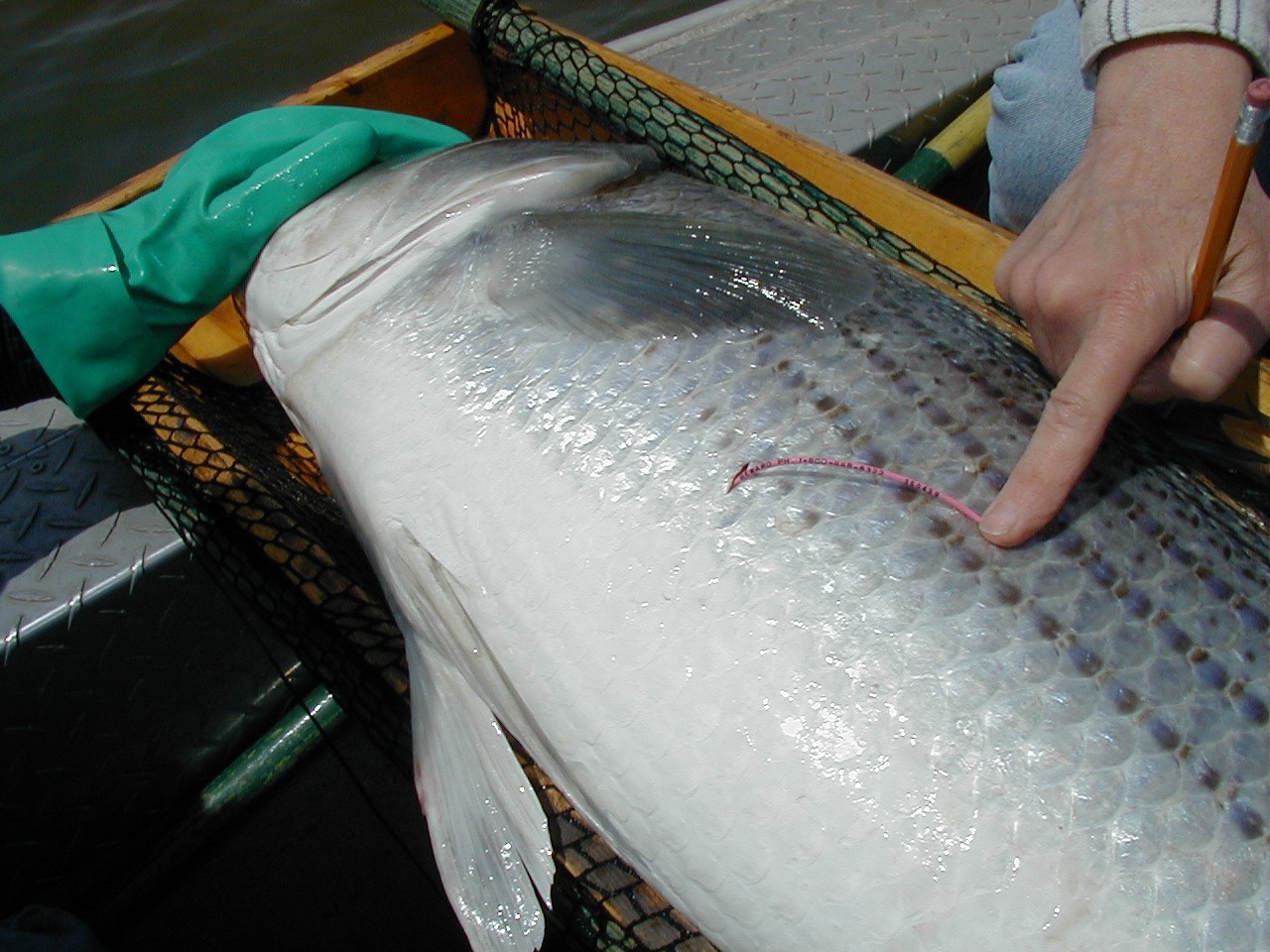
By calling the phone number and reporting the tag number (a “tag return”), anglers provide important information on migration, growth and survival.
Reward rags are red and are located next to the left pectoral fin. They can also be returned to the U.S. Fish & Wildlife Service, at 177 Admiral Cochrane Dr., Annapolis, MD 21401.
For more information on the Delaware River striped bass survey contact DNREC Fisheries Biologist Ian Park, at 302-735-8663 or ian.park@delaware.gov.
Related Topics: fish and wildlife, fish species, fisheries, fishing, monitoring, research, rockfish, striped bass
Delaware's Governor
State Agencies
Elected Officials
General Assembly
Delaware Courts
State Employees
Cities & Towns
Delaware State Code
State Regulations
Business First Steps
Phone Directory
Locations Directory
Public Meetings
Voting & Elections
Transparency
Health Insurance
Tax Center
Personal Income Tax
Privacy Policy
Weather & Travel
Contact Us
Corporations
Franchise Tax
Gross Receipts Tax
Withholding Tax
Delaware Topics
Help Center
Mobile Apps
E-mail / Text Alerts
Social Media


Built by the Government Information Center
©MMXXVI Delaware.gov