DNREC Menu

Biologists from the DNREC Division of Fish and Wildlife keep track of the state’s fish populations. They work on Delaware’s rivers, ponds, estuaries, on the Delaware Bay and in coastal waters and study how different species are faring.
Among other research and responsibilities, they track invasive fish species, provide guidance for Delaware pond owners, and guidance on controlling aquatic plants and herbicides.
The DNREC Division of Fish and Wildlife works closely with the NOAA Fisheries’ Marine Recreational Information Program to gather recreational fishing data from anglers. Learning what people experience while fishing Delaware waters can play a key role in supporting sustainable fisheries.
This involves in-person shoreside catch surveys and a survey by mail, the Weather and Outdoor Activity Survey.
Taking a few minutes to share information about a fishing trip via is one of the most important contributions an angler can make to help balance optimal fishing opportunities with the protection of marine resources.
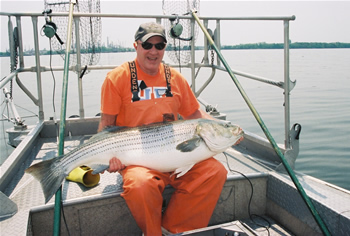
Fisheries biologists use different types of sampling gear to check fish populations. Their methods depend on the habitat (pond, river, estuary, tidal stream, etc.) and the kind of fish involved.
Some fish, like largemouth bass or striped bass, are best collected using electrofishing. Fish in deeper waters, such as weakfish and croaker in the Delaware Bay, are more easily collected by trawling.
Once collected, fish are weighed and measured. Scale samples or other aging structures may be removed to help determine the age and growth of the fish. Finding a variety of sizes and ages indicates a healthy fish population.
Sometimes, fisheries biologists need to gather other information. They’ll design and carry out special studies needed to help manage healthy fish populations.
For example, one study of striped bass food habits in the Delaware Bay uses a small pump to flush out the contents of of fishes’ stomachs. The fish are released, hungry but healthy, and biologists study what they’ve eaten.

Fish biology studies help scientists identify and plan ways to deal with a variety of local and regional problems.
These may include pond-specific issues such as over-crowding of smaller fish or poor growth. There may be habitat issues, such as the destruction of shoreline structures or run-off affecting water quality.
For species like the striped bass, management must be at the regional or coastal level. Striped bass move into the Delaware River during the spring to spawn upstream of the Delaware Memorial Bridge. They can go into Pennsylvania waters. When the adults move out into coastal waters, they may migrate between New England and North Carolina.
All coastal states gather and share information about shared species. The US Fish and Wildlife Service and other inter-state agencies lead management for these species.
The Division of Fish and Wildlife issues Scientific Collection Permits to collect protected wildlife, including finfish and shellfish for scientific, education or propagating purposes.
Related Topics: dfw, fish and wildlife, fisheries, fishing, outdoors, outdoors and recreation, recreation, research
Delaware's Governor
State Agencies
Elected Officials
General Assembly
Delaware Courts
State Employees
Cities & Towns
Delaware State Code
State Regulations
Business First Steps
Phone Directory
Locations Directory
Public Meetings
Voting & Elections
Transparency
Health Insurance
Tax Center
Personal Income Tax
Privacy Policy
Weather & Travel
Contact Us
Corporations
Franchise Tax
Gross Receipts Tax
Withholding Tax
Delaware Topics
Help Center
Mobile Apps
E-mail / Text Alerts
Social Media


Built by the Government Information Center
©MMXXVI Delaware.gov