DNREC Menu

DNREC monitors the presence of chemical contaminants in the edible flesh of finfish and shellfish in Delaware waters. In coordination with the Department of Health and Social Services (DHSS), they issue periodic fish consumption advisories to guide anglers on the amount of fish they can safely consume from specific water bodies to increase risk awareness.
DNREC Fisheries Section
302-739-9914
DHSS Div. of Public Health
302-744-4700
This page contains information on how legacy pollutants impact the safety of finfish and shellfish, the general statewide fish consumption advisory, current advisories for specific water bodies and fish species, and ways you can reduce your risk.
Many of the contaminants that prompt fish advisories in Delaware are considered “legacy pollutants.” These are chemicals such as polychlorinated biphenyls (PCBs), the banned insecticide DDT and dioxins and furans that were released into waterways in significant quantities in the past. These legacy pollutants are slow to break down in the environment and remain in streams and estuaries, where they represent continuous sources of exposure to aquatic life.
Even when present in the water or sediment in extremely small amounts, some chemicals tend to accumulate in fish tissue because fish absorb contaminants from the water and sediment, and from the food they eat.
The amount of contaminants fish accumulate depends on the species, size, age, sex, and the feeding area of the fish.
In general, older, larger individual fish will have accumulated the most contaminants. Since fish accumulate many contaminants in their fatty tissues, species with higher fat/oil content can pose more risk than others.
In recent years, DNREC’s data has indicated improvements in concentrations of most contaminants in fish tissue across the state. This reduction is attributed to regional and local efforts, including state-of-the-science testing to identify, prioritize and control remaining sources of contaminants, and innovative clean-up strategies that are effectively reducing the transport of chemicals and their subsequent availability to accumulate in fish and other aquatic organisms.
For PCBs, the primary chemical driving fish consumption advisories, DNREC and its partners, including the Delaware River Basin Commission, New Castle County Special Services, the City of Wilmington, state environmental agencies in Pennsylvania and New Jersey, and industrial facilities, have been working cooperatively on strategies and projects that implement the Delaware Estuary total maximum daily load (TMDL)
Fish consumption advisories are recommendations by DNREC and DHSS to limit or avoid eating certain species of fish caught in local waters due to potential health risks from contaminants.
DNREC and DHSS remind the public of the general statewide fish consumption advisory to eat no more than one 8-oz. meal per week of any fish species caught in Delaware’s fresh, estuarine and marine waters. This advisory applies to all waters and fish species not otherwise explicitly covered by a specific advisory.
The statewide advisory is issued in an abundance of caution to protect against eating large amounts of fish or fish that have not been tested, or that may contain unidentified chemical contaminants.
Delaware issues more stringent advice for specific waters when justified by the data collected. One meal is defined as an eight ounce serving for adults and three ounce serving for children.
A description of the procedures used by DNREC and DHSS to calculate recommended fish consumption limits can be found in the document: Technical Procedures for Evaluating Human Health Risks Associated with the Consumption of Chemically Contaminated Fish and Shellfish.
The most recent Delaware Fish Consumption Advisories are shown in the chart below or can and are available for download. Contaminants of concern that are responsible for the advisories are listed along with the maximum number of meals per year that are recommended to minimize potential health impacts from consuming the fish.
Fish consumption advisories for individual water bodies are updated as new data is collected and assessed, usually every five to seven years, depending upon available funding for sample collection and analysis.
| Waterbody | Geographic Extent | Species | Contaminant(s) | Meals/Year (8 oz) |
|---|---|---|---|---|
| Shellpot Creek | Governor Printz Blvd. to the Delaware River | All finfish | PCBs, Dieldrin, Chlordane | 1 |
| Upstream of Governor Printz Blvd. | All finfish | PCBs, Dieldrin, Chlordane, Heptachlor epoxide | 2 | |
| Tidal Brandywine River | River Mouth to Baynard Blvd. | All finfish | PCBs, Dioxins and Furans, Dieldrin | 2 |
| Non-tidal Brandywine River | Baynard Blvd. to DE/PA Line | All finfish | PCBs, Dioxins and Furans, Dieldrin | 6 |
| Red Clay Creek | Creek Mouth to DE/PA Line | All finfish | PCBs, Dioxins and Furans, Dieldrin, DDT, DDD, DDE | 3 |
| Tidal White Clay Creek | River mouth to Route 4 | All finfish | PCBs, Dieldrin, DDT, DDD, DDE, Chlordane | 1 |
| Non-tidal White Clay Creek | Route 4 to DE/PA state line | All finfish | PCBs, Dieldrin | 12 |
| Army Creek and Pond | Creek Mouth to Route 13, including Army Pond | All finfish | PCBs, Dioxins and Furans | 4 |
| Red Lion Creek | Route 1 to the Delaware River | All finfish | PCBs, Dioxins and Furans | 2 |
| Upstream of Route 1 | All finfish | PCBs, Dieldrin | 12 | |
| Tidal Christina River | I-95 at Peterson Wildlife Refuge upstream to Smalley’s Dam (includes Nonesuch Creek) | All finfish | PCBs | 12 |
| Mouth upstream to I-95 at Peterson Wildlife Refuge | All finfish | PCBs, Dioxins and Furans, Dieldrin, DDT, DDD, DDE, Chlordane | 1 | |
| Little Mill Creek | Creek Mouth to Kirkwood Highway | All finfish | PCBs, Dieldrin, Chlordane, Heptachlor epoxide | 1 |
| Non-tidal Christina River | Smalley’s Dam to DE/MD state line | All finfish | Dieldrin | 12 |
| Christina Creek | Rittenhouse Park to DE/MD state line | Stocked trout | PCBs, Dieldrin | 6 |
| All other trout streams and ponds | See Delaware Fishing Guide for all designated trout streams | Stocked trout | PCBs | 12 |
| C&D Canal | Entire canal in Delaware | All finfish | PCBs, Dioxins and Furans, Dieldrin | 1 |
| Appoquinimink River | Tidal portions | All finfish | PCBs, Dioxins and Furans, Dieldrin | 2 |
| Drawyers Creek | Tidal portions | All finfish | PCBs, Dioxins and Furans, Dieldrin | 4 |
| Silver Lake, Middletown | Entire lake | All finfish | Dieldrin | 12 |
| St. Jones River and Silver Lake, Dover | Tidal river and entire pond | All finfish | PCBs, Dioxins and Furans, Dieldrin | 4 |
| Fork Branch | McKee Rd. to College Rd. | All finfish | Mercury | 24 |
| Moores Lake | Entire lake | All finfish | PCBs | 12 |
| Wyoming Mill Pond | Entire pond | All finfish | DDT, DDD, DDE | 24 |
| Slaughter Creek | Entire creek | All finfish | PCB, Dioxins and Furans | 12 |
| Delaware River | DE/PA state line to the C&D Canal | All finfish | PCBs, Dioxins and Furans, Dieldrin | 3* |
| Lower Delaware River and Delaware Bay | C&D Canal to the mouth of the Delaware Bay | Striped Bass, Channel Catfish, White Catfish, American Eel | PCBs | 3* |
| White Perch | PCBs | 6 | ||
| Bluefish 20 inches or less | PCBs | 12 | ||
| Bluefish greater than 20 inches | PCBs, Mercury | 3* | ||
| Delaware Atlantic coastal waters including the Delaware Inland Bays | Coastal Delaware from mouth of Delaware Bay south to DE/MD state line | Striped Bass | PCBs | 3* |
| Bluefish 20 inches or less | PCBs | 12 | ||
| Bluefish greater than 20 inches | PCBs, Mercury | 3* | ||
| All waters not listed | All areas not listed | All finfish | All monitored contaminants | 52 |
| *Those who might become or are pregnant or breastfeeding and children should not consume these fish. | ||||
For more information, contact DNREC at 302-739-9939 or the DHSS Division of Public Health at 302-744-4546.
Most contaminants tend to concentrate in a fish’s fatty tissue, so deliberate cleaning and cooking techniques can significantly reduce levels of PCBs, dioxins, chlorinated pesticides and other organic chemicals in the portion that is eaten. Larger fish tend to have higher concentrations.
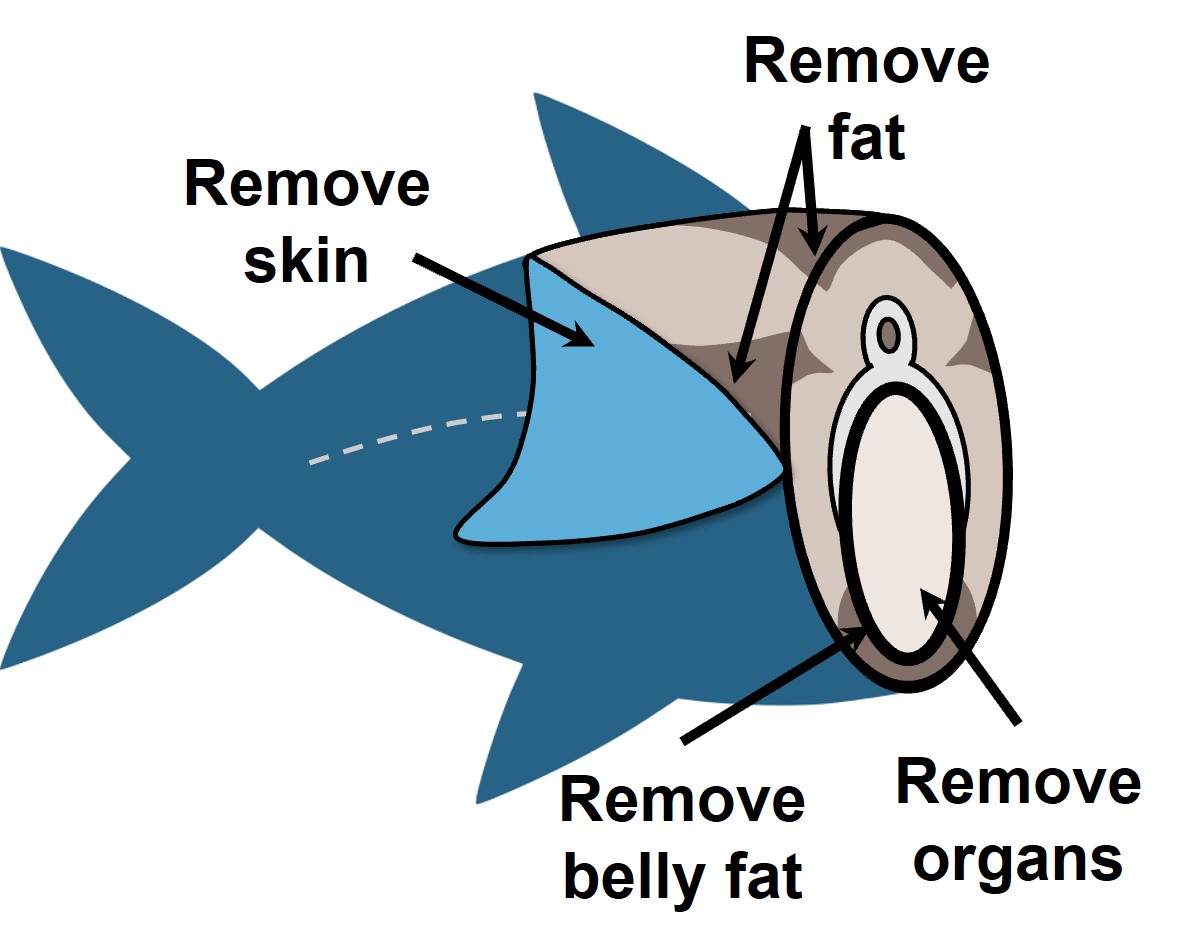
Proper cleaning and preparation of fish can reduce the chance of consuming chemical contaminants:
Bake or broil trimmed fish on a rack or grill so some of the remaining fat can drip away. Discard any drippings; do not eat drippings or use them for cooking other foods.
Note: These techniques will not reduce or remove unsafe levels of mercury or PFAS from fish, as they tend to accumulate in muscle tissue (meat) as opposed to fat.
People who are or may become pregnant, people who are breastfeeding or plan to breastfeed, and children under the age of 15 may want to avoid eating any species of fish suspected to impacted by contaminants.
For more information about fish and shellfish consumption advisories around the United States, visit the EPA Fish Consumption Advisories page.
Delaware's Governor
State Agencies
Elected Officials
General Assembly
Delaware Courts
State Employees
Cities & Towns
Delaware State Code
State Regulations
Business First Steps
Phone Directory
Locations Directory
Public Meetings
Voting & Elections
Transparency
Health Insurance
Tax Center
Personal Income Tax
Privacy Policy
Weather & Travel
Contact Us
Corporations
Franchise Tax
Gross Receipts Tax
Withholding Tax
Delaware Topics
Help Center
Mobile Apps
E-mail / Text Alerts
Social Media


Built by the Government Information Center
©MMXXVI Delaware.gov