DNREC Menu
The Aquatic Resources Education Center (AREC) offers several free field trips throughout the school year. All programs listed are available to any school, homeschool co-ops or youth-affiliated groups. The only cost is for transportation to the Aquatic Resources Education Center. The bus must stay on the property the entirety of the trip.
Taylor Border
Aquatic Education Programs Manager
2520 Lighthouse Road
Smyrna, DE 19977
302-735-8689
All field trip programs are offered free of charge and necessary equipment is provided.
To register your class, send an email with the program name to taylor.border1@delaware.gov.
Eco-Explorers is a free field trip program designed for fifth grade students in Delaware. Participants experience and explore connections between plants and animals within a tidal salt marsh ecosystem.
The Eco-Explorers field trip program uses an eco-station approach in which teams of approximately 10 students rotate through a series of outdoor activities, investigating various components and connections in a salt marsh ecosystem. These include investigations of water chemistry, food webs, plant and animal adaptations, and other ecological topics. All activities are hands-on and similar to those that real scientists perform when studying ecosystems.
Content and activities are aligned with Next Generation Science Standards and linked to the Delaware Ecosystems science unit endorsed by the Delaware Department of Education.
Field trips can accommodate two classes (up to 60 students) at a time. Each field trip lasts approximately three and a half hours, including a lunch break. There is no charge for a field trip, aside from the transportation costs of getting students to and from the center.
There are two sets of field trips each school year. The fall season runs from mid-September through mid-November. The spring season starts in late March and continues until the end of May. Field trip applications with available dates are provided several months prior to each field trip season. Interested teachers can obtain an application by sending an email to Taylor Border.
The Aquatic Resources Education Center also offers a virtual version of the Eco-Explorers field trip program for students or school groups that are unable to attend traditional, in-person field trips.
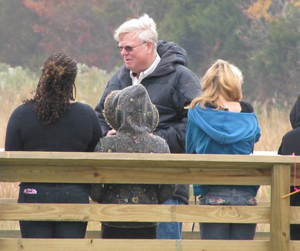
Science teachers who participate in the Eco-Explorers Program are invited to a teacher workshop, where they receive introductory information and resource materials for wetlands education and enrichment to use in the classroom prior to their field trip to the Aquatic Resources Education Center in Smyrna.
Volunteers with the Eco-Explorers Program teach small groups of students about the wonders of the tidal salt marsh ecosystem and guide students as they learn about fish, macro-invertebrates, plants, and water quality. This is a great opportunity to work outdoors in a beautiful salt marsh. Volunteer schedules are flexible. Training is provided.
For more information, contact Taylor Border at taylor.border1@delaware.gov or 302-735-8689.
Bring your group of students out to the Aquatic Resources Education Center to learn more about the sport of angling. The Center offers activity stations where students can learn fundamental fishing skills like casting and knot tying as well as the importance of fisheries conservation.
Depending on your group’s ages and educational needs, we can adapt activities to better suit them. Then, they have an opportunity to practice their new skills on our two stocked fishing ponds. This free trip is four hours long and can accommodate up to 30 students. All equipment is provided.
Seining is a form of fishing where a large net is dragged along the bottom of a body of water and then lifted out to reveal what’s caught. Students will be able to use the net themselves and then record their catch.
We will compare several parts of the beach, seining in the tidal gut and bay to see differences in the species caught. Students will hypothesize why we see differences just several hundred feet apart and then wrap-up with a discussion about Delaware Bay and how to protect species we find.
This program is located at Woodland Beach in Smyrna, and is timed to match a falling tide, at least three hours before low tide. The trip is up to two hours long and we can accommodate up to 15 students due to the beach’s location and size.
Related Topics: eco-explorer, education, field trip, fish and wildlife, fishing, outreach, salt marsh, seining
Delaware's Governor
State Agencies
Elected Officials
General Assembly
Delaware Courts
State Employees
Cities & Towns
Delaware State Code
State Regulations
Business First Steps
Phone Directory
Locations Directory
Public Meetings
Voting & Elections
Transparency
Health Insurance
Tax Center
Personal Income Tax
Privacy Policy
Weather & Travel
Contact Us
Corporations
Franchise Tax
Gross Receipts Tax
Withholding Tax
Delaware Topics
Help Center
Mobile Apps
E-mail / Text Alerts
Social Media


Built by the Government Information Center
©MMXXVI Delaware.gov