DNREC Menu

The DNREC Division of Fish and Wildlife uses various techniques to monitor and study fish populations and habitat to determine when, where and how to best maintain healthy fish populations.
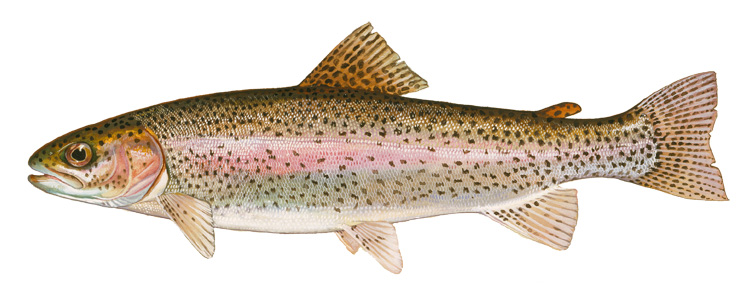
A question often on anglers’ minds is “When was this pond/river/creek last stocked?”
In the past, when most anglers kept their catch, there was a need to maintain populations through stocking. However, with the widespread popularity of catch-and-release fishing, stocking is usually only necessary in specific circumstances.
For more information on Delaware’s fish stocking programs, please contact DNREC Fisheries Biologists Zach Ramsey, at Zachary.Ramsey@delaware.gov or 302-735-2977, or Johnny Moore, at Johnny.Moore@delaware.gov or 302-735-2962.
Before stocking a pond, it is important to assess the existing fish community to determine if stocking is necessary.
The Division of Fish and Wildlife often uses boat electrofishing to collect fish and assess the fish community. Game fish collected during surveys are examined, measured, weighed and released.
The abundance of each species, the size structure (a variety of size groups indicates a balanced population), and the condition of the fish (“plumpness” indicates there is enough forage) are evaluated.
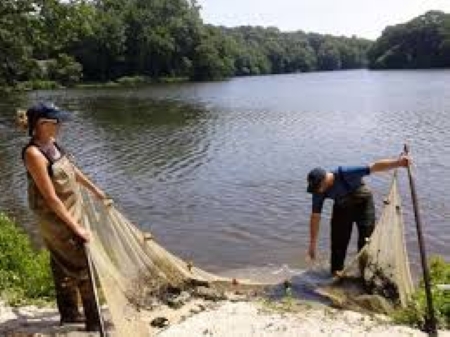
If the survey finds low numbers of juvenile fish, particularly Largemouth Bass and Bluegill, more sampling will be conducted. This involves using a beach seine to capture young-of-year (less than 1 year old) fish between July and September to assess reproduction.
If population numbers are low, or if natural reproduction is poor, stocking may be needed to supplement the population.
Stocking is also necessary to rebuild the fish community if a dam washes out, the water level is reduced or there is a fish kill.
Sometimes fish are stocked for the purposes of a put-and-take fishery, such as at Tidbury Pond and Newton Pond, which are stocked with freshwater trout in the early spring while water temperatures are cool enough for trout to survive.
Trout are also stocked in selected streams in New Castle County from late March to late April. Learn more on the Freshwater Trout Fishing page.
Poor reproduction is common in some of Delaware’s freshwater tidal streams, such as the Nanticoke and Broadkill Rivers.
The negative impact of tidal currents and heavy silt loads on nest-builders such as Largemouth Bass can reduce spawning success.
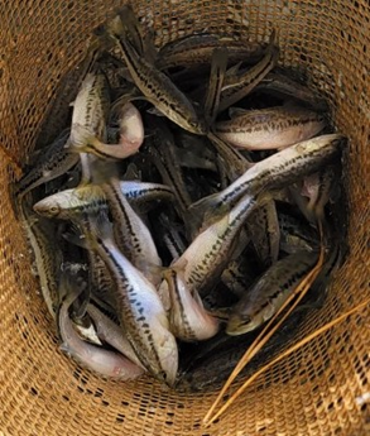
To supplement natural reproduction, the DNREC Division of Fish and Wildlife stocks “advanced” fingerling bass (measuring 3 to 5 inches) into the Nanticoke and Broadkill River systems.
Fingerling bass are purchased from a supplier or grown-out at the Division’s fish hatchery, located on the Nanticoke River. Once fish reach 100 millimeters (about 4 inches) they are tagged with a tiny, battery free transponder and transported to the rivers for stocking.
Since 2020, the Division of Fish and Wildlife has stocked more than 51,000 fingerlings, most of them (80%) being stocked in the Nanticoke River to help support its tournament fishery.
If angling is already satisfactory and the fish community is well-balanced, stocking is not recommended.
Fish compete for finite resources. If populations become too dense, there may not be enough food available.
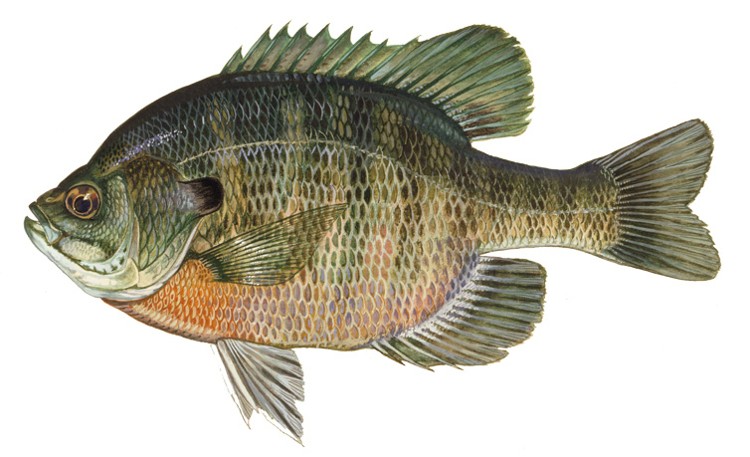
For example, too dense a population of Largemouth Bass can greatly reduce the population of their prey (such as Bluegill) resulting in underweight bass with slower than average growth.
On the other hand, if the Bluegill population is too dense, they can have too negative an impact on bass reproductive success because they eat bass eggs and fry. Overpopulated Bluegill also tend to be small and have stunted growth.
When fish populations are too dense, the DNREC Fisheries Biologists may remove a portion of the population and move them to a different waterbody.
The Division may also install in-water “structure” to provide habitat needed by most gamefish to spawn, seek shelter and forage.
Reducing competition for resources may help fish communities see added benefits that stocking does not provide.
Related Topics: bass, fish and wildlife, fishing, management, ponds, rivers, stocking, trout
Delaware's Governor
State Agencies
Elected Officials
General Assembly
Delaware Courts
State Employees
Cities & Towns
Delaware State Code
State Regulations
Business First Steps
Phone Directory
Locations Directory
Public Meetings
Voting & Elections
Transparency
Health Insurance
Tax Center
Personal Income Tax
Privacy Policy
Weather & Travel
Contact Us
Corporations
Franchise Tax
Gross Receipts Tax
Withholding Tax
Delaware Topics
Help Center
Mobile Apps
E-mail / Text Alerts
Social Media


Built by the Government Information Center
©MMXXVI Delaware.gov