DNREC Menu

The DNREC Division of Fish and Wildlife manages the fish populations in over 30 public ponds across the state ranging in size from 4.8 acres (Tubmill Pond) to nearly 200 acres (Lums Pond).
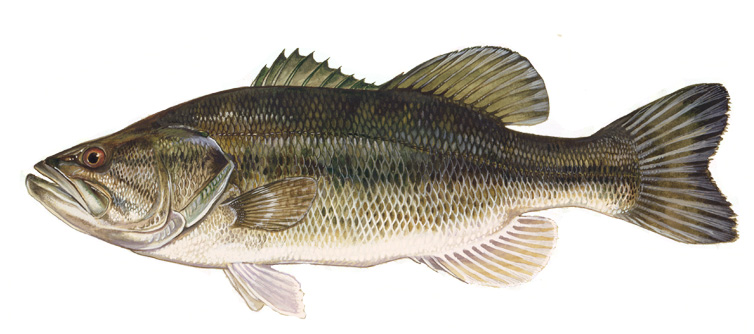
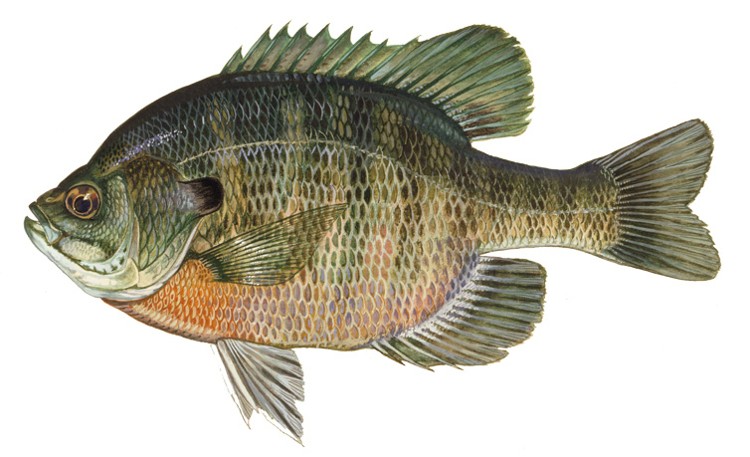
Delaware’s public ponds are managed for moderate densities of game fish including Largemouth Bass and panfish (Bluegill, Black and White Crappie, Pumpkinseed, Redear, White Perch and Yellow Perch).
Other species often targeted by anglers, such as Yellow and Brown Bullheads and Chain Pickerel are also found in the ponds.
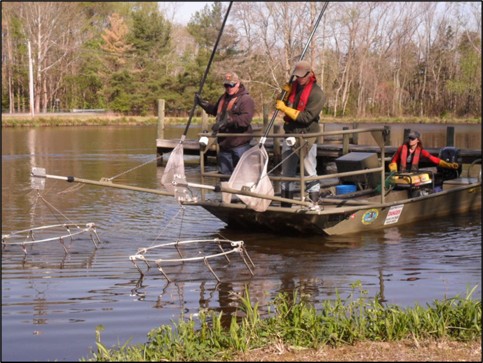
Each pond is surveyed at least once every five years to evaluate the fish community and determine if it is balanced. Boat electrofishing is used to collect fish and hold them in an on-board live-well until they are examined, weighed and measured.
The size distribution (balanced populations have a variety of sizes) and relative weight (a measure of condition, or “plumpness”) are calculated for each gamefish from length and weight measurements. These measurements can indicate if there are sufficient food resources to support growth and good condition, or if there is overcrowding or lack of forage.
When overcrowding occurs, competition for resources increases, resulting in poor condition and slow growth leading to stunted populations. Overcrowding can occur in many of the species in Delaware’s ponds but is most common among species that produce high numbers of offspring such as Crappie and other panfish species. When overcrowding occurs, the division may remove a portion of these stunted fish to benefit the population.
The abundance of each fish species is also measured using Catch per Unit of Effort (CPUE). This is calculated by dividing the number of fish caught during the electrofishing survey by the survey time, generally reported as the number of fish per electrofishing hour (fish/hour).
CPUE is used to compare abundance of that species across years and similar water bodies. If the CPUE is extremely high, a portion of that species may be removed from the pond and placed downstream of the spillway to alleviate overcrowding. Conversely, if the CPUE is low, populations may be supplemented through stocking.
If the survey reveals low numbers of juvenile fish, particularly Largemouth Bass and Bluegill, additional sampling to assess reproduction occurs. This involves using a beach seine in shallow areas of the pond between July and September to capture young-of-year (less than 1 year old). If natural reproduction is poor, supplemental stocking may be conducted.
Another important aspect of managing game fish communities is ensuring there is enough habitat.
Although each species has specific habitat requirements, all game fish need adequate habitat to spawn, seek shelter and forage. Many game fish species have an affinity for in-water structure, which is naturally provided by aquatic vegetation and various types of woody debris (tree deadfalls, brush piles etc.).
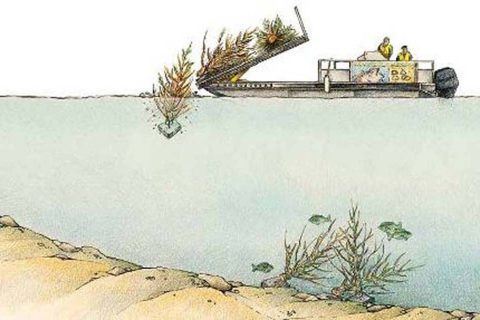
If a pond lacks natural in-water structure, the division will install deadfalls or brush piles (typically comprised of evergreen trees and weighed down by cinder blocks) in shallow areas or near the shore. In deeper areas, pallet/tree structures are installed to provide more complex structure.
Along with habitat, good water quality is essential for a healthy aquatic food web, and essential for the condition, growth and survival of gamefish.
Residents that live along pond shorelines (and within the watershed) should implement best management practices that protect water quality. These include maintaining natural shoreline vegetation to filter stormwater run-off, minimizing the use of fertilizers and chemicals on their property, implementing stringent erosion control measures and avoiding dumping lawn waste into the ponds.
For more information on Delaware’s public ponds contact DNREC Fisheries Biologist Zach Ramsey at 302-735-2977 or zachary.ramsey@delaware.gov.
Delaware's Governor
State Agencies
Elected Officials
General Assembly
Delaware Courts
State Employees
Cities & Towns
Delaware State Code
State Regulations
Business First Steps
Phone Directory
Locations Directory
Public Meetings
Voting & Elections
Transparency
Health Insurance
Tax Center
Personal Income Tax
Privacy Policy
Weather & Travel
Contact Us
Corporations
Franchise Tax
Gross Receipts Tax
Withholding Tax
Delaware Topics
Help Center
Mobile Apps
E-mail / Text Alerts
Social Media


Built by the Government Information Center
©MMXXVI Delaware.gov