DNREC Menu

Hawk watch stations are critical in understanding long-term population trends of migratory raptors throughout the country. The DNREC Division of Fish and Wildlife partners with the Delaware Ornithological Society, the DNREC Division of Parks and Recreation and the Delaware Nature Society to operate two hawk watch stations in the state of Delaware.
Every Fall and Spring, biologists, volunteers and the public flock together to witness the spectacle of birds of prey migrating by the thousands across North America. Migratory hawk counting (or hawk watch) is the collective effort to identify and count birds of prey, such as eagles, hawks, vultures and falcons, as they migrate.
Hawk watch helps scientists track long-term trends and patterns of migratory raptors, providing critical insight into local and national migration trends, behavior and population status of these important birds. High concentrations of these often-secretive raptors give biologists a great opportunity to observe and collect data on many species collectively, rather than the difficult task of tracking them individually.
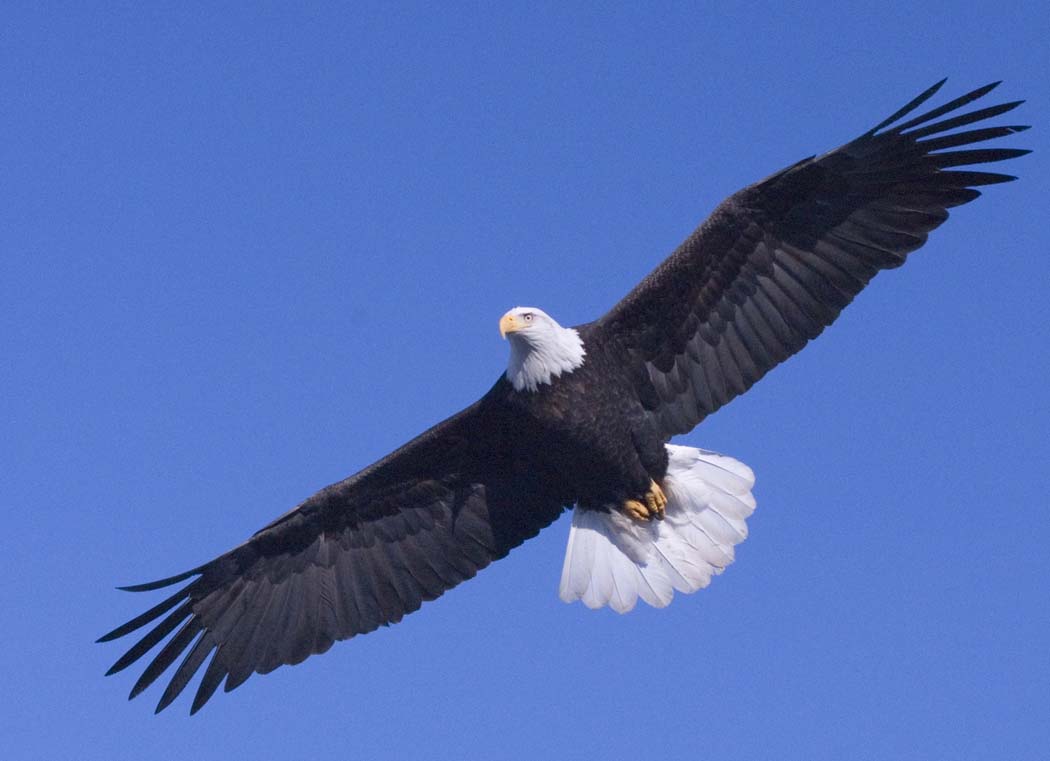
While hawk watch stations are often run by conservation organizations and non-profits, hawk watching is regularly a citizen-science program relying heavily on volunteers to keep up with the demand of observing these birds.
Every Fall, the Division of Fish and Wildlife, alongside the Delaware Ornithological Society, helps to organize the Ashland Nature Center hawk watch in northern Delaware and the Cape Henlopen State Park hawk watch in southern Delaware.
Learn how you can become a Hawk Watch volunteer in the volunteer section below.
There are more than 200 hawk watch stations across North America, all contributing to the nationwide effort to track long-term raptor population trends. Hawk watching stations are situated at peaks of high visibility and avian traffic such as mountain peaks, fire towers and observation platforms, to maximize the potential to see migrating raptors.
Volunteers and staff are often out from dawn to dusk with binoculars and scopes recording raptor observations.
Hawk watch data is submitted to HawkCount Raptor Migration Database, the primary database for all hawk watch information, organized by the Hawk Migration Association. Many counters also submit raptor observations to eBird, the citizen-science birding platform.
The Delaware hawk watch stations observe approximately 20 different species of raptors during the fall season, including a diversity of eagles, vultures, hawks and falcons.
During peak migration, busy hawk counts can see thousands of birds filling the sky in a single day. This is due to the migration pattern of certain species, such as Broad-winged Hawks who migrate together during a very short period, creating huge groups of single species migrating along flyways.
Both Delaware hawk counts have historically observed more than 20,000 birds during a single season. Although raptors are the primary focus, counters also record notable migratory species such as Geese, Common Loons, Nighthawks and even Monarch Butterflies. Occasionally, some rare, unexpected species are seen, such as Crested Caracara in 2016 and Snowy Owl in 2024 at the Cape Henlopen State Park hawk watch.
Migratory birds in Delaware follow the Atlantic Flyway, one of four generalized migratory routes used by songbirds, waterfowl and raptors to travel across North America. Within these four large flyways are many different sub-routes, determined by weather conditions and geology, that biologists use to track the specific direction that raptors migrate.
The Cape Henlopen State Park hawk watch observes the “Coastal Migration Route” which follows along the Eastern Atlantic coast, and the Ashland Nature Center hawk watch observes the “Piedmont Migration Route” southeast of the Appalachian Mountains into Northern Delaware. It is believed migrating raptors use mountainous landscape and coastline as directional landmarks during their travels.
Raptors can be observed migrating in the Fall from mid-August through December, and in the Spring from April through May.
Daily raptor migration is heavily dependent on weather. Raptors rely on thermals created by warm, sunny days to create lift for extended soaring. Wind direction also determines raptor activity, with Northern winds being favorable tailwinds, helping birds conserve energy. Raptors flying along the Atlantic Coast are subject to strong winds and fog that sometimes create unfavorable conditions, but they are also aided by the dunes and beaches which create heat and therefore better thermals.
Hawk counters also have preferred weather conditions: a slightly cloudy day is incredibly beneficial for observations, as it can be difficult to locate birds against a bright, blue sky.
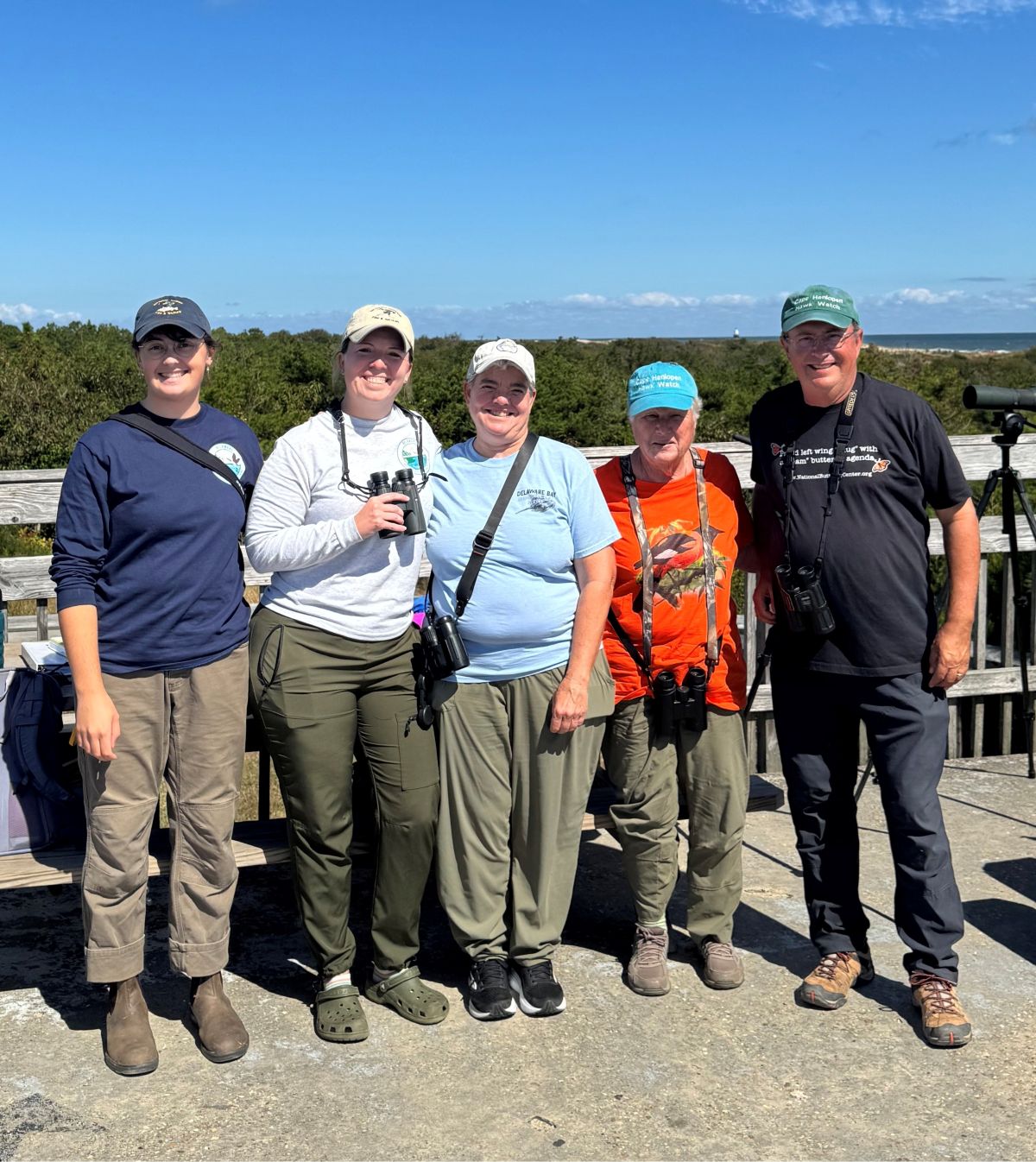
The Cape Henlopen Hawk Watch is conducted at Cape Henlopen State Park in Lewes, Delaware.
This station was started in 1995. It is run from a viewing platform situated on top of a historic World War II bunker, 20 meters above sea level, providing complete views of the sky and Atlantic Ocean.
A total of 19 species and 9,044 raptors were counted at the Cape Henlopen Hawk Watch during the Fall 2024 season, a 22.5% increase in observations from 2023.
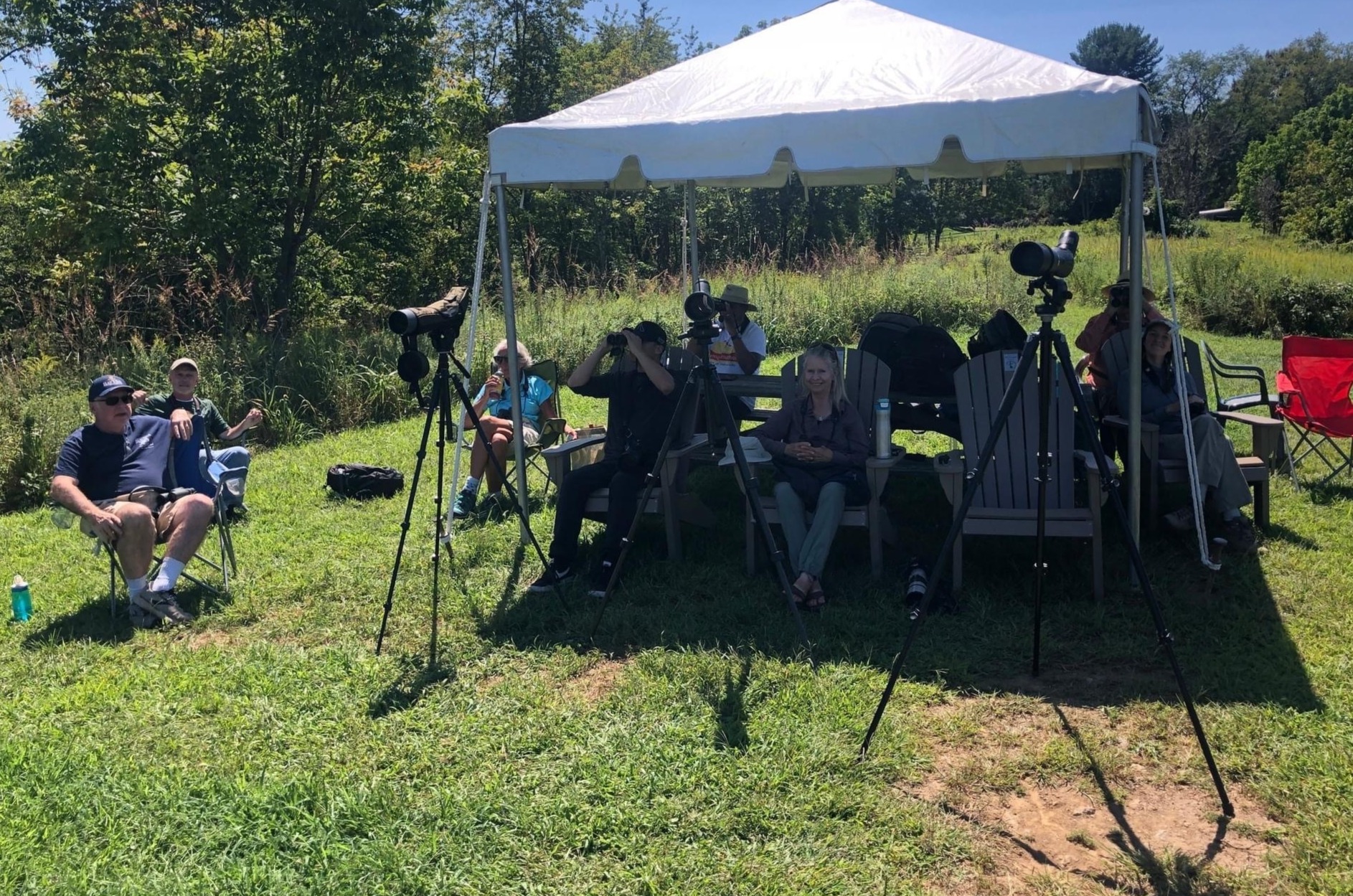
The Ashland Hawk Watch was started in 2007 and is conducted from Ashland Nature Center’s Hawk Watch Hill, the highest hill on-site, located at the center of the Red Clay Audubon Important Bird Area.
This large, open hilltop is the perfect vantagepoint overlooking the Northern edge of the Piedmont, a large expanse of hills and valleys between the Appalachian Mountains and the Atlantic Coast that acts as a highway for migrating raptors.
A total of 15 different species and 7,938 raptors total were counted during the 2024 Fall season.
Delaware Hawk Watch stations rely on volunteers to operate. While both hawk watch stations previously employed paid hawk counters in the fall, beginning in 2026, both hawk watch efforts in Delaware will be strictly volunteer based. Volunteers help record data, observe raptors, and support our critical mission of maintaining a seasonal hawk watch.
Both new and experienced hawk watchers are welcome to participate at either of the Delaware hawk watch stations. Volunteer hawk watchers may be subject to long days in the field, exposed to the elements, and should be comfortable using binoculars or a scope for prolonged periods of time to monitor raptors.
To volunteer, simply show up at either of the hawk watch locations between 9 a.m. and 3 p.m.
A personal vehicle is required to get to the hawk watch site. Volunteers should be familiar with identifying soaring birds and can be trained further on identifying birds of prey.
Volunteer efforts for this project count as match toward funding provided by the State Wildlife Grant and Wildlife Restoration Grant programs through the U.S. Fish and Wildlife Service Office of Conservation Investment, the programs which fund Delaware’s land bird research.
Related Topics: conservation, eagles, fish and wildlife, hawk watch, hawks, raptors, wildlife
Delaware's Governor
State Agencies
Elected Officials
General Assembly
Delaware Courts
State Employees
Cities & Towns
Delaware State Code
State Regulations
Business First Steps
Phone Directory
Locations Directory
Public Meetings
Voting & Elections
Transparency
Health Insurance
Tax Center
Personal Income Tax
Privacy Policy
Weather & Travel
Contact Us
Corporations
Franchise Tax
Gross Receipts Tax
Withholding Tax
Delaware Topics
Help Center
Mobile Apps
E-mail / Text Alerts
Social Media


Built by the Government Information Center
©MMXXVI Delaware.gov