DNREC Menu
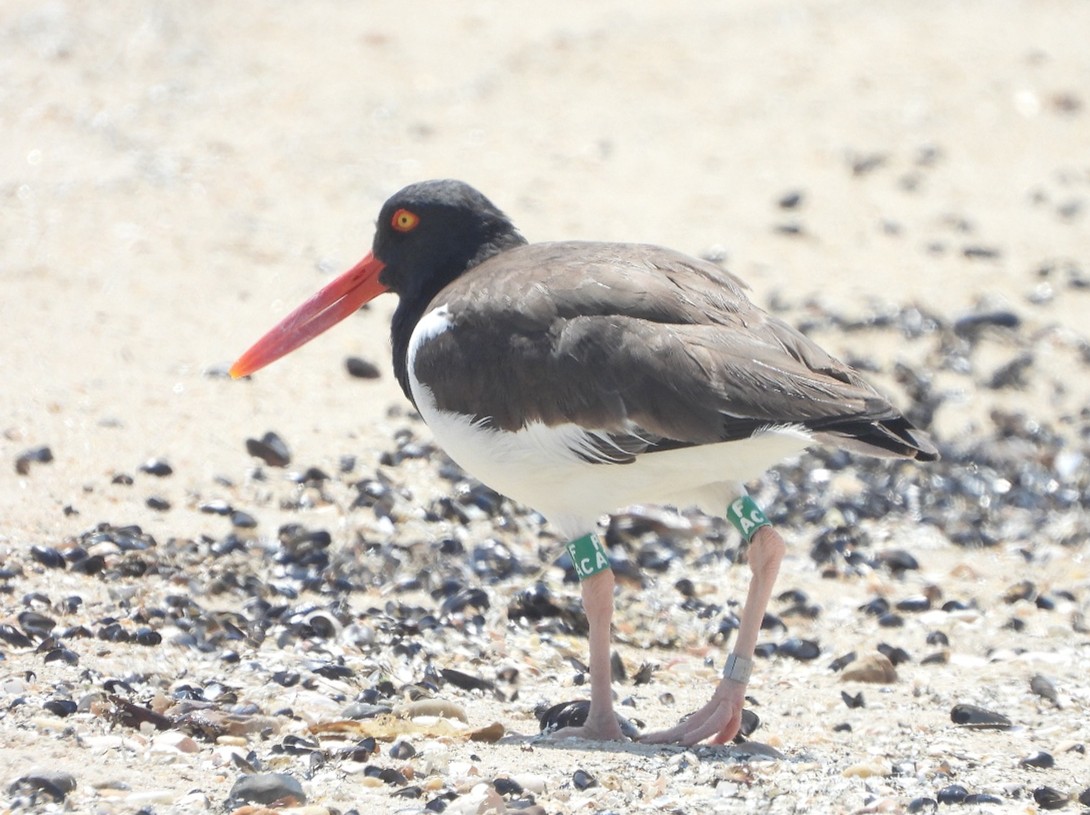
American oystercatchers are black and white shorebirds with bright orange beaks that feed and nest on the beach. The Beach-Nesting Bird Program monitors the population and productivity of American oystercatchers in Delaware.
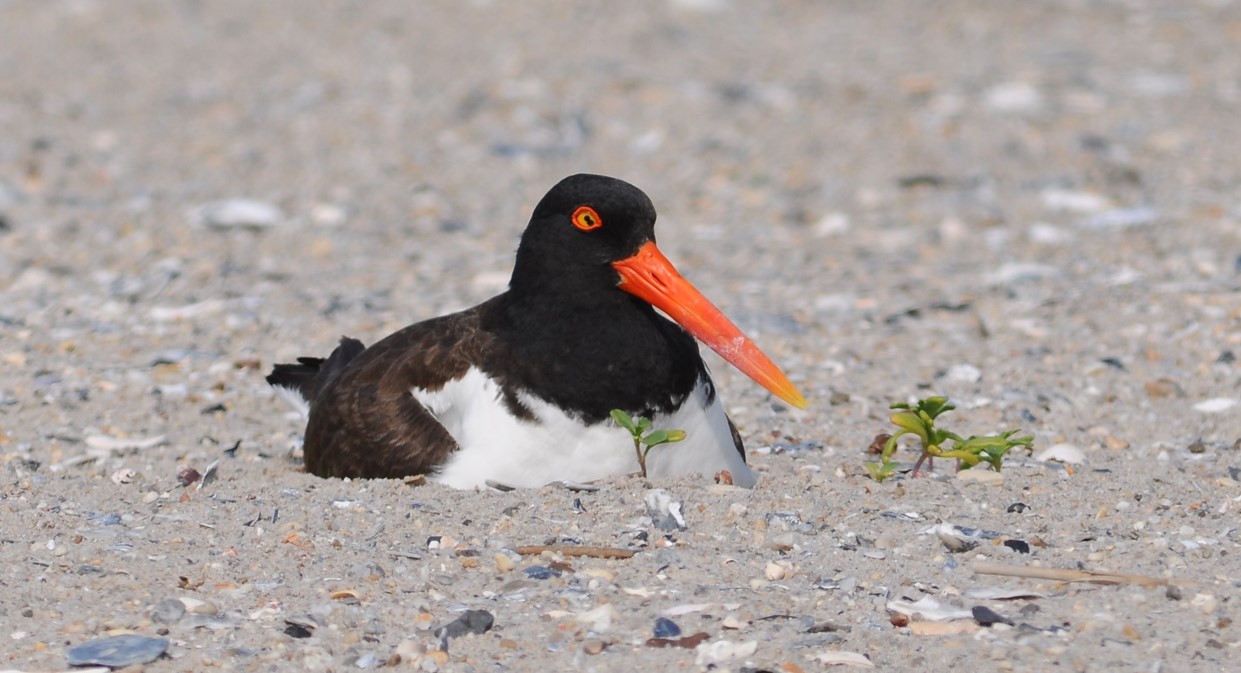
These birds begin arriving in Delaware in March, start nesting in April and migrate south by September.
Like piping plovers and least terns, they lay their eggs directly on the sand. They will also nest in salt marshes.
Historically, American oystercatchers have nested at Cape Henlopen State Park, Delaware Seashore State Park and Delaware’s Inland Bays. They started nesting at Fowler Beach, in Prime Hook National Wildlife Refuge, following the completion of a restoration project in 2016.
The state has tracked nesting pairs of American oystercatchers since 1974 and recorded the number of fledglings each year.
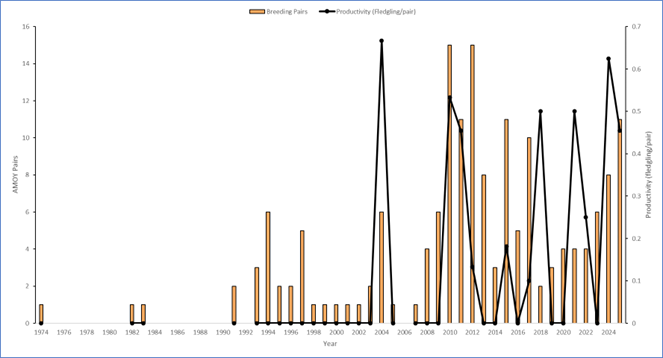
The number of nesting American oystercatchers in Delaware is variable, and survey coverage has changed over time. DNREC monitors all known pairs from the time they arrive for the breeding season until the last chick has fledged. Increased survey coverage of Delaware’s Inland Bays in recent years has improved our ability to estimate American oystercatcher breeding and productivity throughout the state. Due to access constraints and dense vegetation, there are challenges to monitoring in those areas, and not all nests and outcomes are detected.
In Delaware, a banding program, inactive since 2012, was reinitiated in 2025. In coordination with the coastwide banding protocols established by the American Oystercatcher Working Group, DNREC biologists apply duplicate dark green coded leg bands to each upper leg. Delaware-caught birds have codes beginning with F then two additional characters below the F to form a unique ID in the shape of a triangle. An example can be seen in the photo below.
This program will be used to better understand patterns of distribution and productivity among Delaware’s recently-unsuccessful oystercatcher breeding population, allowing us to positively identify returning breeding adults and track where Delaware-fledged chicks ultimately go and whether they enter the breeding population.
Any sightings of banded oystercatchers are reported to the American Oystercatcher Working Group. Members of the public can report sightings to this group or to the Bird Banding Laboratory. Contact DNREC at deshorebirds@delaware.gov with any questions about how to read and report a band.
The figure displayed here only includes confirmed breeding pairs and outcomes, but more nesting likely occurred outside of monitored areas and survey effort has varied across seasons. Each year, survey coverage and methods improve and expand in order to better track American oystercatcher breeding trends in Delaware.
In 2025, 11 breeding pairs were identified on beaches and marshes throughout Delaware.
Several nests hatched and five American oystercatcher chicks fledged, though none from true coastal beach sites, where predators and human disturbance are major threats to nests and chicks.
DNREC’s increased monitoring of nests in the Inland Bays has led to more concrete productivity information, with six monitored pairs this year producing all five of Delaware’s 2025 fledglings.
Additionally, the reinitiation of American oystercatcher banding this year by DNREC biologists will allow for more definitive identification of individuals and their behaviors and distribution within and outside Delaware.
Three of the five fledglings produced this year were banded prior to fledging. It will be interesting to see where they go.
Seven previously unbanded adults were also captured and banded, so that by the end of the season, two thirds of Delaware’s breeding pairs had at least one banded adult which will allow for more detailed cross-season information.
Related Topics: american oystercatchers, atlantic ocean, beach nesters, beaches, birds, conservation, delaware bay, fish and wildlife, shorebirds, wildlife
Delaware's Governor
State Agencies
Elected Officials
General Assembly
Delaware Courts
State Employees
Cities & Towns
Delaware State Code
State Regulations
Business First Steps
Phone Directory
Locations Directory
Public Meetings
Voting & Elections
Transparency
Health Insurance
Tax Center
Personal Income Tax
Privacy Policy
Weather & Travel
Contact Us
Corporations
Franchise Tax
Gross Receipts Tax
Withholding Tax
Delaware Topics
Help Center
Mobile Apps
E-mail / Text Alerts
Social Media


Built by the Government Information Center
©MMXXVI Delaware.gov