DNREC Menu

Chronic Wasting Disease (CWD) affects the brain and nervous system in members of the family Cervidae, such as deer, sika, elk or moose. Delaware has now confirmed its first case of CWD in a wild white-tailed deer.
State wildlife officials are responding under Delaware’s Chronic Wasting Disease Response Plan and taking steps to better understand how far the disease may have spread and help slow it down.
Hunters may submit harvested deer heads for CWD testing at designated chest freezers located at any walk-in Delaware Hunters Against Hunger drop off locations. Test results are posted, as they become available.
DNREC has published an addendum to the Delaware Hunting Guide: What you need to know for the 2026/27 Hunting Season. This addendum explains changes to the hunting regulations and how hunters can help in the response to Chronic Wasting Disease.
DNREC held a community meeting on September 16, at Delaware Technical Community College – Owens Campus, to share information about CWD regulations with the public, and accept public questions and comments. A recording of the CWD meeting is now available on the DNREC YouTube Channel. (September 16, 2026)
Sept. 16, 2026: DNREC Secretary Greg Patterson has signed an emergency order (Secretary’s Order No. 2026-F-0024) adding Wildlife Management Zone 11 to Zones 14 and 16 as Delaware’s Chronic Wasting Disease Management Zones. See the changes to the regulation.
Aug. 19, 2026: DNREC Secretary Greg Patterson has signed an emergency order (Secretary’s Order No. 2026-F-0023) adopting amendments to Delaware’s Wildlife regulation (7 DE Admin. Code 3900). The changes will expand sampling efforts and establish a Chronic Wasting Disease Management Zone. See the changes to the regulation.
DNREC held a community meeting on May 13, at Trap Pond State Park, to share information about the CWD finding with the public. A recording of the CWD meeting is now available on the DNREC YouTube Channel. (May 20, 2026)
Delaware Confirms State’s First Case of Chronic Wasting Disease in Wild White-tailed Deer (April 21, 2026)
Report sick, injured or dead free-ranging deer using the Sick and Injured Wildlife Reporting Form.
For captive, farmed cervids, contact the Office of the State Veterinarian at the Delaware Department of Agriculture at DEanimalhealth@delaware.gov or 302-698-4500.
For more information on Chronic Wasting Disease, please contact DNREC Wildlife Biologist Sam Millman, at Sam.Millman@delaware.gov or 302-735-8676.
The U.S. Geological Survey (USGS)
The Chronic Wasting Disease Alliance
The USDA Animal and Plant Health Inspection Service
Chronic Wasting Disease, or CWD, is a transmissible spongiform encephalopathy (TSE) disease affecting cervid species, including deer, elk and moose, caused by infectious, misfolded prions. These prions misfold neighboring proteins to create holes that lead to neurological dysfunction and ultimately death by secondary causes (e.g., starvation, pneumonia, drowning, etc.).
CWD has been reported to occur in cervid species six months of age and older. Scientists believe that CWD prions are spread between animals through bodily fluids, including saliva, blood, urine and feces, which can occur through direct contact or indirectly through contamination of soil, food or water.
CWD can also be transmitted from doe to fawn in utero or during birth and has been found in buck semen.
Currently, no treatments or vaccines are available. All deer that contract CWD will get sick and die.
CWD belongs to the same family of prion diseases as bovine spongiform encephalopathy (BSE), commonly known as “mad cow” disease in cattle, scrapie in sheep, Kuru, and Creutzfeldt-Jakob Disease (CJD) in humans.
Although there is no known transmission of CWD to humans, the Centers for Disease Control and Prevention (CDC) recommends that people who harvest deer — such as white-tailed, red, sika or mule deer — and elk or moose from areas where CWD has been confirmed test their animals for CWD before consuming the meat.
While eating muscle meat from deer has not been shown to pose a risk to human health, out of an abundance of caution, deer meat should not be consumed if the animal tests positive for CWD.
Since 2003, the DNREC Division of Fish and Wildlife has conducted annual CWD surveillance, with random sampling of hunter-harvested deer statewide.
The Division tests at least 600 random samples across the state each year. There is a 99% chance of detecting the disease if it exists in more than 1% of the harvested deer population. Over the past 23 years, the Division has tested 12,938 samples.
In addition to random sampling of harvested deer, the Division also tests sick deer that show signs associated with CWD.
DNREC has now activated its Chronic Wasting Disease Response Plan, which includes establishing a management area around the first detection, cluster sampling in and around that area and additional monitoring to look for other cases.
Chronic Wasting Disease (CWD) is believed to spread through direct contact among members of the Cervidae family — deer, elk or moose — or indirectly through the environment.
Because CWD has a long incubation period, deer may not show signs for over a year but can still transmit the disease to other deer. A deer may appear healthy while still carrying and spreading the disease.
Signs of CWD can overlap with other diseases, so CWD cannot be confirmed just by looking at an animal. Testing is required. Signs that may be seen in the late stages of disease include:
Often, once signs of CWD appear, the infected deer dies from secondary causes such as predators, vehicle strikes or other diseases.
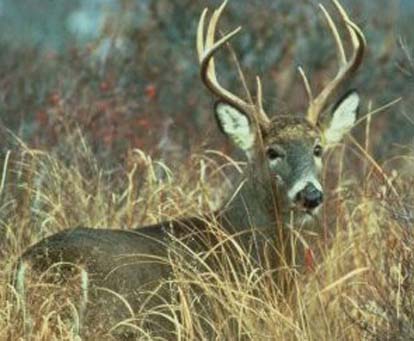
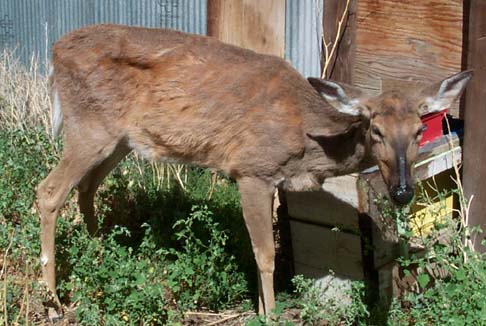
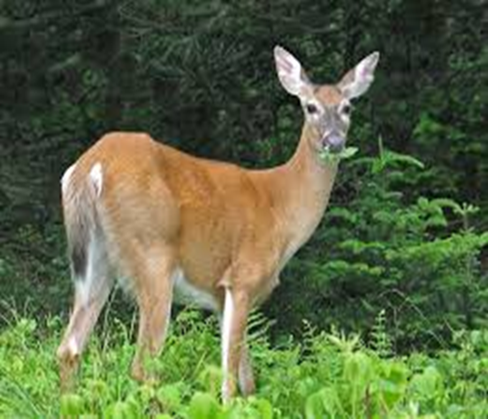
The reality is that most deer infected with Chronic Wasting Disease show no visible signs during the early and middle stages of the disease. Clinical symptoms typically do not appear until the late stages of prion incubation, meaning an infected deer can appear healthy long before signs such as weight loss, abnormal behavior or poor body condition become noticeable.
Despite appearances, both of the deer shown below are affected by Chronic Wasting Disease.
The causes of transmissible spongiform encephalopathy diseases like CWD are believed to be abnormal, protein-based infectious particles called prions. Prions are closely related to cell proteins typically produced in the central nervous system and lymphatic system. However, prions are abnormal cell proteins that cannot be broken down by the body’s enzyme system.
When prions accumulate in nerve tissue, they kill nerve cells and lead to loss of normal neurological function. The damage to the brain’s nervous system tissue creates spaces that can be seen under a microscope.
Ongoing research will offer more insight into the effects of CWD on wildlife and human health. Meanwhile, Delaware stays vigilant, ensuring local deer populations are closely monitored, and plans are in place to control the disease.
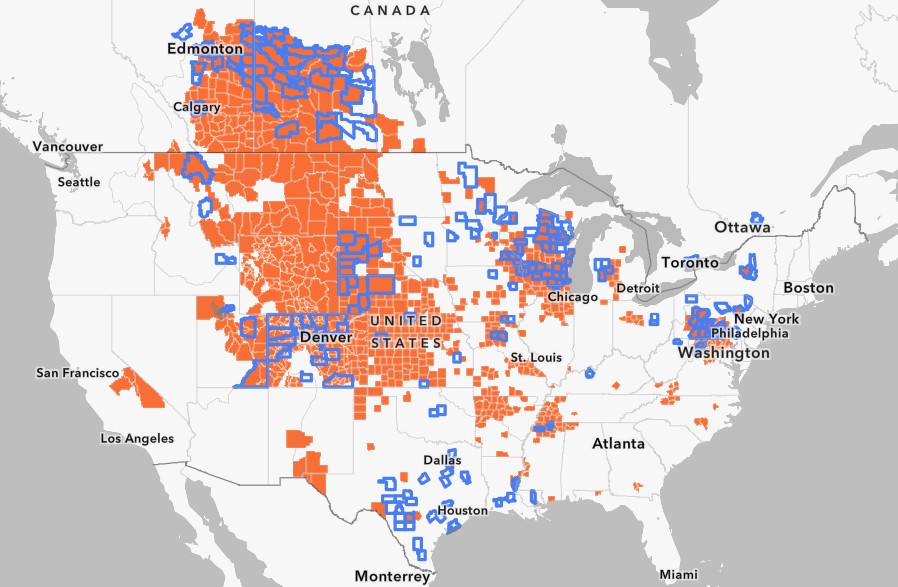
Delaware has rules to reduce the risk of CWD spreading through carcass movement and other activities.
In general, whole carcasses from areas where CWD has been found should not be brought into Delaware, and whole carcasses should not be moved out of Delaware’s CWD Management Area.
However, Delaware does allow the following low-risk deer, elk and moose parts to be imported into the state:
Maryland, Pennsylvania, Virginia and West Virginia have confirmed the presence of CWD. However, through regional agency cooperation, only the specific counties within a neighboring state’s disease management zone are subject to the import restrictions.
Deer harvested from the counties listed below are subject to the same import restrictions described above. If the county of harvest is not listed below, hunters may bring a harvested carcass to Delaware.
Chronic Wasting Disease is documented in the following counties in neighboring states, and are subject to the import restrictions.
Allegany, Baltimore, Carroll, Frederick, Howard, Montgomery and Washington counties.
Adams, Armstrong, Bedford, Berks, Blair, Butler, Cambria, Carbon, Centre, Clarion, Clearfield, Columbia, Cumberland, Dauphin, Elk, Franklin, Fulton, Huntingdon, Indiana, Jefferson, Juniata, Lancaster, Lebanon, Luzerne, Lycoming, Mifflin, Montour, Northumberland, Perry, Schuykill, Snyder, Somerset, Sullivan, Union, Warren, Wayne, Westmoreland Counties and York counties.
Arlington, Carroll, Clarke, Culpeper, Fairfax, Fauquier, Floyd, Franklin, Frederick, Loudoun, Madison, Montgomery, Orange, Page, Patrick, Prince William, Pulaski, Rappahannock, Roanoke, Rockingham, Shenandoah, Warren and Wythe counties.
Berkley, Grant, Hampshire, Hardy, Jefferson, Mineral, Morgan and Pendleton counties.
Due to the long incubation period of CWD and the movement of deer herds, an area classified as non-CWD may still have the disease present, but not yet detected. Follow precautions for the safe handling, field-dressing and home processing of venison.
If you hunt deer, elk, moose or other cervids in other states or Canadian provinces, particularly those in which CWD has been detected, check with the local fish and wildlife agencies for special regulations or specific advice for hunters.
Use synthetic instead of natural deer urine.
Do not pour natural deer urine on the ground; use a scent station that can be removed.
Avoid shooting or handling a deer that appears sick or acts strangely. Report sick or injured deer to the DNREC Division of Fish and Wildlife.
Wear latex or rubber gloves when field-dressing and/or butchering deer.
Do not use household knives or utensils.
Remove all internal organs.
Avoid cutting through bones or the spinal column (backbone).
Bone the deer (remove the meat from the bones and spinal column).
If you saw off antlers or through a bone, or if you sever the spinal column with a knife, disinfect your tools before using them for butchering or removing meat.
Remove all fat, membranes and connective tissue from the meat. Normal field-dressing and trimming of fat from meat will remove lymph nodes.
Never eat a deer’s brain, eyeballs, spinal cord, spleen or lymph nodes.
Always wash hands and instruments thoroughly after dressing and processing game meat.
Use a 50/50 solution of household chlorine bleach and water to disinfect tools and work surfaces. Wipe down counters and let them dry. Soak knives for one hour.
If your deer is processed commercially, consider asking to have your animal processed individually. This ensures that you are only getting meat from your animal. If your animal tests positive for CWD, do not eat meat from that animal.
Do not dump any portion of a carcass on the ground where it can come in contact with other deer or infectious prions could get into the soil. Dispose of your deer carcass waste in an appropriate landfill, double-bagged or in a carcass bag, where the chance of deer coming across the carcass is minimal.
Related Topics: chronic wasting disease, conservation, CWD, deer, dfw, fish and wildlife, hunting, wildlife
Delaware's Governor
State Agencies
Elected Officials
General Assembly
Delaware Courts
State Employees
Cities & Towns
Delaware State Code
State Regulations
Business First Steps
Phone Directory
Locations Directory
Public Meetings
Voting & Elections
Transparency
Health Insurance
Tax Center
Personal Income Tax
Privacy Policy
Weather & Travel
Contact Us
Corporations
Franchise Tax
Gross Receipts Tax
Withholding Tax
Delaware Topics
Help Center
Mobile Apps
E-mail / Text Alerts
Social Media


Built by the Government Information Center
©MMXXVI Delaware.gov