DNREC Menu

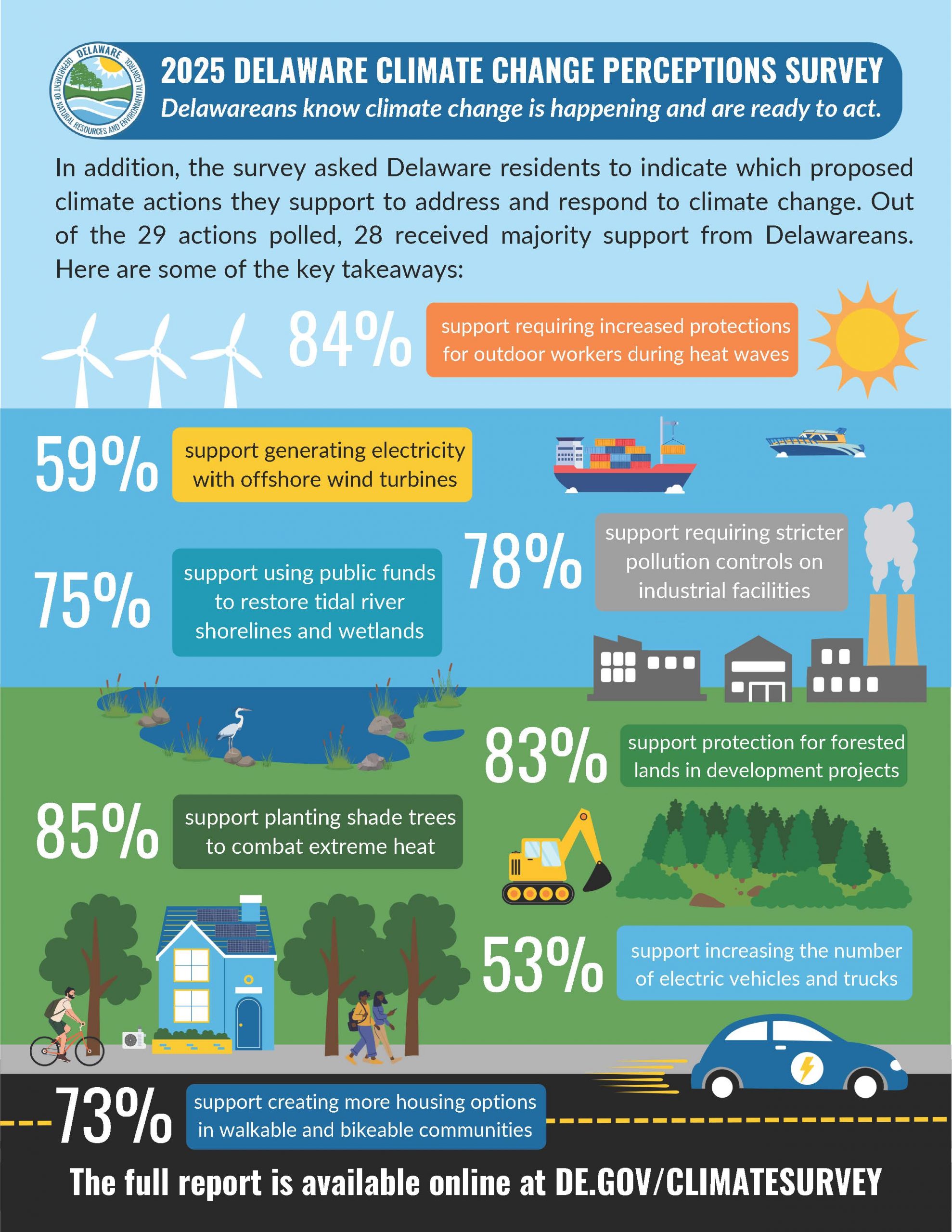
The Department of Natural Resources and Environmental Control (DNREC) has initiated a series of public perception surveys to measure the Delaware public’s knowledge of, and interest in, the issues of climate change and sea level rise. The latest survey was conducted in February of 2025. Surveys were also conducted in 2009, 2014 and 2019.
Attitudes, perceptions and knowledge about climate change and sea level rise are rapidly evolving. Climate change stories are in the headlines almost daily, politicians are increasingly discussing the need to act and weather events like coastal hurricanes and nor’easters have brought the potential impacts of climate change home to many on the East Coast.
Given this changing landscape, it is important for decision-makers, educators and others to have locally based and up-to-date information about public attitudes and perceptions about climate change so that plans, projects and outreach materials can be specific and tailored for Delaware.
According to the latest survey, it is clear that climate change remains a top concern for a significant majority of Delawareans with many believing that it poses a serious threat that will harm future generations.
The 2025 survey was administered to 1,520 Delaware residents via phone, text and online between Feb. 5 and Feb. 18, 2025. Respondents were selected through random sampling. Statistical results were weighted by demographic factors to reflect population values.
Among the findings:
Read the executive summary of the findings or read the complete 2025 Delaware Residents’ Opinions on Climate Change report.
According to the latest survey, most Delawareans believe climate change and sea level rise is happening, and a majority say we should act now to reduce their impacts.
The survey, commissioned by DNREC’s Division of Climate, Coastal and Energy and supervised by the University of Delaware’s Center for Political Communication, was conducted by Standage Market Research from November 17 to December 1.
Among the findings:
77% of Delawareans are completely or mostly convinced that climate change is happening, and 70% say we should take immediate action to reduce its impact.
70% are completely or mostly convinced that sea level rise is happening, and 63% say we should take immediate action to reduce its impacts.
56% say they have personally experienced or observed local impacts of climate change. This is similar to responses in a 2014 survey sponsored by DNREC (53%).
47% say they have personally experienced sea level rise. This represents a 19-point increase from the 2014 climate survey (28%) and a 25-point increase from a 2009 survey (22%).
56% of Delawareans think climate change will personally harm them a great deal (21%) or a moderate amount (35%).
77% believe climate change will harm future generations a great deal (61%) or a moderate amount (16%).
Read a summary report of the findings, or read the complete Delaware Residents’ Opinions on Climate Change and Sea Level Rise.
Delaware Coastal Programs contracted with Responsive Management, Inc. in 2009 to conduct a baseline survey and analysis about the general knowledge of climate change and sea level rise, general knowledge of potential impacts and support for action. The survey was repeated in 2014 by Responsive Management, Inc. with funding and technical assistance from the DNREC’s Delaware Coastal Programs, the Division of Climate, Coastal and Energy, and Delaware Sea Grant. The 2014 survey utilized the same methodology as the 2009 survey and was based upon the same set of questions.
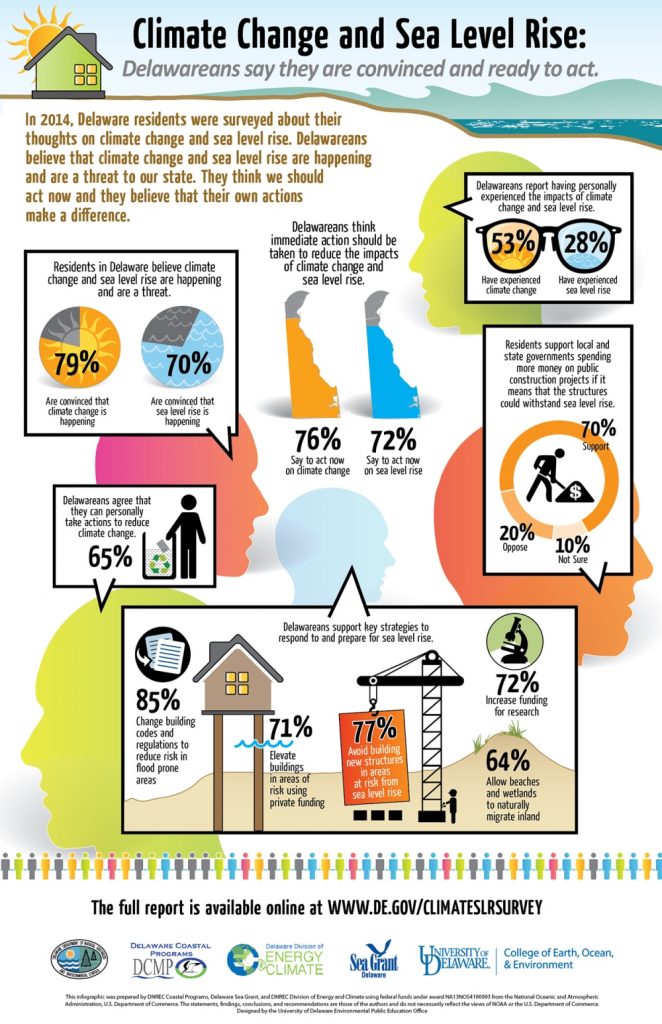
Overall, the 2014 survey indicated that Delaware residents had become slightly more supportive of, or agreeable to, the concepts and actions related to climate change and sea level rise since the 2009 survey. Survey respondents in 2014 were also slightly more likely to consider climate change and sea level rise threats, but concern for both did not increased substantially.
The 2014 survey showed that there remained strong agreement that we should take immediate action to reduce the impacts of climate change and sea level rise. It is also worth noting that many of the increases and decreases that were seen in the comparisons between the 2009 and 2014 surveys show shifts into response categories of “strongly” or “very” which may be an indication that in the intervening five years, those who were only marginally convinced or concerned about climate change and sea level rise have become increasingly concerned. There were also some small, yet encouraging, decreases in responses that suggest denial or misunderstanding of climate change and sea level rise.
Delaware Residents’ Opinions on Climate Change and Sea Level Rise
2014 full survey report by Responsive Management
Summary of the 2014 Delaware Residents’ Opinions of Climate Change and Sea Level Rise
A summary from Delaware Coastal Programs that highlights the methods and major findings of the 2014 survey
Presentation on the survey for the Partnership for the Delaware Estuary’s Science and Environmental Summit (January 26, 2015)
Delaware Residents’ Opinions on Climate Change and Sea Level Rise
2009 Full survey report by Responsive Management
2009 Executive Summary
Highlights the methods and major findings of the 2009 survey
Related Topics: climate change, coastal, education, management, ocean and coasts, perception, planning, sea level rise, training
Delaware's Governor
State Agencies
Elected Officials
General Assembly
Delaware Courts
State Employees
Cities & Towns
Delaware State Code
State Regulations
Business First Steps
Phone Directory
Locations Directory
Public Meetings
Voting & Elections
Transparency
Health Insurance
Tax Center
Personal Income Tax
Privacy Policy
Weather & Travel
Contact Us
Corporations
Franchise Tax
Gross Receipts Tax
Withholding Tax
Delaware Topics
Help Center
Mobile Apps
E-mail / Text Alerts
Social Media


Built by the Government Information Center
©MMXXVI Delaware.gov