DNREC Menu

DNREC’s Delaware Coastal Programs conducts a variety of coastal research programs to study the effects of climate change, impacts from human pollutants and other factors impacting the changing coastal environment of Delaware.
For more information, please contact the Delaware National Estuarine Research Reserve at 302-739-6377.
In 2024, researchers at DNREC’s Delaware National Estuarine Research Reserve began building a database of the various epibionts found on horseshoe crabs and expanded upon that in 2025.
Epibionts are organisms that attach to and live on other organisms, and basibionts, or host organisms, can be home to a variety of epibionts.
Learn more about the research into epibionts and horseshoe crabs.
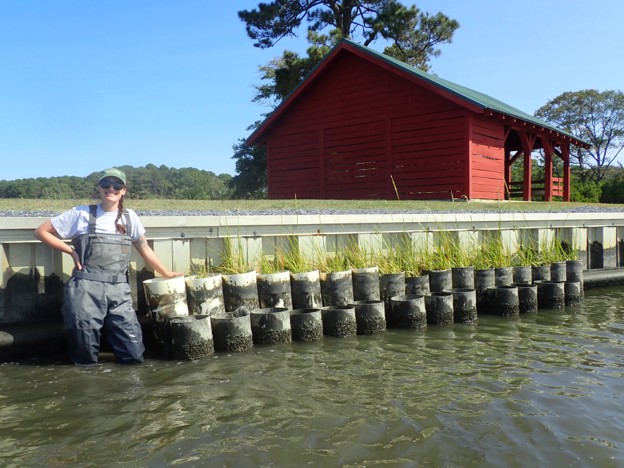
DNREC’s Delaware Coastal Programs tested whether traditional bulkheads could be adapted to have more ecological value with a “green bulkhead” style bulkhead retrofit. This project was inspired and adapted from a “green bulkhead” project designed and installed by the Maryland Coastal Bays National Estuary Program.
The green bulkhead approach used PVC designed like a Peruvian Flute. Native tidal marsh plants were planted into the PVC to add habitat and greenery in front of an already installed bulkhead.
This project was installed in 2022, monitored for four years and removed in the fall of 2025. The green bulkhead provided habitat for habitat for native fish, ribbed mussels, blue crabs and other fauna. The information learned from this project will be used to develop other bulkhead retrofit projects in the future.
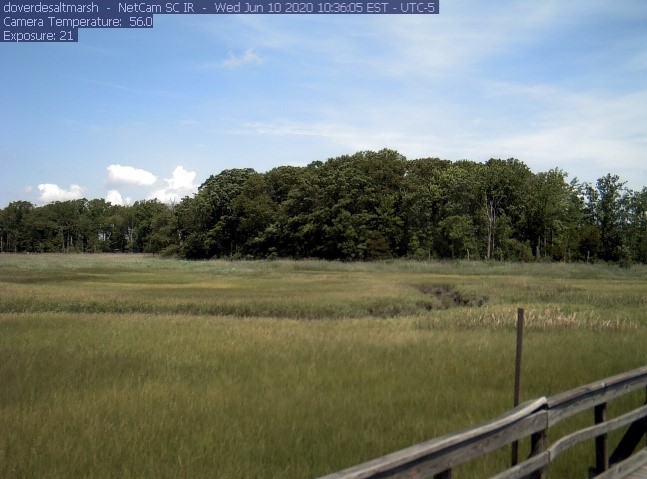
Marsh migration is an important process in tidal marshes. As sea level rises, many tidal wetlands have the ability to move inland. However, accelerating sea level rise rates, land barriers and other factors can affect this process. Additionally, that landward marsh migration can impact other coastal habitats, such as the creation of ghost forests.
Monitoring marsh migration is an important part of understanding how this horizontal habitat change is occurring. This is especially important at the ecotone — the boundary area where different habitat types are transitioning (the space between the tidal marsh and upland forest for example).
DNREC’s Delaware Coastal Programs is implementing a long-term ecotone monitoring effort to help assess how marsh migration is occurring at the Delaware National Estuarine Research Reserve. This will leverage on-going emergent tidal wetland vegetation monitoring data to better understand marsh changes with sea level rise.
Legacy organic pollutants are chemicals that remain in the environment for long periods of time. These pollutants include polychlorinated biphenyls (PCBs) and polycyclic aromatic hydrocarbons (PAHs), many of which have known toxicological effects on the environment and human health.
The St. Jones River watershed near Dover is a highly urbanized system with a known legacy of PCB and PAH contamination, among other pollutants.
DNREC’s Delaware Coastal Programs is conducting efforts to better understand the presence and fate of organic contaminants in marsh habitats within the St. Jones River. This includes a PCB bioaccumulation pilot study to determine the concentrations of PCBs at the base of the tidal marsh food web.
Data will help inform if larger scale investigation is needed and can help identify organisms at risk.
DNREC’s Delaware Coastal Programs has also previously collected sediments from five points along the St. Jones River to measure PAH concentrations and conduct a sediment toxicity test at each site. These sites will periodically be revisited to understand how PAH concentrations are changing downriver.
In 2019, the DNREC’s Delaware Coastal Management Program received a NOAA Coastal Zone Management Project of Special Merit to better understand the potential economic impacts to Delaware resulting from simulated offshore oil spills.
The goal of this project was to provide information for Delaware’s coastal decision-makers to assess potential impacts to the local economy in the event of an offshore oil spill.
The project had two parts, each resulting in comprehensive reports:
To model oil fate and transport to Delaware under different offshore spill scenarios (View a recorded webinar on the report).
An economic impacts assessment of the modeled offshore oil spills (View a recorded webinar on the report).
Economic and Fiscal Impacts Summary
Related Topics: climate coastal energy, coastal programs, research, science
Delaware's Governor
State Agencies
Elected Officials
General Assembly
Delaware Courts
State Employees
Cities & Towns
Delaware State Code
State Regulations
Business First Steps
Phone Directory
Locations Directory
Public Meetings
Voting & Elections
Transparency
Health Insurance
Tax Center
Personal Income Tax
Privacy Policy
Weather & Travel
Contact Us
Corporations
Franchise Tax
Gross Receipts Tax
Withholding Tax
Delaware Topics
Help Center
Mobile Apps
E-mail / Text Alerts
Social Media


Built by the Government Information Center
©MMXXVI Delaware.gov