DNREC Menu

The spread of invasive species poses a significant threat to SGCN throughout the Northeast. With Northeast Association of Fish and Wildlife Agencies (NEAFWA) funding through the Regional Conservation Needs (RCN) Grant Program, Klopfer (2012) identified 238 invasive species from 12 groups with a potential to adversely affect SGCN, while at the same time acknowledging that this is not a complete list of invasive species for the Northeast. The majority of species identified are plants (68%), and the majority of these (58%) occurred in seven or more states. There were 71 (30%) invasive species common to all states in the Northeast. The habitat identified with the greatest number of invasive species was “forest edge” with 115 species (48%), followed by pasture and grassland with 94 and 86 species respectively (39% and 36%).
The Delaware Invasive Species Council (DISC) defines an invasive species as “an alien species whose introduction causes or is likely to cause economic or environmental harm or harm to human health.” This is the same definition promulgated by Executive Order 13112 (1999) that established the National Invasive Species Council.
Delaware has a series of laws and regulations designed to prevent the import and establishment of invasive species. Two state agencies, the Delaware Department of Agriculture (DDA) and DNREC, administer laws involving invasive species. Senate Bill 22 – which took effect July 1, 2022 – prohibits the import, export, sale, transport, distribution, or propagation of any plant identified by the Secretary of the Department of Agriculture, with the advice of the Delaware Native Species Commission, as an invasive plant.

The Species Conservation and Research Program (DNREC, DFW) has compiled a list of 167 non-native plant species that cause or are likely to cause ecological impacts (McAvoy 2024). Invasive plant species have the potential for widespread dispersal and establishment, they can out-compete and displace native flora, they have the potential for rapid growth and high seed production, and they can become established in natural areas.
Some terrestrial invasive plant species that are particularly problematic in Delaware are: Japanese Stiltgrass (Microstegium vimineum), Lesser Celandine (Ficaria verna), Winged Euonymus (Euonymous alatus), Oriental Bittersweet (Celastrus orbiculatus), and Garlic Mustard (Alliaria petiolata).
In aquatic systems, Hydrilla (Hydrilla verticillata), an invasive, submerged aquatic plant, has heavily impacted ponds, creeks and small rivers throughout Delaware. Hydrilla tolerates high nutrient levels (eutrophic conditions) and contributes to hypoxic conditions in ponds (Bradshaw et al. 2014).
European Reed (Phragmites australis) has perhaps the most dramatic impact on Delaware’s natural habitats. European reed, first introduced in North America in the early 1800’s, is now widespread in Delaware, where it grows in tidal and non-tidal wetlands. The species is extremely aggressive and can grow up to 15 feet tall. It grows so densely, that nothing else can grow with it, and can form a monoculture covering 100’s of acres. Wetlands that once supported a diverse assemblage of native plants, are now dominated by a single species. DFW manages a Phragmites Control Program that treats over 3,500 acres annually. Many studies have demonstrated significant impacts of European Reed invasion on Delaware’s estuarine species, including SGCN (Able and Hagan 2000; Able and Hagan 2003; Jivoff and Able 2003; Hunter et al. 2006). A recent wetland assessment (Jennette et al. 2014) found that European Reed was the most abundant in estuarine wetlands and was a significant stressor in non-tidal flat and riverine wetlands. Well over 1000 acres of European Reed have been mapped in the Inland Bays region of Sussex County.

Northern Snakehead (Channa argus), a native fish of China and Russia, was originally brought to the U.S. for the live food fish market. Unfortunately, these exotic invaders escaped or were illegally stocked and now occur in at least eleven states. In Delaware, Northern Snakeheads have been documented in several rivers and ponds and are now considered common in the state. Unauthorized stocking of this species has likely contributed to its spread in freshwater impoundments in New Castle County. To curtail illegal stocking in Delaware, a regulation was passed in 2013 that prohibits the transport, purchase, sale, and possession of live snakeheads. Unfortunately, once established, this species is difficult to eradicate, making preventive measures even more crucial.
Several species of non-native, invasive crabs are present in Delaware’s estuarine and marine systems, including the European Green Crab (Carcinus maenas), and the Chinese Mitten Crab (Eriocheir sinensis). The Asian Shore Crab (Hemigraspus sanguineus), which was first discovered in North America near the mouth of Delaware Bay in 1988, expanded to far outnumber native crabs in rocky nearshore habitats, then recently declined in abundance (Schab et al. 2013). Some of Delaware’s freshwater invasive invertebrates include the Channeled Apple Snail (Pomacea canaliculata), Red Swamp Crayfish (Procambarus clarkii), and Zebra Mussel (Dreissena polymorpha).
Blue Catfish (Ictalurus furcatus) and Flathead Catfish (Pylodictis olivaris) are freshwater fish native to the Ohio and Mississippi River basins that were introduced into parts of the Chesapeake basin for sportfishing in the 1960s through the 1980s. These catfish are voracious predators now found in the Delaware River that may have major impacts on blue crabs and diadromous fish.
Nutria (Myocastor coypus), a non-native, marsh-damaging, beaver-like rodent had been documented in Delaware, but is now considered eradicated in the state.
A study by Loss et al. (2013) estimated that free-ranging domestic cats may be the single greatest source of direct anthropogenic mortality for US birds and small mammals, killing an estimated 2.4 billion birds and 12.3 billion mammals annually. Un-owned cats, as opposed to owned pets, cause the majority of this mortality. Cat attack injuries account for over 10% of all injured bird cases brought to Tristate Bird Rescue and Research, Inc., a non-profit wildlife rehabilitation and rescue organization in Newark, DE (Tristate Bird Rescue and Research unpublished data). Free-ranging cats have been documented to kill numerous native species of birds, mammals, snakes, frogs, lizards, and invertebrates (Schweitzer and Gillin 2020).
As a result of globalization, many species of non-native insects have become established in the eastern U.S. Some of these species, such as emerald ash borer, Gypsy Moth (Lymantria dispar), Hemlock Woolly Adelgid (Adelges tsugae), and Spotted Lanternfly (Lycorma delicatula) have highly detrimental effects on native biodiversity, while many other species, such as those that are new arrivals, have small populations, or have restricted host specificity, have not yet become established to the point where negative effects are observable. While many of these species can be highly problematic, control of non-native insects can also have unintended effects on non-target biodiversity (e.g., Rawlins et al. 1998), so a balanced approach is needed.
Other invasive insect threats in Delaware include the Asian Tiger Mosquito (Aedes albopictus) and Japanese Rockpool Mosquito (Aedes japonicus), with the latter being a known vector of West Nile Virus (Kaufman and Fonseca 2013).
The Emerald Ash Borer was newly discovered in Delaware since the 2015 DEWAP, and although only about two percent of Delaware’s forest trees are ash. Aerial surveys in 2022 mapped over 3,300 acres of damage due to Emerald Ash Borer compared to 800 acres in 2021 (DFS 2022). Some ash-dependent SGCN may be highly threatened by the loss of this group of trees. For example, the larvae of the Ash Sphinx Moth (Manduca jasminearum) are only known to feed on ash trees (Tuttle 2007).
The Asian Longhorned Beetle (Anoplophora glabripennis) was also discovered in Delaware in 2015. Unlike other longhorned beetles, which usually attack stressed, diseased, and dying trees, Anoplophora glabripennis attacks and kills healthy trees. Consequently, there is concern that this exotic insect will become a major pest in North America. Asian Longhorned Beetles attack maple (Acer) trees including Norway, Red, Sugar, and Silver Maple, and Boxelder. Horse-chestnut (Aesculus) and willow (Salix) trees are also attacked. The most obvious sign of a beetle infestation is the presence of characteristic circular exit holes on the trunk, branches, and exposed roots.
American Beech (Fagus grandifolia) is a common tree in Delaware and is easily recognized by its smooth gray bark. Unfortunately, a non-native disease complex called beech bark disease (BBD) has killed millions of beech trees in the Northeast. Currently found from Canada down the Appalachians as far as West Virginia, BBD begins with infestation by a scale insect, followed by infection of a destructive fungus. Most of the beech trees in infested stands die within a few years. Four sites in Delaware were surveyed for BBD in 2021. When test trees were reinspected in the summer of 2022, beech leaf disease and beech bark disease were not detected (DFS 2022).
Other emerging plant pathogens that may occur in Delaware in the future include: thousand cankers disease, which affects walnuts (Juglans sp.); redbay ambrosia beetle-laurel wilt pathogen, which affects Redbay (Persea borbonia) and related species; and Sudden Oak Death (Phytophthora ramorum).
Problematic native species include native animal species that have become overabundant due to introduction, habitat changes, and a lack of predators, all usually resulting from human activities. Some of Delaware’s most important problematic native species are detailed in this section.
White-tailed Deer (Odocoileus virginianus) can and have significantly altered forest composition and structure in many regions, including Delaware, by selectively feeding on native plant species (Schwegmann et al. 2023). This bottom-up impact cascades through ecosystems, directly affecting SGCN such as butterflies, moths, bees, and other pollinators that depend on specific plants for food and habitat and indirectly altering entire ecosystems by reducing plant diversity and regeneration.
As of the 2009 aerial survey, the statewide average deer density in Delaware was estimated at 44.3 deer per square mile, exceeding the management goal of 40 deer per square mile of suitable habitat, which includes forested, rangeland, and wetland areas (Rogerson 2010). However, research has shown that even deer densities below this threshold can negatively impact biodiversity in some habitats (deCalesta 1994; Tymkiw et al. 2013). Deer browsing often interacts with invasive plant species to further suppress native vegetation (Williams and Ward 2006; Baiser et al. 2008; Knight et al. 2009), and in heavily browsed systems, natural disturbances that typically promote tree diversity may have diminished effects (Nuttle et al. 2013). Furthermore, the ecological legacy of high deer density can persist long after populations are reduced (Royo et al. 2010; White 2012). An updated deer density survey is underway to provide revised population estimates and inform adaptive management strategies.
Resident, non-migratory Canada Geese (Branta canadensis) are another problematic native species. These geese exhibit high survival (Beston et al. 2014) and reproductive rates and impact vegetation and water quality in freshwater wetlands statewide. Congregations of resident geese can remove vegetation along shorelines by feeding and trampling, resulting in bank erosion and soil sediments being carried by rainwater into lakes, ponds, reservoirs, and wetlands. Goose feces can also be a significant source of phosphorus and nitrogen into surfaces waters (AFCTS 2011).
Resident Canada Geese often become a nuisance when they occupy human-influenced landscapes, such as golf courses, parks, backyards, and agricultural fields. They can consume grasses and leave feces to the extent that it causes monetary damage and/or becomes a public health hazard. Recent concerns about the presence of highly pathogenic avian influenza in the United States have heightened public awareness and health officials’ interest in the role that birds may play in transmission of diseases to captive/backyard poultry. Resident Canada Geese can become dangerous when situated near airports and airfields because of the potential for bird strikes which can damage or crash aircraft.
Resident Canada Geese have been traditionally managed through hunting, including a special hunting season from September 1st-September 25th annually that has a daily bag limit of 15 geese per day. For the 2025-2026 season, the Delaware Advisory Council on Wildlife and Freshwater Fish voted to select additional hunting methods for the Special September resident Canada Goose hunting season. The additional hunting methods include extended hunting hours (½ hour before sunrise to ½ hour after sunset), unplugged shotguns, and electronic calls, and this may increase harvest of resident Canada Geese. DFW also issues agricultural depredation permits to landowners that have problems with resident Canada Geese, allowing for oiling of eggs and adult goose removals. To estimate the post-breeding population size of resident Canada Geese in Delaware, DFW has initiated a capture and banding project that occurs in June to estimate annual productivity, age ratios, and harvest rate.
Beginning in the mid to late 1970’s, Greater Snow Goose (Anser caerulescens atlantica) numbers increased across the wintering grounds, both in known wintering areas and new wintering areas, such as the coastal areas of the Delaware Bay and Maryland’s Eastern Shore, indicating a large population increase. Historically, Delaware supported <1% of the total wintering population, but now Delaware supports a much larger proportion of the population. In January 2025, there were 164,569 Snow Geese counted during the midwinter aerial survey.
As Greater Snow Goose populations have continued to grow, so has damage to wetlands and agricultural fields. Rather than simply browsing on the leaves of plants, Snow Geese often feed on vegetation by uprooting the plant or clipping the vegetation at the base of the stem. In habitats where vegetation has yet to emerge, snow geese will “grub” for roots and tubers. These techniques are very destructive and can produce unvegetated “eat-outs” in fields and wetlands.
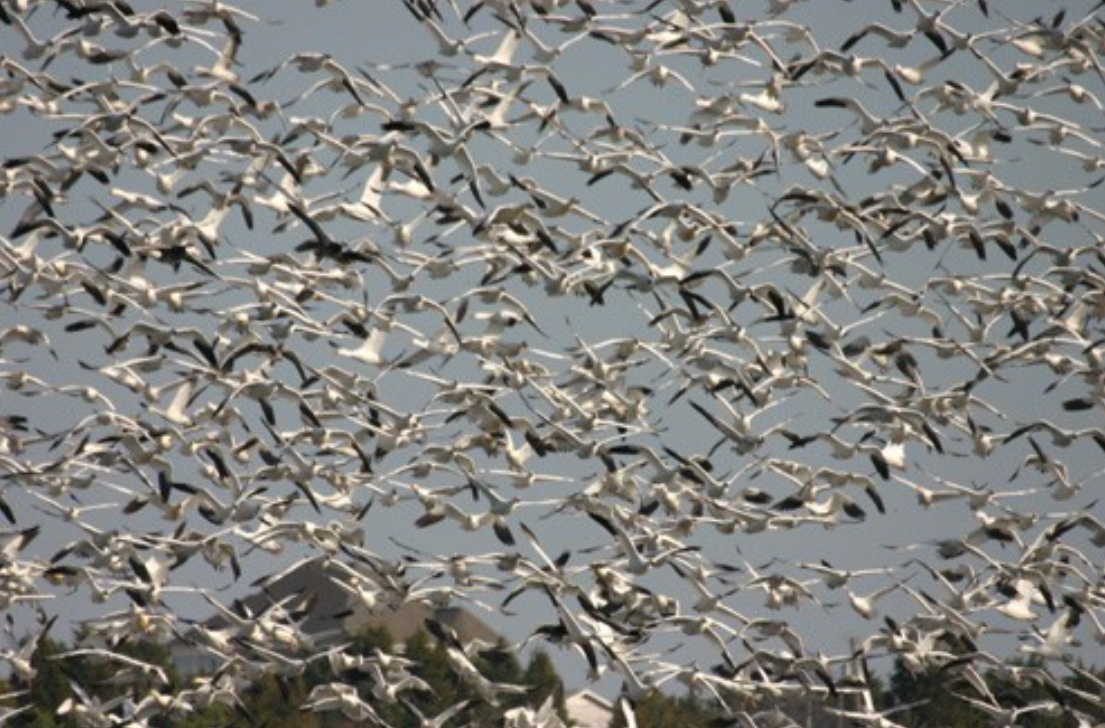
Management strategies for Snow Geese have primarily relied on hunter harvest to curb population growth. In 2009, Delaware established a Conservation Order for Snow Geese that eliminated daily bag and possession limits and authorized the use of special harvest methods. Despite the implementation of expanded hunting opportunities and an increase in snow goose harvest, current management strategies may be inadequate to address the Snow Goose population increase. The introduction of the Conservation Order initially led to a reduction in adult survival and annual productivity and stabilized the population between 714,000 and 1,000,000 individuals. This is still above the recommended target population of 500,000-750,000 individuals. Environment and Climate Change Canada (ECCC) is working collaboratively with the Atlantic Flyway Council member states (including Delaware) to band Greater Snow Geese on their breeding grounds of Bylot Island, Nunavut to evaluate the impact of the Conservation Order on the survival and recruitment of the breeding population.
Many wildlife diseases have emerged in recent years as critical threats to particular taxa. In some cases, climate change threatens to exacerbate the spread and severity of wildlife pathogens. A few of the most important wildlife diseases in Delaware are detailed below.
White-nose syndrome (WNS) has caused unprecedented mortality among cave bats throughout North America. With 90 to 100 percent mortality at some hibernation sites, this large-scale bat die-off represents a huge challenge to wildlife agencies. States are tasked with collecting data on WNS and working cooperatively to find solutions for safeguarding bat populations. Delaware, despite its small size and lack of many winter hibernacula, has documented WNS and the fungus that causes WNS, Pseudogymnoascus destructans (Pd), in winter and summer roosts.

Delaware has no caves or mines suitable for hibernating bats; however, hibernating bats have been documented at Fort Delaware State Park, a Civil War-era fort situated on an island in the Delaware River. The fort is made primarily of brick and concrete and parts of it provide temperature and humidity levels similar to what is found in caves. Bats were also documented using small ammunition bunkers in Fort DuPont State Park located on the mainland near Fort Delaware. Surveys conducted in the winter of 2011-2012 documented the presence of WNS at both Fort Delaware and Fort DuPont and changed the status of WNS in Delaware from Suspect to Confirmed. Subsequent surveys confirmed that WNS was still present. Swabbing studies at Fort Delaware documented the presence of Pd year-round Pd was not detected from a swabbing survey in 2024; however, Delaware is still experiencing the effects of WNS and Pd surveillance will continue. Species confirmed with WNS include Big Brown Bat (Eptesicus fuscus), Tricolored Bat (Perimyotis subflavus), Little Brown Bat (Myotis lucifugus), Northern Long-eared Bat (Myotis septentrionalis), and Eastern Small-footed Bat (Myotis leibii). Additional species have been confirmed as Pd positive, but no diagnostic sign of WNS has been documented, such as Silver-haired Bat (Lasionycteris noctivagans), and Eastern Red Bat (Lasiurus borealis).
Ranaviruses are a group of viruses (genus Ranavirus, family Iridoviridae) affecting fish, amphibians, and reptiles. They are highly infectious, often lethal, and can cause mass die-offs, especially in aquatic amphibians and turtles. These viruses are found nearly worldwide.
Delaware participated in a regional ranavirus SWG grant from 2013-2014 to better understand the geographic distribution of ranavirus in the Mid-Atlantic region and its potential effects on amphibian and reptile populations. Sampling focused on Wood Frogs (Lithobates sylvaticus), a species highly susceptible to die-offs, and their breeding ponds (typically vernal pools). Mortality rates are 50-99% in the tadpole stage compared to low mortality rates in adult frogs; thus, tadpoles are the appropriate life stage to sample to increase the probability of detection of the disease.
In 2013 ranavirus was detected in 13 of 23 sampled ponds (56%) with positive detections in all three counties, and wood frog die-offs were documented at two sampled sites. In 2014, all sites that were positive in 2013 (and had Wood Frogs present in 2014) were resampled. Ranavirus was documented at seven of the 13 populations sampled (54%). Ponds that were negative for ranavirus in 2013 were also visited to look for signs of ranavirus in tadpoles. A die-off was observed in 2014 at one of these sites, and a sample tested positive for ranavirus. In 2014 die-offs were documented at four of the 13 sites that were positive for ranavirus in 2013.
Ranavirus has also detected in Bog Turtles (Glyptemys muhlenbergii), Snapping Turtles (Chelydra serpentina) and Eastern Box Turtles (Terrapene carolina) in Delaware. However, no outward symptoms were seen in turtles that tested positive for disease, and all bog turtles that tested positive survived the winter and spring without incident.
Snake fungal disease (ophidiomycosis) is an emerging disease caused by a fungal pathogen affecting the skin of snakes resulting in dermal legions and ulcers and may be fatal. Several snake species have tested positive for the disease in Delaware, and individuals with clinical signs of the disease have been observed in all three counties. However, its impact to Delaware populations is unknown.
Some of these pathogens may be dormant in the animal’s systems and may not cause problems unless other stresses are present. Continued research is needed to determine the effects of pathogens in Delaware. Large scale die-offs of some species (including box turtles, frogs, and salamanders) have been documented in other locations due to ranavirus. Continued monitoring and research are necessary to determine long-term impacts of diseases on amphibian and reptile populations in Delaware.
High-Pathogenic Avian-Influenza (HPAI) is a virus that is highly transmittable among domestic and wild birds, often leading to death. In January 2022, an outbreak occurred on the eastern seaboard of the United States, spreading across North America and that outbreak has persisted until present day (June 2025), although the effects on wild bird populations fluctuate seasonally with the migration of wintering waterfowl into the U.S. from Canada. HPAI is deadly to domestic poultry, both in commercial and backyard flocks, and since 2022 has affected 1,904,270 domestic birds in the state of Delaware (USDA 2025). Among wild birds, it is transmitted regularly through waterfowl, waterbirds, gulls, and shorebirds, as well as scavenging species such as Black Vultures (Coragyps atratus) and Bald Eagles (Haliaeetus leucocephalus), although it can affect mammals scavenging on HPAI-positive carcasses such as Red Fox (Vulpes vulpes). Among waterfowl, Snow Geese (Anser caerulescens), especially immature birds, seem to be especially symptomatic, and staff from Delaware DNREC and USDA APHIS Wildlife Services disposed of dead Snow Geese during the months of December 2024 to February 2025; DNREC estimates that ~2,500 Snow Geese were affected during this period.
Many other existing and emerging wildlife diseases present significant threats to SGCN. Of particular note is emerging evidence that pathogens prevalent in managed or introduced invertebrates are actively transmitted to wild invertebrates, and may pose major threats to SGCN. This has been demonstrated in the case of native bumblebees (Bombus spp.) becoming infected by pathogens of the managed, non-native Honeybee (Apis mellifera) (Fürst et al. 2014).
Other emerging wildlife diseases of note include West Nile Virus (birds), Chytrid Fungus (Batrachochytrium dendrobatidis) (amphibians), and fibropapillomatosis (sea turtles). Since climate change may affect the spread and effects of wildlife diseases, additional emerging diseases are likely to become problematic in the future.
Related Topics: action plan, conservation, draft, fish and wildlife, habitat, plan, species, wildlife
Delaware's Governor
State Agencies
Elected Officials
General Assembly
Delaware Courts
State Employees
Cities & Towns
Delaware State Code
State Regulations
Business First Steps
Phone Directory
Locations Directory
Public Meetings
Voting & Elections
Transparency
Health Insurance
Tax Center
Personal Income Tax
Privacy Policy
Weather & Travel
Contact Us
Corporations
Franchise Tax
Gross Receipts Tax
Withholding Tax
Delaware Topics
Help Center
Mobile Apps
E-mail / Text Alerts
Social Media


Built by the Government Information Center
©MMXXVI Delaware.gov