DNREC Menu
Climate change is a major threat to fish and wildlife habitats, populations, and assemblages. Climate change affects ecosystems as distributions of animals and plants change, the timing of natural events is disrupted, and community compositions and structures are altered. Species and populations likely to have greater sensitivities to climate change include:
Species with these traits will be even more vulnerable if they have a small population, a low reproductive rate, long generation times, low genetic diversity, or are threatened by other factors (NFWPCAP 2014).
Climate modeling analyses for the northeastern region of the U.S. have projected major changes over the rest of this century, although the magnitudes of these changes are likely to vary spatially across the region. Specifically, the coastal regions have already experienced enhanced warming relative to the interior parts of the Northeast (Staudinger et al. 2024).
In 2021, DNREC’s Division of Climate, Coastal and Energy released Delaware’s Climate Action Plan, identifying multiple issues that affect Delaware’s wildlife habitats and species. This plan offers a comprehensive summary of climate change impacts expected for Delaware in the years to come (DNREC 2021). DNREC is expected to release an updated plan in 2025. All future updates to the Climate Action Plan will direct the steps Delaware and DNREC need to take to meet greenhouse gas emission goals and prepare for the impacts of a changing climate.
Delaware is projected to experience increases in annual and seasonal temperatures, high temperatures, and heavy precipitation, all of which show greater increases under higher as compared to lower scenarios and by end of century as compared to more near-term projections. The lower scenario represents a future in which people shift to clean energy sources in the coming decades, reducing emissions of carbon dioxide and other greenhouse gases. The higher scenario represents a future in which people continue to depend heavily on fossil fuels, and emissions of greenhouse gases continue to grow. All climate projections and graphs are based on Staudinger et al. 2024, and the Delaware Climate Projections Portal.
Effects of climate change in Delaware on ecosystems, natural resources, and infrastructure are detailed in the Delaware Climate Change Impact Assessment (DNREC Division of Energy and Climate 2014).
Many of Delaware’s wildlife species will face changes in habitat quality, timing, and availability of food sources, abundance of pests and diseases, and other stressors related to changes in temperature and precipitation. Species with very restricted ranges and isolated populations are likely to be most vulnerable to climate change impacts, compounded by other stressors. Changes in temperature and precipitation will affect species that depend on wetland and aquatic habitats.
The ways in which species and populations respond to climate changes can vary widely. Differences in how organisms respond to climate change, or their adaptive capacity, will lead to some species benefiting, by expanding their range and/or increasing population, and other species declining. In the northeastern United States, for example, some forest types such as oak-hickory are expected to expand, while maple-beech-birch forests are expected to contract.
Responses to climate change that have already been observed include changes in geographic range and the timing of life cycle events such as migration and reproduction. Numerous studies show shifts in the geographic range of species in response to increasing temperatures. As the climate warms, species may shift poleward (north in the northern hemisphere) or to higher elevations. For example, research on monarch butterflies found that there has been a shift on the monarch migration window by 16-19 days between 1992-2020 (Culbertson et al. 2021). Range contraction and distribution is also being documented for many marine fish (NOAA Fisheries 2022).
Changes in bloom time, migration, and nesting are also well documented. Some changes in life cycle activities are triggered by the increasing length of the growing season. However, a species’ ability to adjust geographically or temporally does not guarantee survival. The timing of these shifts can be critical for ecologically linked species, potentially resulting in a mismatch between species and the resources they need to survive. Migratory birds, for example, depend on food supply in breeding territories, wintering grounds, and throughout their migratory path. The earlier onset of spring may alter the optimum timing for arrival of birds that rely on peak food availability to support their breeding cycle.
In addition to being an existing external stressor, new invasive species and diseases may emerge as they benefit from changing climate conditions, readily establishing in new areas and outcompeting native species for resources. The spread of new diseases and pathogens may also be enhanced by changing climate conditions, potentially affecting native species and humans.
| Observed or projected physical change | Examples of potential impacts on biodiversity |
|---|---|
| Increased temperature | Species and population range shifts Changes in phenology leading to alteration or loss of biotic interactions |
| Changes in annual and seasonal precipitation | Changes in species composition of communities and habitats |
| Increased frequency of extreme events | Mortality resulting from flooding after storms Damage or mortality resulting from drought or heat waves |
| Changes to hydrologic regimes | Reduced streamflow affecting species population persistence and community composition |
| Changes to fire regimes | Changes in species composition of communities |
| Ocean acidification | Change in water chemistry affecting calcification rates of marine organisms |
| Sea level rise | Habitat loss and fragmentation from coastal erosion or inundation |
| Increases in ocean stratification | Reduced productivity of pelagic ecosystems |
| Changes in coastal upwelling and/or ocean temperatures | Changes in productivity of coastal ecosystems and fisheries Species and population range shifts and/or changes in phenology leading to alteration or loss of biotic interactions |
Delaware’s beach and dune ecosystems, including beaches, maritime dune and grasslands, interdunal wetlands, and tidal sand flats, are already vulnerable to coastal storms. If sediment input into the system is unbalanced, the combined effects of sea level rise and severe storms may lead to increased erosion and loss of beaches and dunes. Barrier beaches and dunes may be subject to more frequent overwash from storm surge and may be increasingly vulnerable to breaching and formation of new inlets (DNREC Division of Energy and Climate 2014). Interdunal wetlands, rare habitats that support several SGCN, including the Bethany Beach Firefly (Photuris bethaniensis), will be mostly inundated at moderate levels of sea level rise.
Delaware’s diverse range of wetland and aquatic ecosystems, including tidal, nontidal, freshwater, brackish, and saltwater wetland habitats, as well as stream and riverine habitats, will be vulnerable to sea level rise and increased storm surge from extreme weather events. Climate change impacts will likely accelerate erosion in tidal marshes, leading to further wetland losses, landward migration of marsh habitat, or conversion to open water. Increased temperatures and higher variance in precipitation intensity will stress freshwater habitats, including streams, rivers, and ponds. Higher water temperatures are likely to increase the incidence of harmful algal blooms (DNREC Division of Energy and Climate 2014).
Delaware’s forest ecosystems may experience shifts in the range of forest species and composition of forest communities, triggered by changes in temperature. Temperature and moisture changes are likely to contribute to plant stress, resulting in decreased productivity and greater susceptibility to pests and diseases for some species (DNREC Division of Energy and Climate 2014). Loblolly Pine (Pinus taeda) and some species of oaks (Quercus stellata, Quercus nigra) and hickories (Carya cordiformis) are expected to increase their abundance in Delaware’s forests, while Red Maple (Acer rubrum), White Oak (Quercus alba), Tulip Poplar (Liriodendron tulipifera), and others are expected to decrease (Prasad et al. 2008).
Accelerating rising sea levels are another manifestation of the changing climate. Under rising global temperatures, sea water is undergoing thermal expansion, and ice caps and glaciers are melting and contributing to rising sea levels. Sea level rise (SLR) poses significant threats to coastal ecosystems that may become inundated, resulting in habitat changes and losses, and adverse impacts to species or communities that depend on these habitats.
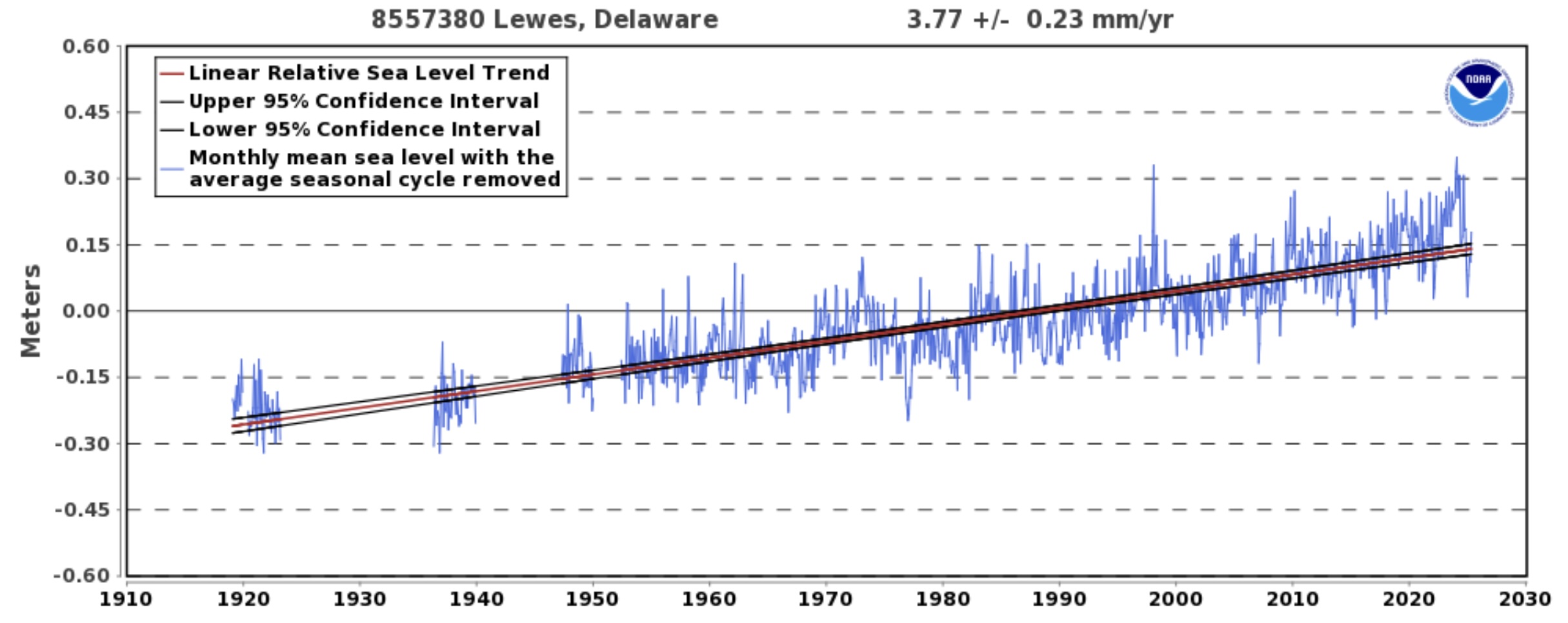
The Fifth National Climate Assessment (2023) estimated a range of additional SLR from about 1 foot to as much as 6.5 feet by 2100, depending on emissions scenario (USGCRP 2023). Locally, in Lewes, Delaware, the rate of existing SLR has been estimated to be 3.77 ± 0.23 mm/year (NOAA 2025). This is higher than the average global linear trend of 3.3 mm/yr (Copernicus 2019).
Coastal ecological resources are likely to be among the most sensitive to the changing climate. As sea levels rise, tidal marshes will be inundated and converted to shallow open water habitats. Some non-tidal wetlands, as well as most freshwater and brackish tidal wetlands, may be converted to higher salinity marshes. DNREC’s Division of Watershed Stewardship recently developed a Marsh Migration Model which estimates that under a moderate level of sea level rise (4-feet), Delaware still has at least 21,449 acres that are highly suitable for marsh migration (DNREC 2025).
Coastal development and hardened shorelines reduce the ability of wetlands to migrate inland with increasing sea level, restricting these systems until they convert to open water. As sea level rises, salt water will intrude further upstream into freshwater systems and disrupt natural processes. Salinity of the Delaware Estuary has already increased significantly, with further increases predicted regardless of changes in stream flow (Ross et al. 2015)
SLR will also have complex effects on future tidal range. Model runs for Delaware Bay indicate a spatially complex behavior with tidal-range changes of up to 10% (Hall et al. 2013). SLR will dramatically affect many SGCN in Delaware, including beach-nesting birds like Piping Plover (Charadrius melodus) and saltmarsh species, especially those whose life history makes them especially vulnerable, such as Saltmarsh Sparrow (Ammodramus caudacutus) and Eastern Black Rail (Laterallus jamaicensis).
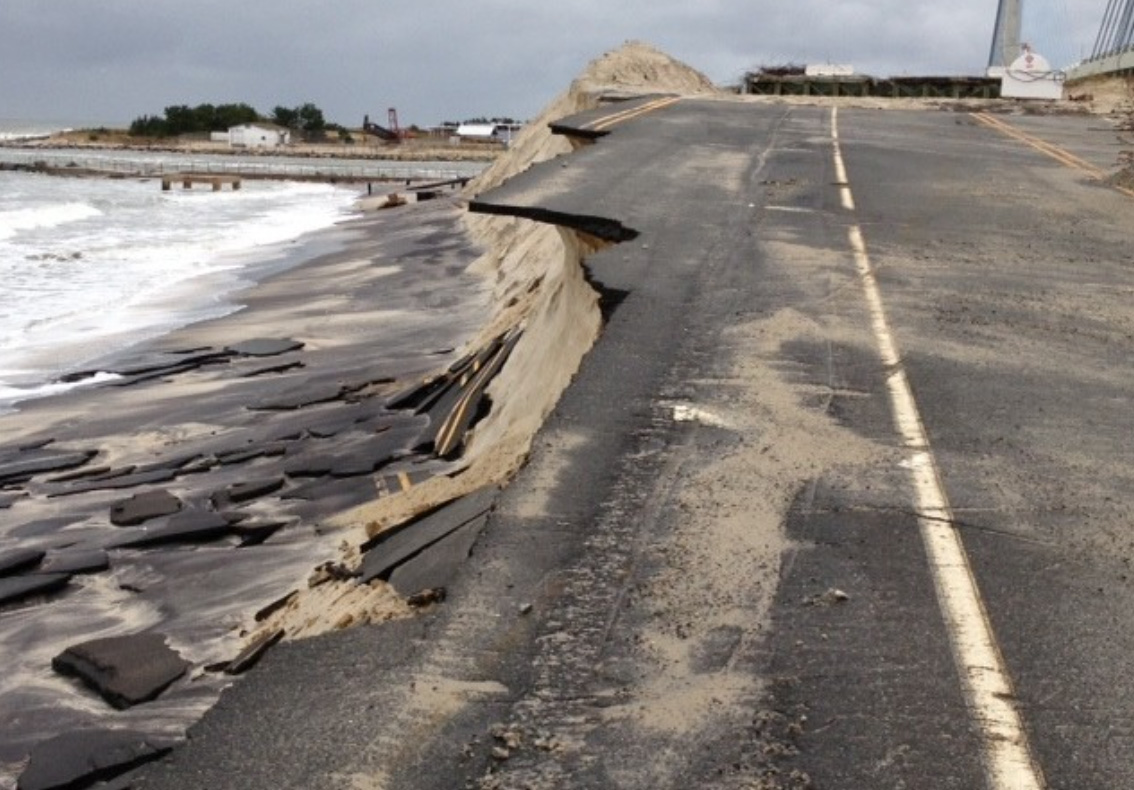
As sea levels increase, higher storm surges will occur in coastal areas (Anthes et al. 2006). The Northeastern U.S. is currently experiencing the highest annual frequency of coastal flooding due to strong wide and wide, shallow continental shelf, and frequencies are increasing and predicted to continue to increase (USGCRP 2023).
Storm effects on beach systems have shown sensitivity to compounding impacts of human disturbance. For example, macroinvertebrate communities on Gulf coast beaches showed negative effects on community recovery post-hurricane in beaches that were subject to high vehicular traffic (Witmer and Roelke 2014). Impacts on freshwater aquatic systems may include increased input of sediment and pollutants, mechanical disturbance due to highly varied flow rates, and increased turbidity. Estuarine systems may be impacted by increases in freshwater flow rates, as illustrated by large oyster die-offs during periods of prolonged low salinity at beds in the upper estuary after Hurricane Irene and Tropical Storm Lee in 2011.
Observed historical data indicate that temperatures across Delaware have been increasing since record-keeping began in 1895. This warming trend includes all seasons and is asymmetrical, with greater increases in minimum temperatures, especially in more recent years, than in maximum temperatures. the Northeast and Mid-Atlantic region, heavy precipitation has already increased significantly over the last 60 years (Whitehead et al., 2023).
Predicted increased frequency of very warm days in summer will result in warmer summer water temperatures in shallow estuarine habitats and may lead to decreased water quality and lower dissolved oxygen content as well as changes to food availability and heat stress to aquatic organisms. This warming could also promote the spread of parasites and other pests in aquatic environments (Pyke et al. 2008; Najjar et al. 2010). Moore et al. (2014) predict that increasing frequency of short-term summer temperature spikes may lead to near-complete eelgrass die-offs, which, combined with continued spread of widgeon grass (Ruppia) into these areas, may result in the extirpation of eelgrass in the region. In freshwater aquatic systems, multiple existing stressors may interact with warming to impact SGCN (Pinkney et al. 2014). Marine aquatic species are also affected by changing sea surface temperatures, acidification, and other factors
Temperature increases may also be problematic for terrestrial species at the edge of their ranges, whose physiological temperature tolerances may be exceeded. Species that are restricted in pursuing their climate niche by barriers to dispersal may be capable of limited adaptation in place via genetic and phenotypic plasticity (Urban et al. 2014). For example, some Plethodon salamanders in rapidly drying and warming habitats have responded with body size reduction over the past half century (Caruso et al. 2014). It is unclear whether such plastic metabolic responses can keep pace with climate change.
Warming temperatures will also lead to changes in plant phenology, as has already been observed (Ellwood et al. 2013; Polgar et al. 2013). These changes may have significant impacts on ecosystems by permitting spread and increasing competitive advantage of invasive species (Polgar et al 2013).
For more information on the threat of Climate in Delaware, please refer to Delaware’s Climate Action Plan.
Related Topics: action plan, conservation, draft, fish and wildlife, habitat, plan, species, wildlife
Delaware's Governor
State Agencies
Elected Officials
General Assembly
Delaware Courts
State Employees
Cities & Towns
Delaware State Code
State Regulations
Business First Steps
Phone Directory
Locations Directory
Public Meetings
Voting & Elections
Transparency
Health Insurance
Tax Center
Personal Income Tax
Privacy Policy
Weather & Travel
Contact Us
Corporations
Franchise Tax
Gross Receipts Tax
Withholding Tax
Delaware Topics
Help Center
Mobile Apps
E-mail / Text Alerts
Social Media


Built by the Government Information Center
©MMXXVI Delaware.gov