DNREC Menu

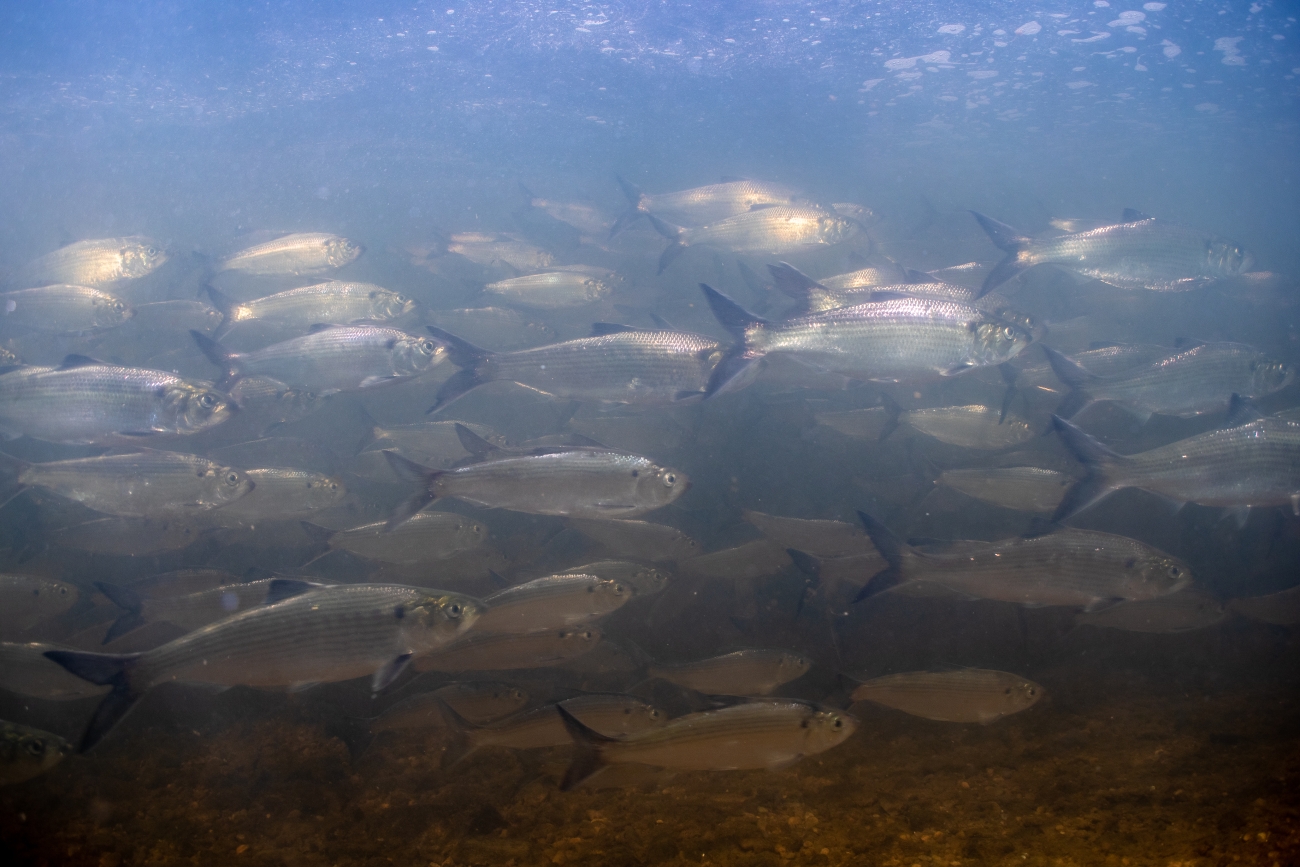
At least one hundred and seventy-seven species of fish have been documented in Delaware waters. One hundred of these are considered SGCN in the state.
NOAA estimates that 130 species of fish use the estuarine habitats of the Delaware River and Bay. The shallow waters of Delaware’s Inland Bays provide habitat for at least 112 species of fish (Delaware Center for the Inland Bays 2011). Four fish species might be extirpated from the Delaware River Basin: Mud Sunfish (Acantharchus pomotis), Blackbanded Sunfish (Enneacanthus chaetodon), Swamp Darter (Etheostoma fusiforme), and Longnose Gar (Lepisosteus osseus) (Cooper 1983; Horwitz et al. 2008).
Seventy-eight finfish species have been identified as Northeast RSGCN, making them one of the most numerous vertebrate groups listed. These fish taxa include representatives of all of the major fish families found in the Northeast, with certain families (Percidae, Cyprinidae, Salmonidae, Centarchidae) particularly well represented.
NOAA’s NMFS provides an Essential Fish Habitat (EFH) Mapper tool online for viewing the spatial representations of EFH for all 39 species under federal management in the Mid-Atlantic and Northeast, as well as links to supporting materials, including fishery management plans, and the ability to download GIS data. It was developed for general visualization and informational purposes only and does not necessarily represent the most important habitats. EFH is defined as those waters and substrate necessary to fish for spawning, breeding, feeding, or growth to maturity (16 U.S.C. 1802(10)). Species for which EFH has been mapped in the Delaware River and Bay and the Delaware Inland Bays are listed below. Several additional species have EFH mapped in the Atlantic Ocean offshore of Delaware.
The Atlantic States Marine Fisheries Commission (ASMFC) manages coastal (0-3 miles) inshore migratory species, and the Mid-Atlantic Fisheries Management Council (MAFMC) maintains jurisdiction from 3 to 200 miles off the coast. The MAFMC manages more than 65 species, with 15 species directly managed under seven specific Fishery Management Plans (FMPs): Mackerel, Squid, and Butterfish; Bluefish; spiny dogfish (joint with the NEFMC); Summer Flounder, Scup, and Black Sea Bass; Golden Tilefish; Blueline Tilefish; and Monkfish (available online at https://www.mafmc.org/). The ASMFC manages 27 species or groups of species for conservation and has approved interstate FMPs for several of them (e.g., striped bass; available online at http://www.asmfc.org/species/). All of these interstate FMPs assess the abundance and distribution of each species and describe conservation measures to address any threats to the fish stocks.
Species for which Essential Fish Habitat is mapped within Delaware Bay and the Delaware Inland Bays. Source: NOAA/TNC.
| Species | Upper DE Bay | Lower DE Bay | Inland Bays |
|---|---|---|---|
| Black Sea Bass | JA | JA | JA |
| Cod | |||
| Atlantic Herring | JA | JA | J |
| Bluefish | JA | JA | JA |
| Clearnose Skate | JA | JA | JA |
| Little Skate | JA | JA | JA |
| Monkfish | ELA | ||
| Red Hake | A | ELJA | A |
| Sandbar Shark | J | JA | J |
| Sand Tiger Shark | A | JA | A |
| Scup | JA | JA | JA |
| Silver Hake | ELA | ||
| Skipjack Tuna | A | ||
| Smoothhound Shark Complex (Atlantic Stock) | EJA | EJA | |
| Spiny Dogfish | JA | JA | |
| Summer Flounder | JA | JA | LJA |
| Windowpane Flounder | JA | EJA | ELJA |
| Winter Flounder | |||
| Winter Skate | JA | JA | JA |
| Butterfish | LJA | ELJA | JA |
| Longfin Inshore Squid | E | EJA | E |
| Rosette Skate | |||
| Yellowtail Flounder | J | ||
| Total Species | 15 | 20 | 18 |
The Atlantic Coastal Fish Habitat Partnership (ACFHP) developed a Conservation Strategic Plan for 2022-2025, focused on broad coastwide strategies for determining and addressing the threats affecting habitats that are important for all life stages of Atlantic diadromous, estuarine-dependent, and coastal species. (ACFHP 2022). The ACFHP further developed a 2023-2024 Action Plan which outlined objectives, strategies and actions to address serious threats to fish habitats along the Atlantic coast (ACFHP 2023). The National Fish Habitat Partnership (NFHP) published a National Fish Habitat Action Plan (NFHP 2006), which detailed specific actions for the restoration and conservation of fish habitat across the United States. The National Fish Habitat Partnership (NFHP) published a second edition of the habitat action plan with new conservation and management actions and updates on progress since the first plan. In 2015, NFHP conducted the national assessment of fish habitat, Through a Fish’s Eye: The Status of Fish Habitats in the United States 2015 (NFHP 2015), which detailed the status of fish habitats across the country and served to accomplish one of the major goals of the 2006 Action Plan.
Human activities continue to impact aquatic systems across the Northeast, and fish populations face many threats. Destruction or modification of habitat, which can result in loss of populations and reductions in species range, includes dam construction, stream channelization, mining, conversion of forests to agriculture, and urban and suburban development. Pollution from point and non-point source contaminants in run-off reduces water quality to the point where only highly tolerant fish species survive. Sedimentation of fine particulates can also smother bottom substrates, causing declines in bottom-dwelling species that require clean substrates and good water quality.
Introduction of non-native species, which may result in hybridization, competition, and predation, has the potential to impact native species. Examples of aquatic invasives that may impact SGCN fishes include the Northern Snakehead (Channa argus), the Rusty Crayfish (Orconectes rusticus), Blue Catfish (Ictalurus furcatus), and Flathead Catfish (Pylodictis olivaris). The USGS developed a database of non-native aquatic species for the region. Disease or parasitism such as whirling disease (introduced from Europe) has affected many wild and hatchery populations of trout and salmon species in the United States and Canada. Overharvesting for commercial, recreational, scientific, or educational purposes has also historically affected some species such as the federally endangered Shortnose Sturgeon (Acipenser brevirsotrum) and Atlantic Sturgeon (Acipenser oxyrichus oxyrinchus). Eutrophication and resulting hypoxia can create unsuitable conditions in summer months for sensitive species, especially in shallow estuarine waters.
Global climate change and associated changes in weather and rainfall patterns across the Northeast have the potential to alter water quality and quantity in many streams, lakes, and rivers, with resulting detrimental effects for many fish species. Climate change effects in estuarine and marine habitats can affect currents, water temperature, and many other factors that may result in impacts to SGCN. Climate change can also exacerbate the other threats listed above.
Sixteen species of freshwater fishes were identified as SGCN in Delaware.
| Common Name | Scientific Name | Tier |
|---|---|---|
| Swallowtail Shiner | Notropis procne | Assessment Priority |
| Blackbanded Sunfish | Enneacanthus chaetodon | Tier 1 |
| Blueridge Sculpin | Cottus caeruleomentum | Tier 1 |
| Bridled Shiner | Notropis bifrenatus | Tier 1 |
| Glassy Darter | Etheostoma vitreum | Tier 1 |
| Ironcolor Shiner | Notropis chalybaeus | Tier 1 |
| Shield Darter | Percina peltata | Tier 1 |
| American Brook Lamprey | Lethenteron appendix | Tier 2 |
| Banded Sunfish | Enneacanthus obesus | Tier 2 |
| Comely Shiner | Notropis amoenus | Tier 2 |
| Least Brook Lamprey | Lampetra aepyptera | Tier 2 |
| Margined Madtom | Noturus insignis | Tier 2 |
| Mottled Sculpin | Cottus bairdii | Tier 2 |
| Mud Sunfish | Acantharchus pomotis | Tier 2 |
| Shorthead Redhorse | Moxostoma macrolepidotum | Tier 2 |
| Bowfin | Amia calva | Tier 3 |
| Swamp Darter | Etheostoma fusiforme | Tier 3 |
Both Slimy (Cottus cognatus) and Mottled Sculpin (Cottus bairdii) occur in Delaware and have been documented as potential host fish for several mussel species, including dwarf wedgemussel (Alasmidonta heterodon), Brook Floater (Alasmidonta varicosa), and Creeper (Strophitus undulatus) (Nedeau et al. 2000; CTDEP 2003). Sculpin have small home ranges and need networks of connected headwaters and small streams to maintain genetic diversity and minimize the risk of localized extinction.
These species thrive in cool or warm sluggish headwater streams and in the backwaters of small and large rivers. Bridle Shiner (Notropis bifrenatus) were once abundant in the Delaware Basin but now are considered rare. Declines have been rapid and range-wide over the past 50 years (Cooper 1983; NFHP 2015). Surveys within the Delaware River basin have documented Bridle Shiners in small sluggish warm-water creeks, permanent backwaters within the floodplain, and in beaver ponds. They were often found swimming above and into patches of submerged aquatic vegetation, which are used for cover and during spawning (Horwitz et al. 2008).
While they were never abundant, Ironcolor Shiner (Notropis chalybaeus) distributions have also decreased. Only two populations have been documented recently in the Delaware River basin. Both shiners spawn over aquatic vegetation (Jenkins and Burkhead 1993). Possible causes of species decline include siltation, loss of aquatic vegetation, and a reduction in critical backwater habitat historically created by beavers (Horwitz et al. 2008; PNHP 2010). Eastern Mudminnow (Umbra pygmaea) also thrives in vegetated backwater pools and wetlands within the floodplain of major tributaries and the mainstem river (Horwitz et al. 2008). Adjacent land cover, lateral connectivity, and groundwater contribution are important to maintaining vegetation, temperature, and dissolved oxygen in these habitats.
Several freshwater species, including Delaware’s four SGCN sunfish (Centrarchidae) species, as well as Margined Madtom (Noturus insignis) and Fallfish (Semotilus corporalis) build nests in which to spawn. Some species such as Banded (Enneacanthus obesus) and Blackbanded Sunfish (Enneacanthus chaetodon) prefer spawning habitat in shallow areas with low flow and aquatic vegetation. Margined Madtom (Noturus insignis) prefer moderate to fast currents over sand and gravel substrates. They are important indicators of the persistence of shallow, fast water habitats and serve as host fish for several freshwater mussel species. Fallfish also serves as a host fish for freshwater mussels (Strayer and Jirka 1997; CTDEP 2003).
Nest builders require maintenance of suitable nesting substrate and are sensitive to extreme high and low flow events that could impact eggs and fry. Changes to land cover, loss of baseflows, and high flow events during spawning could impact nesting success. Blackbanded Sunfish, while apparently never common, has now become extremely rare and is listed as Endangered in Delaware. Blackbanded Sunfish is one of the species that likely used beaver dam habitat extensively in pre-colonial times. A full review of the associations of freshwater fish with beaver dams is provided by Pollock et al. (2003).
| Common Name | Scientific Name | Tier |
|---|---|---|
| American Eel | Anguilla rostrata | Tier 1 |
| Atlantic Sturgeon | Acipenser oxyrinchus oxyrinchus | Tier 1 |
| Blueback Herring | Alosa aestivalis | Tier 1 |
| Shortnose Sturgeon | Acipenser brevirostrum | Tier 1 |
| Alewife | Alosa pseudoharengus | Tier 2 |
| American Shad | Alosa sapidissima | Tier 2 |
| Atlantic Herring | Clupea harengus | Tier 2 |
| Striped Bass | Morone saxatilis | Tier 2 |
| Hickory Shad | Alosa mediocris | Tier 3 |
The Delaware River Basin supports ten diadromous fish species, which migrate between freshwater and marine habitats during their life cycles (Cooper 1983; Greene et al. 2009; NOAA 2011).
Anadromous fish, including clupeids, American Shad (Alosa sapidissima), Hickory Shad (A. mediocris), Alewife (A. pseudoharengus), and Blueback Herring (A. aestivalis); Atlantic Sturgeon (Acipenser oxyrinchus oxyrinchus); and Striped Bass (Morone saxatilis) spend most of their adult lives at sea before returning to natal rivers to spawn.
Although often referred to as an anadromous species, Shortnose Sturgeon (Acipenser brevirostrum) in the Delaware River is more correctly referred to as an amphidromous species, as its individuals move between freshwater and the bay to feed, but not to spawn. Delaware’s catadromous species, American Eel (Anguilla rostrata), migrates from the ocean into freshwater environments as juveniles. Once mature, they emigrate to spawn in marine environments.
Diadromous fish require connectivity between marine and freshwater habitats. The Delaware River is unique among major eastern rivers in that its mainstem is free of dams, allowing these species to access much of their historic spawning habitat. A review of habitat conditions, threats, and recommendations for diadromous fish was completed for the Atlantic coast by Greene et al. (2009). Nine species of diadromous fishes were identified as SGCN in Delaware.
Historical information and restoration efforts for shad and other anadromous species in northern Delaware tributaries are detailed in Narvaez et al. (2010). American Shad are historically known from the Brandywine and Christina watersheds, the Broadkill, and the Nanticoke. American Shad from hatcheries have been stocked in the Nanticoke River. A state moratorium on the commercial and recreational harvest of Blueback Herring and Alewife went into effect in 2012.
Sturgeon populations remain at historic lows as well. The Delaware River spawning population of Atlantic Sturgeon is currently estimated at less than 300 adults, down from an estimated 180,000 prior to 1890 (NOAA NMFS n.d.). The New York Bight Distinct Population Segment (DPS) of Atlantic Sturgeon (including the Delaware River spawning population) was one of 4 DPSs listed as federally Endangered in 2012 (NMFS 2012). Shortnose sturgeon (Acipenser brevirostrum) was listed as federally Endangered in 1967 (32 FR4001), with a recovery plan published in December 1998.
Threats to both sturgeon species include vessel strikes and entrainment and impingement in cooling water withdrawal systems. Fifty-three confirmed mortalities of Atlantic Sturgeon as a result of vessel strikes were documented in the Delaware River from 2019 to 2024, and 21 of these fish were large adults. A recent study indicated that the loss of only a few adult female Atlantic Sturgeon would impact recovery of Atlantic Sturgeon in the Delaware River (NOAA NMFS n.d.). The effects of main channel deepening of the Delaware River (both dredging and increased vessel traffic) on sturgeon could be significant. Delaware is in the process of applying for an Endangered Species Act Section 10 Incidental Take Permit (ITP) for Atlantic sturgeon that will cover all its commercial fisheries in state waters. The ITP will reduce the already low impact of Delaware’s state water commercial fisheries by setting a limit on Atlantic Sturgeon takes by the fisheries and requiring some level of observer coverage.
| Common Name | Scientific Name | Tier |
|---|---|---|
| American Butterfish | Peprilus triacanthus | Assessment Priority |
| American Sand Lance | Ammodytes americanus | Assessment Priority |
| Atlantic Mackerel | Scomber scombrus | Assessment Priority |
| Atlantic Tomcod | Microgadus tomcod | Assessment Priority |
| Cunner | Tautogolabrus adspersus | Assessment Priority |
| Fourspot Flounder | Paralichthys oblongus | Assessment Priority |
| Goosefish | Lophius americanus | Assessment Priority |
| Longhorn Sculpin | Myoxocephalus octodecemspinosus | Assessment Priority |
| Northern Puffer | Sphoeroides maculatus | Assessment Priority |
| Northern Sea Robin | Prionotus carolinus | Assessment Priority |
| Ocean Pout | Zoarces americanus | Assessment Priority |
| Red Hake | Urophycis chuss | Assessment Priority |
| Sea Raven | Hemitripterus americanus | Assessment Priority |
| Striped Searobin | Prionotus evolans | Assessment Priority |
| Windowpane | Scophthalmus aquosus | Assessment Priority |
| Bluefish | Pomatomus saltatrix | Tier 1 |
| Lined Seahorse | Hippocampus erectus | Tier 1 |
| Smooth Skate | Malacoraja senta | Tier 1 |
| Tautog | Tautoga onitis | Tier 1 |
| Thorny Skate | Amblyraja radiata | Tier 1 |
| Weakfish | Cynoscion regalis | Tier 1 |
| Winter Flounder | Pseudopleuronectes americanus | Tier 1 |
| Atlantic Menhaden | Brevoortia tyrannus | Tier 2 |
| Barndoor Skate | Dipturus laevis | Tier 2 |
| Black Seabass | Centropristis striata | Tier 2 |
| Fourspine Stickleback | Apeltes quadracus | Tier 2 |
| Oyster Toadfish | Opsanus tau | Tier 2 |
| Scup | Stenotomus chrysops | Tier 2 |
| Silver Hake | Merluccius bilinearis | Tier 2 |
| Atlantic Bluefin Tuna | Thunnus thynnus | Tier 3 |
| Atlantic Croaker | Micropogonias undulatus | Tier 3 |
| Black Drum | Pogonias cromis | Tier 3 |
| Red Drum | Sciaenops ocellatus | Tier 3 |
| Spanish Mackerel | Scomberomorus maculatus | Tier 3 |
| Spot | Leiostomus xanthurus | Tier 3 |
| Spotted Seatrout | Cynoscion nebulosus | Tier 3 |
| Summer Flounder | Paralichthys dentatus | Tier 3 |
The ecology of Delaware’s estuarine fishes was extensively reviewed by Able and Fahay (2010). Much foundational information on juvenile life stages was compiled by Wang and Kernehan (1979). Thirty-four species of estuarine and marine fishes were identified as SGCN in Delaware.
Steep declines in Atlantic Bluefin Tuna (Thunnus thynnus) between 1970 and 1992 led to the species’ listing as Endangered by the IUCN and as a NMFS Species of Concern in 2011. The International Commission for the Conservation of Atlantic Tunas (ICCAT) scientific committee typically assesses the abundance of Atlantic Bluefin Tuna stocks every two to three years. According to the 2021 stock assessment, the western Atlantic Bluefin Tuna stock is no longer subject to overfishing. However, based on the information in the 2021 stock assessment and continued uncertainty about population estimates, NOAA Fisheries has determined that the western Atlantic Bluefin Tuna Stock overfished status is undetermined. A recent satellite tagging study indicated a coastal core-use area centered near the shelf break of the Mid-Atlantic bight (Galuardi and Lutcavage 2012).
Tautog (Tautoga onitis) is listed as a Tier 1 species due to its IUCN status of Vulnerable and status as RSGCN. This important recreational fishery species experienced a 73% reduction in spawning biomass between 1986 and 2004 (Choat and Pollard 2010). As of the 2021 stock assessment, Tautog stocks are only overfished in the New Jersey-New York Bight stock assessment region (ASFMC 2021). Overfishing was not occurring in Delmarva region (ASMFC 2021).
The Delaware Bay is an important spawning area for Weakfish (Cynoscion regalis). Weakfish populations are currently very low compared with historic estimates of abundance, and juvenile Weakfish rarely reach adulthood in Delaware’s Inland Bays. Black Drum (Pogonias cromis) use the bay for spawning, and juveniles use tidal creeks as nursery areas. Several flatfish are common in bay waters, including the SGCN Summer Flounder (Paralichthys dentatus), and Windowpane Flounder (Scophthalmus aquosus).
| Common Name | Scientific Name | Tier |
|---|---|---|
| Atlantic Thresher Shark | Alopias vulpinus | Tier 1 |
| Basking Shark | Cetorhinus maximus | Tier 1 |
| Bigeye Thresher Shark | Alopias superciliosus | Tier 1 |
| Blacktip Shark | Carcharhinus limbatus | Tier 1 |
| Bonnethead Shark | Sphyrna tiburo | Tier 1 |
| Bull Shark | Carcharhinus leucas | Tier 1 |
| Dusky Shark | Carcharhinus obscurus | Tier 1 |
| Great Hammerhead Shark | Sphyrna mokarran | Tier 1 |
| Great White Shark | Carcharodon carcharias | Tier 1 |
| Lemon Shark | Negaprion brevirostris | Tier 1 |
| Longfin Mako Shark | Isurus paucus | Tier 1 |
| Night Shark | Carcharhinus signatus | Tier 1 |
| Nurse Shark | Ginglymostoma cirratum | Tier 1 |
| Oceanic Whitetip Shark | Carcharhinus longimanus | Tier 1 |
| Porbeagle Shark | Lamna nasus | Tier 1 |
| Sand Tiger Shark | Carcharias taurus | Tier 1 |
| Sandbar Shark | Carcharhinus plumbeus | Tier 1 |
| Scalloped Hammerhead | Sphyrna lewini | Tier 1 |
| Seven-gill Shark | Heptranchias perlo | Tier 1 |
| Shortfin Mako Shark | Isurus oxyrinchus | Tier 1 |
| Silky Shark | Carcharhinus falciformis | Tier 1 |
| Smooth Hammerhead Shark | Sphyrna zygaena | Tier 1 |
| Spinner Shark | Carcharhinus brevipinna | Tier 1 |
| Spiny Dogfish | Squalus acanthias | Tier 1 |
| Whale Shark | Rhincodon typus | Tier 1 |
| Blue Shark | Prionace glauca | Tier 2 |
| Bluntnose Sixgill Shark | Hexanchus griseus | Tier 2 |
| Finetooth Shark | Carcharhinus isodon | Tier 2 |
| Smooth Hound | Mustelus canis | Tier 2 |
| Tiger Shark | Galeocerdo cuvier | Tier 2 |
| Atlantic Angel Shark | Squatina dumeril | Tier 3 |
| Atlantic Sharpnose Shark | Rhizoprionodon terraenovae | Tier 3 |
| Common Name | Scientific Name | Tier |
|---|---|---|
| Little Skate | Leucoraja erinacea | Assessment Priority |
| Rosette Skate | Leucoraja garmani | Assessment Priority |
| Roughtail Stingray | Dasyatis centroura | Tier 1 |
| Winter Skate | Leucoraja ocellata | Tier 1 |
There are 32 species of sharks, and 2 species of rays and skates considered SGCN in Delaware. Global populations of sharks and other cartilaginous fishes have been severely reduced in recent decades through over-harvest for the commercial market. Many species of sharks of conservation concern use the waters of Delaware Bay and the Atlantic Ocean. A few of these species may be very uncommon as far north as Delaware, however, the high global concern for shark species and potential changes in distribution and abundance due to climate change warrants their listing even if they are currently uncommon or rare in Delaware waters.
The shallow habitats of coastal Delaware Bay are important primary and secondary nursery habitat for the Sandbar Shark (Carcharhinus plumbeus) (Merson and Pratt 2001; Rechisky and Wetherbee 2003). The Sand Tiger Shark (Carcharias taurus), along with Smooth Hound (Mustelus canis) and Spiny Dogfish (Squalus acanthias) also use the Bay extensively. Researchers have conducted radio-tagging research on Sand Tiger Sharks in Delaware Bay since 2007 as part of the Atlantic Cooperative Telemetry (ACT) Network, finding that this species leaves Delaware Bay in fall, with males moving south to Hatteras or beyond, and females moving to offshore waters near the shelf break (Fox et al. 2009, Teter et al. 2015). Sand Tiger Sharks are also frequently removed from the Delaware Bay under a NOAA Fisheries permit to be supplied to aquariums. A limited number of Sand Tiger Sharks are taken annually from Delaware Bay for display and educational purposes at aquariums under permits issued by NOAA Fisheries and the Delaware Division of Fish and Wildlife. Several species of oceanic sharks [as classified by Camhi et al. (2009)] regularly visit the waters off Delaware. All shark species managed by the Atlantic States Marine Fisheries Commission (ASMFC) with observations or potentially suitable habitat in Delaware and adjacent ocean waters are included as SGCN.
Related Topics: action plan, conservation, draft, fish and wildlife, habitat, plan, species, wildlife
Delaware's Governor
State Agencies
Elected Officials
General Assembly
Delaware Courts
State Employees
Cities & Towns
Delaware State Code
State Regulations
Business First Steps
Phone Directory
Locations Directory
Public Meetings
Voting & Elections
Transparency
Health Insurance
Tax Center
Personal Income Tax
Privacy Policy
Weather & Travel
Contact Us
Corporations
Franchise Tax
Gross Receipts Tax
Withholding Tax
Delaware Topics
Help Center
Mobile Apps
E-mail / Text Alerts
Social Media


Built by the Government Information Center
©MMXXVI Delaware.gov