DNREC Menu
Evidence indicates worldwide declines in amphibian (Stuart et al. 2004) and reptile populations and a need to identify the specific causes and impacts of these declines is warranted (Gibbons et al. 2000; LaRoe et al. 1995). There is a recognized national and regional need for advocacy focused on conservation of amphibians and reptiles and the use of an ecosystem approach to incorporate species protection into existing management plans (NEPARC 2004, NEPARC 2009). An estimated 35% of amphibians that are dependent on aquatic habitats are rare or imperiled nationally (TNC 1996; Abell et al. 2000). LaRoe et al. (1995) found that 45% of the nation’s turtle species need conservation action, with many species experiencing significant population and distribution declines over the last century. Moreover, vernal pools, the habitat for many amphibian species and some reptile species, are declining in the Northeast (Calhoun and Klemens 2002). Results from a long-term study of amphibian occupancy rates on National Wildlife Refuges, a place where anthropogenic threats should be minimal, documented a 3.7% overall decline in amphibian occupancy at study sites (Adams et al. 2013). With this level of decline, 50% of the sites would be expected to be unoccupied within 27 years.
A total of 67 amphibian and reptile species are native to Delaware. Of these, 12 are listed by the state as Endangered and five are also federally listed. The range, habitats, status, and ecology of Delaware’s herpetofauna are reviewed in White and White (2007), and DFW conducted a statewide distributional survey of all amphibian and reptile species at an approximate 10 square mile spatial scale from 2018-2023. Based on GAP analysis of habitat models, all herp taxa are poorly represented within protected natural areas in the Delaware, Maryland, and New Jersey region. Amphibians appear to be in the worst shape, with over 95% of amphibian species having less than 10% of their potential habitat occurring within protected natural lands (GAP Status 1 and 2) (McCorkle et al. 2006). Threats to Delaware’s herps include habitat loss and fragmentation, disease, and climate change.
Thirty-seven species of Delaware’s herpetofauna are identified as SGCN, including 13 amphibians, 12 lizards and snakes, 7 non-marine turtles, and 5 marine turtles.
| Common Name | Scientific Name | Tier |
|---|---|---|
| Striped Mud Turtle | Kinosternon baurii | Assessment Priority |
| Atlantic Coast Leopard Frog | Lithobates kauffeldi | Tier 1 |
| Atlantic Hawksbill | Eretmochelys imbricata imbricata | Tier 1 |
| Barking Treefrog | Hyla gratiosa | Tier 1 |
| Bog Turtle | Glyptemys muhlenbergii | Tier 1 |
| Carpenter Frog | Lithobates virgatipes | Tier 1 |
| Diamondback Terrapin | Malaclemys terrapin | Tier 1 |
| Eastern Box Turtle | Terrapene carolina | Tier 1 |
| Eastern Tiger Salamander | Ambystoma tigrinum | Tier 1 |
| Green Sea Turtle | Chelonia mydas | Tier 1 |
| Kemp's Ridley Sea Turtle | Lepidochelys kempii | Tier 1 |
| Leatherback Sea Turtle | Dermochelys coriacea | Tier 1 |
| Loggerhead Sea Turtle | Caretta caretta | Tier 1 |
| Mud Salamander | Pseudotriton montanus | Tier 1 |
| Plain-bellied Watersnake | Nerodia erythrogaster | Tier 1 |
| Red Cornsnake | Pantherophis guttatus | Tier 1 |
| Scarletsnake | Cemophora coccinea | Tier 1 |
| Spotted Turtle | Clemmys guttata | Tier 1 |
| Wood Turtle | Glyptemys insculpta | Tier 1 |
| Broad-headed Skink | Plestiodon laticeps | Tier 2 |
| Eastern Copperhead | Agkistrodon contortrix | Tier 2 |
| Eastern Cricket Frog | Acris crepitans | Tier 2 |
| Eastern Kingsnake | Lampropeltis getula | Tier 2 |
| Eastern Milksnake | Lampropeltis triangulum | Tier 2 |
| Eastern Ribbonsnake | Thamnophis saurita | Tier 2 |
| Little Brown Skink | Scincella lateralis | Tier 2 |
| Long-tailed Salamander | Eurycea longicauda | Tier 2 |
| New Jersey Chorus Frog | Pseudacris kalmi | Tier 2 |
| Northern Red-bellied Cooter | Pseudemys rubriventris | Tier 2 |
| Queensnake | Regina septemvittata | Tier 2 |
| Red-bellied Snake | Storeria occipitomaculata | Tier 2 |
| Smooth Earthsnake | Virginia valeriae | Tier 2 |
| Spotted Salamander | Ambystoma maculatum | Tier 2 |
| Northern Dusky Salamander | Desmognathus fuscus | Tier 3 |
| Northern Two-lined Salamander | Eurycea bislineata | Tier 3 |
| Red Salamander | Pseudotriton ruber | Tier 3 |
| Wood Frog | Lithobates sylvaticus | Tier 3 |
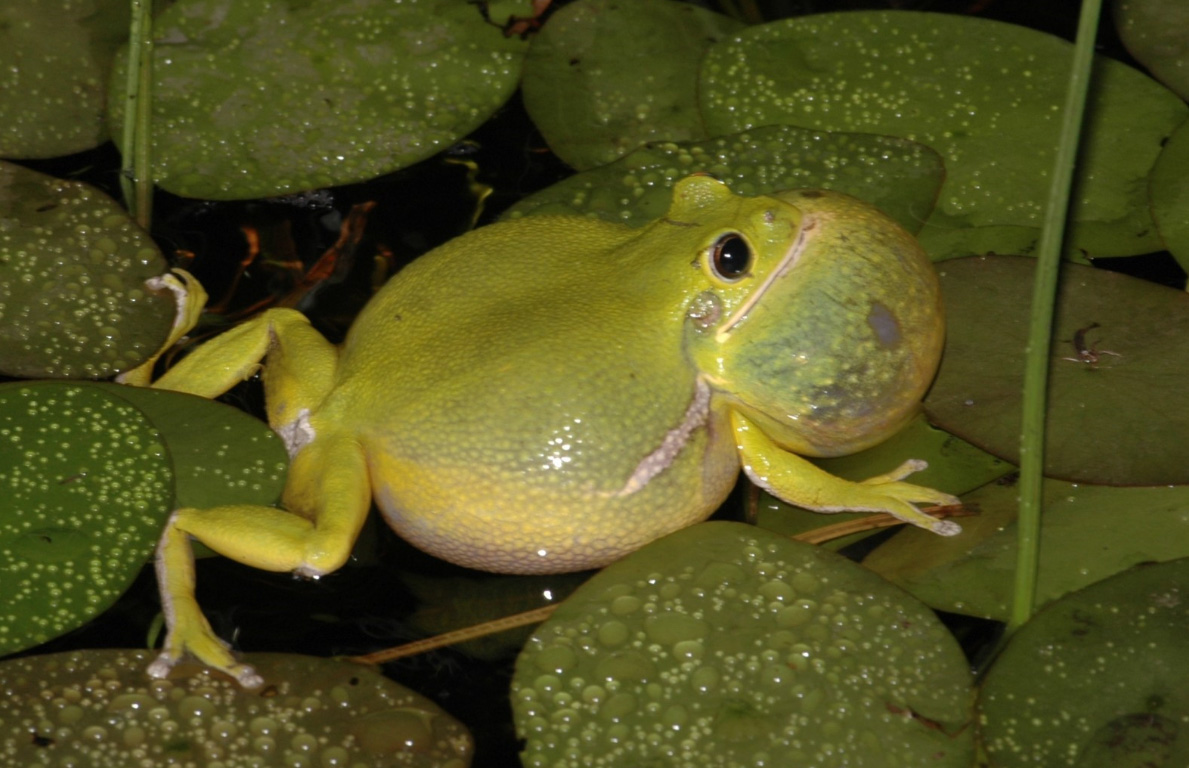
Delaware is home to 28 species of amphibians, of which 13 (46%) meet the criteria for SGCN. Notable ecological groups include ephemeral wetland obligate breeders and species associated strongly with groundwater-fed lotic habitats such as springs and seeps.
The RSGCN list for the Northeast includes 18 species of amphibians, of which 15 are salamanders and three are frogs. Three of Delaware’s SGCN amphibians are included on the RSGCN list. Amphibian species in the Northeast are under many threats, including wetland loss, water pollution, groundwater contamination, exurban and suburban sprawl, increased habitat fragmentation from roads and new human developments, and exotic, non-native diseases.
In terms of rarity and vulnerability to human impacts, vernal pool-breeding amphibians represent an important species assemblage. Several species are of conservation concern, including the Spotted Salamander (Ambystoma maculatum), Eastern Tiger Salamander (Ambystoma tigrinum), and Barking Treefrog (Hyla gratiosa), all of which depend upon forests and Coastal Plain seasonal ponds for their survival.
The Blackbird-Millington Corridor, which spans the boundary between Maryland and Delaware on the northern part of the Coastal Plain, includes the largest concentration of Coastal Plain seasonal ponds on the Delmarva Peninsula. These seasonal wetlands and the surrounding matrix of hardwood forest represented the most significant rare amphibian species hotspot in the Maryland, Delaware, and New Jersey GAP Analysis (MDN-GAP) project area, and much of the area remains unprotected (McCorkle et al. 2006). Because the topography of the area is very flat, its forests and seasonal wetlands are especially vulnerable to development. Even though significant portions of this corridor occur on state-owned forest land and wildlife management area land, all the species mentioned above have less than 10% of their predicted distributions occurring within protected natural lands (GAP status 1 or 2) (McCorkle et al 2006).
Barking Treefrog (Hyla gratiosa) and Carpenter Frog (Rana virgatipes) have less than 5% of their predicted regional distributions occurring within protected natural lands (GAP status 1 or 2) (McCorkle et al. 2006).
Upland forested buffers are extremely important for conservation of ephemeral wetland breeders. For example, adult salamanders of six Ambystoma species were found an average of 125 m from the edge of aquatic habitats during the non-breeding portions of their life cycles, such that a wetland buffer zone of 164 m (534 ft) could be expected to encompass most of the population of these salamanders during their entire life cycle (Semlitsch 1998). It is also important to consider corridors to allow gene flow between populations, and when possible, to protect entire complexes of breeding wetlands as well as their forest matrix.
Several of Delaware’s amphibian SGCN are dependent on groundwater-fed, lotic habitats associated with springs, seeps, and stream headwaters. These include the Long-tailed Salamander (Eurycea longicuada), Mud Salamander (Pseudotriton montanus), Northern Dusky Salamander (Desmognathus fuscus), Northern Two-lined Salamander (Eurycea bislineata), and Red Salamander (Pseudotriton ruber).
The northeastern region RSGCN list includes 16 reptile species: 11 turtles and five snakes. Of these species, Northern Red-bellied Cooter (Pseudemys rubriventris) and Bog Turtle (Glyptemys muhlenbergii) are Delaware species considered to be of high regional responsibility for management as well as high or very high regional conservation concern. These high-priority reptiles, along with many of the other herptile SGCN, are threatened by habitat loss and fragmentation, pollution, disease, and illegal harvest.
Twenty-three species of lizards and snakes (collectively known as squamates) are known to occur in Delaware. Of these, 12 species are considered SGCN in the state. A subset of these species is found entirely or primarily in sandy habitats on the Coastal Plain. Accurate population assessments are needed to determine the status of many of the species in this group.
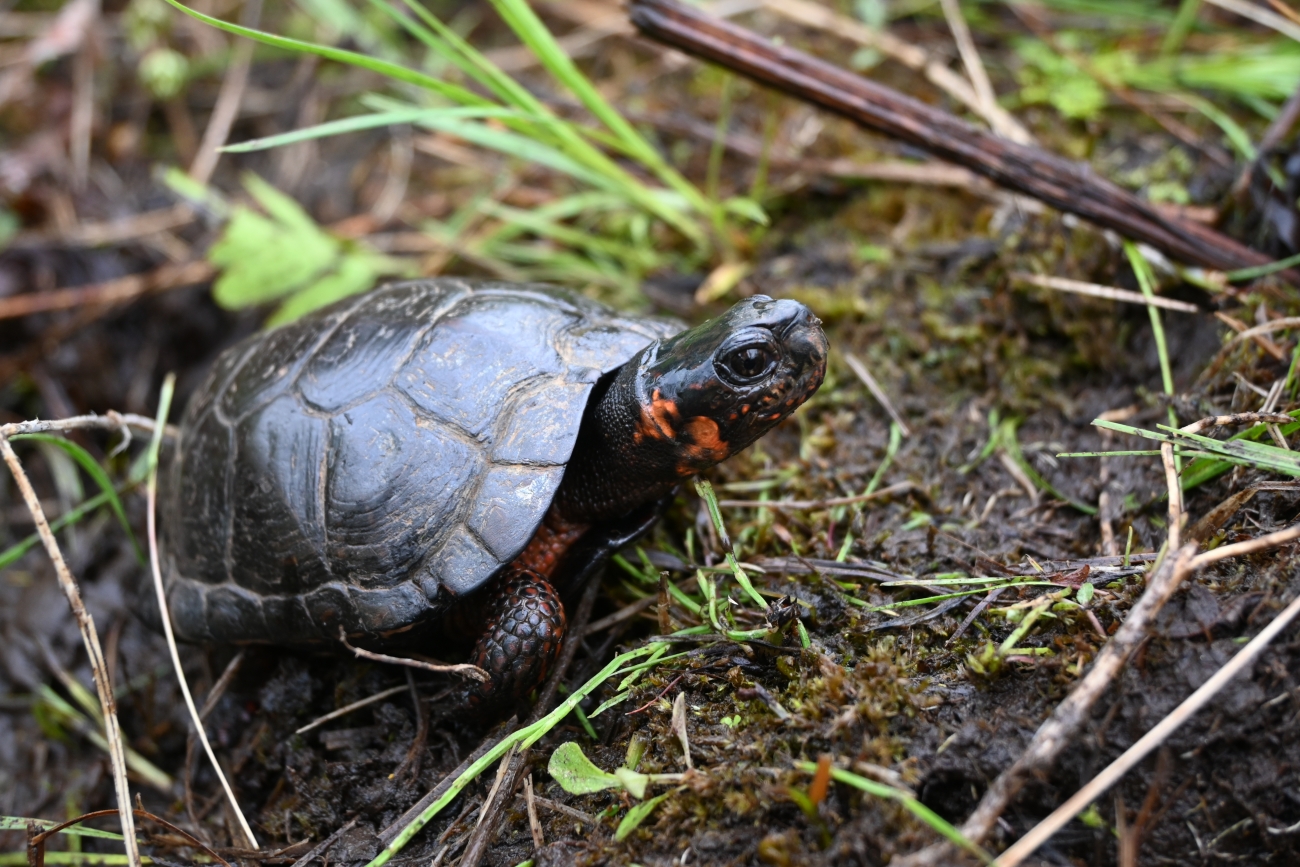
Eleven species of non-marine turtles are known to occur in Delaware. Seven of these species are considered SGCN in the state. All of Delaware’s SGCN turtles are listed as RSGCN except the Striped Mud Turtle (Kinosternon baurii).
The Bog Turtle is a small, semi-aquatic turtle that inhabits freshwater wetland habitats that have soft muck and pedestal vegetation. Unfortunately, the species is in trouble due to loss of habitat, wetland alteration, and illegal collection for the pet trade. The U.S. Fish and Wildlife Service listed the northern population as federally threatened in 1997, with a recovery plan prepared for the northern population in 2001 (USFWS 2001) and a conservation plan developed in 2019 (Erb 2019). There are only two known locations in Delaware where Bog Turtles are reproducing.
The DFW Wildlife Species Conservation & Research Program has been monitoring Bog Turtles since 1992 and monitors known sites with trapping and radio telemetry to keep track of population status and evaluates potential new habitats to see if Bog Turtles are present. DFW also works with the Brandywine Zoo, a state-owned facility, to head-start hatchling Bog Turtles to augment populations.
Like the Bog Turtle, the Spotted Turtle (Clemmys guttata) is associated with wetlands and is generally found within 500 m of a wetland (Willey et al. 2002). Although far more widespread in Delaware than Bog Turtles, Spotted Turtles remain a species of concern due to habitat loss and illegal collection for the pet trade.
Diamondback Terrapins, once a seasonal food item across Delmarva, are no longer routinely trapped for food, but continue to face beach development, bulk-heading and traffic as major threats to their breeding areas. The DNREC DPR and DFW erected turtle fencing to minimize road mortality during the nesting season along the busy barrier beach highway at Delaware Seashore State Park. Nesting habitat was also added to the bayside of the highway to deter females from crossing the road.
All five species of sea turtles known from Delaware waters were identified as SGCN in Delaware. All are included on the RSGCN list except the Hawksbill Sea Turtle (Eretmochelys imbricata). Because of their broad distributions, but significant range-wide declines, sea turtles are considered to be a low regional responsibility, but of very high conservation concern in the Northeast. Information about their distribution, abundance, migratory movements, and population characteristics are collected by USFWS, National Marine Fisheries Service (NMFS), and other partners to implement actions identified in the species’ Federal Recovery Plans.
Sea turtles visit Delaware’s estuarine and marine waters during the warmer months (June through October). The Delaware Estuary has an abundance of benthic invertebrates, which are the primary prey for Loggerhead (Caretta caretta), Kemp’s Ridley (Lepidochelys kempii), and juvenile Green Sea Turtles (Chelonia mydas). Because Leatherback Sea Turtles (Dermochelys coriacea) feed primarily upon jellyfish, their occurrence in Delaware waters is more pelagic although sightings in the lower Delaware Bay have occurred, likely tied to jellyfish blooms.
In the Delaware Bay, loggerheads occur in the greatest number, and the estuary provides important developmental habitat for juveniles. The estuary may be equally important for adults as evidenced by satellite-tagged individuals that travelled to Delaware Bay and set up “home ranges,” some staying as long as several months before heading offshore or southward when water temperatures begin dropping in the fall (Martin 2010). Survey data compiled from 1996-1997 indicate that a high density (21-33 animals/100 km2) of turtles, primarily loggerheads, are found in the Delaware Bay during the summer (Spotila et al. 2007).
Research indicates that Loggerhead Sea Turtles have an apparent affinity for channel habitat in other estuarine and near shore habitats along the U.S. Atlantic Coast (Byles 1988). This makes them vulnerable to ship strikes and channel dredging activities. Baseline data is needed on sea turtles in Delaware, especially with regard to periods of peak abundance, population size and habitat usage.
Although sea turtle nesting events in Delaware are rare, two species of sea turtles have nested on Delaware beaches in recent years. In 2011, a green sea turtle nested at Cape Henlopen State Park, and in 2018 a loggerhead nested in Fenwick Island. Historically, the loggerhead was the only known sea turtle to nest in Delaware with a single known nest in Bethany Beach in 1972. Loggerhead Sea Turtles have also nested in adjacent states such as Maryland and New Jersey, and in 2018 a Kemp’s Ridley nested on Long Island, NY. While several of these nests were naturally successful, some have needed human intervention through protection and monitoring to ensure turtle hatchlings found their way to the ocean. Delaware State Parks owns and maintains approximately half of the Delaware’s Atlantic coastline, while the remainder is mostly developed. Most of the State Park beaches allow surf fishing where fisherman can drive off road vehicles up and down the beach. Off road vehicles can leave behind a mosaic of wheel ruts that can trap turtle hatchlings leaving them to desiccate in the hot sun or get run over by vehicles. In addition, the developed portions of the coast emit light pollution that can disorient sea turtles, including hatchlings. Therefore, future sea turtle nesting events in Delaware will likely need some level of protection and/or monitoring to ensure nesting success.
Related Topics: action plan, conservation, draft, fish and wildlife, habitat, plan, species, wildlife
Delaware's Governor
State Agencies
Elected Officials
General Assembly
Delaware Courts
State Employees
Cities & Towns
Delaware State Code
State Regulations
Business First Steps
Phone Directory
Locations Directory
Public Meetings
Voting & Elections
Transparency
Health Insurance
Tax Center
Personal Income Tax
Privacy Policy
Weather & Travel
Contact Us
Corporations
Franchise Tax
Gross Receipts Tax
Withholding Tax
Delaware Topics
Help Center
Mobile Apps
E-mail / Text Alerts
Social Media


Built by the Government Information Center
©MMXXVI Delaware.gov