DNREC Menu

Invertebrates account for an exceptionally large proportion of the biodiversity of Delaware. In Pennsylvania, where invertebrate species numbers have been quantified, Rawlins and Bier estimate that invertebrates make up 53.2% of the state’s species diversity, with plants, algae, fungi, and lichens accounting for 40%, and vertebrate animals only 3.2%. Among invertebrates, the vast majority are insects (Rawlins and Bier, n.d.). Although published estimates do not exist for Delaware, the proportions are likely similar. Additional information needs have been recognized and presented as conservation actions to better quantify and understand Delaware’s invertebrate fauna. Of the more than 1700 invertebrate species documented from the state, 365 species are considered as SGCN, including 318 insects, 11 freshwater mussels, 27 freshwater and terrestrial snails and 9 estuarine/marine invertebrates.

There are more than 163,000 species of insects in the U.S. and Canada, but much of this incredible diversity is not yet understood. In adjacent Pennsylvania, insects alone make up an estimated 45.8% of all species in the state, plant or animal, and 76.3% of animal species (Rawlins and Bier, n.d.) The numbers are likely similar in Delaware. Despite this tremendous dominance in terms of biodiversity, the ecology, distribution, and habitat associations of most species remain poorly known.
Highly specialized relationships between insects and host plants can render some insects highly vulnerable to extinction should the host decline. It is presumed, for example, that at least two species of moths have become extinct due to the loss of the American Chestnut (Dunn 2005). Similar risks exist for species dependent on plants threatened by invasive species, such as ashes (Fraxinus sp.), which may decline in Delaware in the near future because of Emerald Ash Borer invasion. Pollinators are dependent on sufficient diversity and abundance of host plants for pollen and nectar, and these relationships are also becoming threatened due to habitat loss, invasive species, climate change, pesticides, and other factors.
Declines in pollinator populations are poorly understood in most cases, with potential contributing factors including intensification of agricultural practices, use of certain pesticides, and habitat loss and degradation. Climate change is also expected to pose additional challenges to pollinator populations, including decoupling of plant-pollinator interactions when plants and pollinators respond differently to climate cues. Some bumblebees, particularly Bombus affinis in the east, have experienced declines or range retractions because of the apparent spread of parasites accidentally introduced from European bees used in hothouse tomato production. At least 4 bumblebee species (Bombus affinis, Bombus ashtoni, Bombus fraternus, Bombus variabilis) have been extirpated from Delaware. The American Bumblebee (Bombus pennsylvanicus) was petitioned for listing under the ESA in 2021. A status review of this species is underway to determine whether the petitioned actions are warranted.
Most pollinator species are invertebrates and are mostly insects. Major pollinator groups in the Northeast include social and solitary bees, certain groups of solitary wasps, hoverflies, as well as many other fly species, beetles, butterflies, and moths. The Xerces Society has published a Red List of Native Bees in Decline (Xerces Society 2014). The Heinz Center (2013) has prepared guidance for incorporating information about the conservation of animal pollinators into Wildlife Action Plans.
Dragonflies and damselflies are relatively well known in Delaware, thanks to the efforts of H.B. White, whose Natural History of Delmarva Dragonflies and Damselflies (2011) presents a series of essays on all species known to occur on the peninsula as well as a county distribution checklist.
The regional status and habitat associations of northeastern odonates were assessed by White et al. (2014). Two hundred twenty-eight species of odonates are known from the northeast region, an area that is widely considered to be a “hotspot” for odonate diversity, and 130 of those species are known to occur on the Delmarva Peninsula.
Seventy-eight (78) species are included on the SGCN list for Delaware, ranging from common species for which the Northeast has high conservation responsibility, to rare species, as well as many species that are at the edge of their ranges in the state. Several species, such as the Elfin Skimmer and the Sable Clubtail are state Endangered species.
A worldwide assessment of the conservation status of odonates conducted by Clausnitzer et al. (2009) found that only about 1 in 10 odonates are currently threatened with extinction according to IUCN criteria, a relatively low percentage compared to other taxa. Peatlands, low gradient streams and seeps, high gradient headwaters, and larger rivers are habitats that harbor a disproportionate number of imperiled species in our region and should be considered priority habitat types for conservation, monitoring, and management (White et al. 2014). In fact, Collins and McIntyre (2017) found that future climate change will significantly impact the range of all 15 northeastern lotic species in his climate modeling study, even assuming unlimited dispersal.
| Common Name | Scientific Name | Tier |
|---|---|---|
| Blue-ringed Dancer | Argia sedula | Assessment Priority |
| Dot-tailed Whiteface | Leucorrhinia intacta | Assessment Priority |
| Duckweed Firetail | Telebasis byersi | Assessment Priority |
| Sedge Sprite | Nehalennia irene | Assessment Priority |
| Seepage Dancer | Argia bipunctulata | Assessment Priority |
| Yellow-sided Skimmer | Libellula flavida | Assessment Priority |
| Amber-winged Spreadwing | Lestes eurinus | Tier 1 |
| Arrow Clubtail | Stylurus spiniceps | Tier 1 |
| Ashy Clubtail | Phanogomphus lividus | Tier 1 |
| Aurora Damsel | Chromagrion conditum | Tier 1 |
| Azure Bluet | Enallagma aspersum | Tier 1 |
| Banner Clubtail | Hylogomphus apomyius | Tier 1 |
| Big Bluet | Enallagma durum | Tier 1 |
| Black-shouldered Spinyleg | Dromogomphus spinosus | Tier 1 |
| Black-tipped Darner | Aeshna tuberculifera | Tier 1 |
| Brown Spiketail | Cordulegaster bilineata | Tier 1 |
| Burgundy Bluet | Enallagma dubium | Tier 1 |
| Calico Pennant | Celithemis elisa | Tier 1 |
| Clamp-tipped Emerald | Somatochlora tenebrosa | Tier 1 |
| Comet Darner | Anax longipes | Tier 1 |
| Delta-spotted Spiketail | Cordulegaster diastatops | Tier 1 |
| Double-ringed Pennant | Celithemis verna | Tier 1 |
| Dusky Dancer | Argia translata | Tier 1 |
| Eastern Red Damsel | Amphiagrion saucium | Tier 1 |
| Elegant Spreadwing | Lestes inaequalis | Tier 1 |
| Elfin Skimmer | Nannothemis bella | Tier 1 |
| Fawn Darner | Boyeria vinosa | Tier 1 |
| Green-striped Darner | Aeshna verticalis | Tier 1 |
| Harlequin Darner | Gomphaeschna furcillata | Tier 1 |
| Illinois River Cruiser | Macromia illinoiensis | Tier 1 |
| Lancet Clubtail | Phanogomphus exilis | Tier 1 |
| Laura's Clubtail | Stylurus laurae | Tier 1 |
| Least Clubtail | Stylogomphus albistylus | Tier 1 |
| Lilypad Forktail | Ischnura kellicotti | Tier 1 |
| Little Blue Dragonlet | Erythrodiplax minuscula | Tier 1 |
| Martha's Pennant | Celithemis martha | Tier 1 |
| Midland Clubtail | Gomphurus fraternus | Tier 1 |
| Painted Skimmer | Libellula semifasciata | Tier 1 |
| Pale Bluet | Enallagma pallidum | Tier 1 |
| Robust Baskettail | Epitheca spinosa | Tier 1 |
| Ruby Meadowhawk | Sympetrum rubicundulum | Tier 1 |
| Sable Clubtail | Stenogomphurus rogersi | Tier 1 |
| Seaside Dragonlet | Erythrodiplax berenice | Tier 1 |
| Selys' Sundragon | Helocordulia selysii | Tier 1 |
| Skimming Bluet | Enallagma geminatum | Tier 1 |
| Slender Bluet | Enallagma traviatum | Tier 1 |
| Slender Spreadwing | Lestes rectangularis | Tier 1 |
| Southern Pygmy Clubtail | Lanthus vernalis | Tier 1 |
| Spangled Skimmer | Libellula cyanea | Tier 1 |
| Spatterdock Darner | Rhionaeschna mutata | Tier 1 |
| Sphagnum Sprite | Nehalennia gracilis | Tier 1 |
| Spotted Spreadwing | Lestes congener | Tier 1 |
| Springtime Darner | Basiaeschna janata | Tier 1 |
| Stream Cruiser | Didymops transversa | Tier 1 |
| Stripe-winged Baskettail | Epitheca costalis | Tier 1 |
| Swamp Spreadwing | Lestes vigilax | Tier 1 |
| Sweetflag Spreadwing | Lestes forcipatus | Tier 1 |
| Taper-tailed Darner | Gomphaeschna antilope | Tier 1 |
| Tiger Spiketail | Cordulegaster erronea | Tier 1 |
| Treetop Emerald | Somatochlora provocans | Tier 1 |
| Turquoise Bluet | Enallagma divagans | Tier 1 |
| Twin-spotted Spiketail | Cordulegaster maculata | Tier 1 |
| Umber Shadowdragon | Neurocordulia obsoleta | Tier 1 |
| Unicorn Clubtail | Arigomphus villosipes | Tier 1 |
| Vesper Bluet | Enallagma vesperum | Tier 1 |
| Atlantic Bluet | Enallagma doubledayi | Tier 2 |
| Attenuated Bluet | Enallagma daeckii | Tier 2 |
| Band-winged Meadowhawk | Sympetrum semicinctum | Tier 2 |
| Black Spotted Skimmer | Celithemis fasciata | Tier 2 |
| Blackwater Bluet | Enallagma weewa | Tier 2 |
| Golden-winged Skimmer | Libellula auripennis | Tier 2 |
| Great Spreadwing | Archilestes grandis | Tier 2 |
| Needham's Skimmer | Libellula needhami | Tier 2 |
| Royal River Cruiser | Macromia taeniolata | Tier 2 |
| Southern Spreadwing | Lestes australis | Tier 2 |
| Southern Sprite | Nehalennia integricollis | Tier 2 |
| Sparkling Jewelwing | Calopteryx dimidiata | Tier 2 |
| Cherry-faced Meadowhawk | Sympetrum internum | Tier 3 |
| Common Name | Scientific Name | Tier |
|---|---|---|
| Aaron's Skipper | Poanes aaroni | Assessment Priority |
| American Snout | Libytheana carinenta | Assessment Priority |
| Aphrodite Fritillary | Argynnis aphrodite | Assessment Priority |
| Brown Elfin | Callophrys augustinus | Assessment Priority |
| Carolina Roadside-skipper | Amblyscirtes carolina | Assessment Priority |
| Checkered White | Pontia protodice | Assessment Priority |
| Dreamy Duskywing | Erynnis icelus | Assessment Priority |
| Eyed Brown | Lethe eurydice | Assessment Priority |
| Gold-banded Skipper | Telegonus cellus | Assessment Priority |
| Gray Comma | Polygonia progne | Assessment Priority |
| Hayhurst's Scallopwing | Staphylus hayhurstii | Assessment Priority |
| Henry's Elfin | Callophrys henrici | Assessment Priority |
| Hobomok Skipper | Poanes hobomok | Assessment Priority |
| Indian Skipper | Hesperia sassacus | Assessment Priority |
| Lace-winged Roadside-skipper | Amblyscirtes aesculapius | Assessment Priority |
| Little Glassywing | Vernia verna | Assessment Priority |
| Meadow Fritillary | Boloria bellona | Assessment Priority |
| Mottled Duskywing | Erynnis martialis | Assessment Priority |
| Sleepy Dusky Wing | Erynnis brizo brizo | Assessment Priority |
| Wild Indigo Duskywing | Erynnis baptisiae | Assessment Priority |
| Regal Fritillary | Argynnis idalia | Extirpated |
| Appalachian Azure | Celastrina neglectamajor | Tier 1 |
| Baltimore Checkerspot | Euphydryas phaeton | Tier 1 |
| Black Dash | Euphyes conspicua | Tier 1 |
| Chermock's Mulberry Wing | Poanes massasoit chermocki | Tier 1 |
| Cobweb Skipper | Hesperia metea | Tier 1 |
| Frosted Elfin | Callophrys irus | Tier 1 |
| Hessel's Hairstreak | Callophrys hesseli | Tier 1 |
| King's Hairstreak | Satyrium kingi | Tier 1 |
| Monarch | Danaus plexippus | Tier 1 |
| Mulberry Wing | Poanes massasoit massasoit | Tier 1 |
| Rare Skipper | Problema bulenta | Tier 1 |
| Bronze Copper | Tharsalea hyllus | Tier 2 |
| Dion Skipper | Euphyes dion | Tier 2 |
| Dusted Skipper | Atrytonopsis hianna | Tier 2 |
| Great Purple Hairstreak | Atlides halesus | Tier 2 |
| Harvester | Feniseca tarquinius | Tier 2 |
| Myrina Fritillary | Boloria selene myrina | Tier 2 |
| Pipevine Swallowtail | Battus philenor | Tier 2 |
| Silver-bordered Fritillary | Boloria selene | Tier 2 |
| Southern Broken-dash | Polites otho | Tier 2 |
| Striped Hairstreak | Satyrium liparops strigosa | Tier 2 |
| Striped Hairstreak | Satyrium liparops | Tier 2 |
| Tawny Emperor | Asterocampa clyton | Tier 2 |
| Delaware Skipper | Anatrytone logan | Tier 3 |
| Hackberry Emperor | Asterocampa celtis | Tier 3 |
| Juniper Hairstreak | Callophrys gryneus | Tier 3 |
Forty-seven of the approximately 105 species of butterflies and skippers that occur or have occurred historically in Delaware are considered SGCN. Many Delaware SGCN are associated with relatively rare small-patch habitats such as Piedmont seepage meadows and xeric sand ridge openings. A butterfly of herbaceous wetlands is the Baltimore Checkerspot, a Tier 1 species.
Butterflies of the families Hesperiidae and Lycaenidae occur in large numbers on the regional and state SGCN lists because many species in these families are small-bodied, relatively weak fliers with very specific host plant requirements, or they have other narrow ecological specializations such as association with specific vegetation communities. In addition, the larvae of many species of Lycaenidae participate in symbiotic relationships with ants, so that both the larval host plant and suitable ant partners must be available for the species to thrive.

Beginning in the 1990s, researchers have documented a steady decline in Monarch Butterfly (Danaus plexippus) numbers. A primary threat to the Monarch Butterfly is a decline in populations of milkweed, the primary food plant required by caterpillars. The decline in milkweed is partially due to the reduction of open habitats, but in the Midwest, losses are mostly due to the dramatic increase in use of the herbicide Roundup (glyphosate), which has been associated with the mass-planting of genetically modified herbicide resistant corn and soy (Pleasants and Oberhauser 2012). In addition, the widespread use of systemic insecticides such as neonicotinoids within the breeding range of the Monarch poses a considerable threat; illegal logging of fir forests in Mexico has reduced wintering habitat; and extreme weather events in the eastern U.S. may be negatively impacting Monarchs. In 2020 the USFWS developed a species status assessment (SSA) for the Monarch Butterfly and determined that listing it as endangered or threatened was warranted but precluded by higher priority species. After assessing new information on the species submitted after 2020, USFWS updated the SSA in 2024 to reflect new information on the species and proposed listing the Monarch as threatened under the ESA (USFWS 2024).
In recognition of the decline in Monarch Butterflies, the Monarch Joint Venture (MJV) was initiated in 2008 as a partnership of federal agencies, state agencies, non-governmental organizations, and academic programs working together to protect the Monarch and its annual, long-distance migration. Guided by the Monarch Conservation Implementation Plan that is updated annually, the MJV is taking a science-based approach to address conservation issues for Monarchs. The MJV promotes Monarchs as a flagship species whose conservation will sustain habitats for pollinators and other plants and animals. For more information about MJV: http://www.monarchjointventure.org/.

In 2018, the USFWS conducted an interim SSA on the Frosted Elfin (Callophrys irus) and since 2019 has coordinated range-wide surveys with state agencies and other partner organizations to see if they still occur at historical locations. From 2019 through 2024, surveys conducted in Delaware resulted in no observations of this species at any sites they once occurred. Although the habitat for the Frosted Elfin still occurs in Delaware and is actively managed for this species and its host plant, the Frosted Elfin is likely extirpated from the state.
| Common Name | Scientific Name | Tier |
|---|---|---|
| A Prominent Moth | Heterocampa astarte | Assessment Priority |
| Alabama Underwing | Catocala alabamae | Assessment Priority |
| An Underwing Moth | Catocala carissima | Assessment Priority |
| Ash Borer Moth | Papaipema furcata | Assessment Priority |
| Ash Sphinx | Manduca jasminearum | Assessment Priority |
| Black Alder Or Pawpaw Sphinx | Dolba hyloeus | Assessment Priority |
| Black-etched Prominent | Cerura scitiscripta | Assessment Priority |
| Buffalo Moth | Parapamea buffaloensis | Assessment Priority |
| Colona Moth | Haploa colona | Assessment Priority |
| Connected Dagger Moth | Acronicta connecta | Assessment Priority |
| Eastern Buckmoth | Hemileuca maia | Assessment Priority |
| Eastern Cactus-boring Moth | Melitara prodenialis | Assessment Priority |
| Eupatorium Borer Moth | Papaipema eupatorii | Assessment Priority |
| Four-lined Chocolate Moth | Argyrostrotis quadrifilaris | Assessment Priority |
| Franck's Sphinx | Sphinx franckii | Assessment Priority |
| Galium Sphinx | Hyles gallii | Assessment Priority |
| Great Ash Sphinx | Sphinx chersis | Assessment Priority |
| Grote's Sallow | Copivaleria grotei | Assessment Priority |
| Huckleberry Sphinx | Paonias astylus | Assessment Priority |
| Imperial Moth | Eacles imperialis | Assessment Priority |
| Inconsolable Underwing | Catocala insolabilis | Assessment Priority |
| Kentucky Lichen Moth | Cisthene kentuckiensis | Assessment Priority |
| Lettered Sphinx | Deidamia inscriptum | Assessment Priority |
| Lintner's Gluphisia Moth | Gluphisia lintneri | Assessment Priority |
| Little Underwing | Catocala minuta | Assessment Priority |
| Loosestrife Borer Moth | Papaipema lysimachiae | Assessment Priority |
| Louisiana Owlet Moth | Macrochilo louisiana | Assessment Priority |
| Masked Parahypenodes Moth | Parahypenodes quadralis | Assessment Priority |
| Mayapple Borer Moth | Papaipema rutila | Assessment Priority |
| Mother Underwing | Catocala parta | Assessment Priority |
| Once-married Underwing | Catocala unijuga | Assessment Priority |
| Phyllira Tiger Moth | Apantesis phyllira | Assessment Priority |
| Pink Spotted Hawkmoth | Agrius cingulata | Assessment Priority |
| Rigid Sunflower Borer Moth | Papaipema rigida | Assessment Priority |
| Ruddy Dagger Moth | Acronicta rubricoma | Assessment Priority |
| Scribbled Sallow Moth | Sympistis perscripta | Assessment Priority |
| Small Tolype Moth | Tolype notialis | Assessment Priority |
| Southern Oak Dagger Moth | Acronicta increta | Assessment Priority |
| Streaked Dagger Moth | Acronicta lithospila | Assessment Priority |
| Sweetfern Underwing | Catocala antinympha | Assessment Priority |
| The Betrothed Underwing | Catocala innubens | Assessment Priority |
| Thin-Banded Lichen Moth | Cisthene tenuifascia | Assessment Priority |
| Three-lined Flower Moth | Schinia trifascia | Assessment Priority |
| Trumpet Vine Sphinx | Paratrea plebeja | Assessment Priority |
| Umbellifer Borer Moth | Papaipema insulidens | Assessment Priority |
| Walnut Sphinx | Amorpha juglandis | Assessment Priority |
| Waved Sphinx | Ceratomia undulosa | Assessment Priority |
| White-tailed Diver Moth | Bellura gortynoides | Assessment Priority |
| Wild Indigo Borer Moth | Papaipema baptisiae | Assessment Priority |
| Yellow Banded Underwing | Catocala cerogama | Assessment Priority |
| Yellow Sedge Borer Moth | Globia subflava | Assessment Priority |
| Chestnut Clearwing Moth | Synanthedon castaneae | Extirpated |
| Aralia Shoot Borer Moth | Papaipema araliae | Tier 1 |
| Brick-red Borer Moth | Papaipema marginidens | Tier 1 |
| Coneflower Borer Moth | Papaipema nelita | Tier 1 |
| Dark Stoneroot Borer Moth | Papaipema duplicatus | Tier 1 |
| Dejected Underwing | Catocala dejecta | Tier 1 |
| Fir Tussock Moth | Orgyia detrita | Tier 1 |
| Graphic Moth | Drasteria graphica | Tier 1 |
| Gray-banded Zale Moth | Zale squamularis | Tier 1 |
| Hop Borer | Papaipema circumlucens | Tier 1 |
| Marbled Underwing | Catocala marmorata | Tier 1 |
| Maritime Sunflower Borer Moth | Papaipema maritima | Tier 1 |
| Northern Flower Moth | Schinia septentrionalis | Tier 1 |
| Osmunda Borer Moth | Papaipema speciosissima | Tier 1 |
| Pitcher Plant Borer Moth | Papaipema appassionata | Tier 1 |
| Pitcher Plant Moth | Exyra fax | Tier 1 |
| Slender Clearwing | Hemaris gracilis | Tier 1 |
| Southern Pine Looper Moth | Caripeta aretaria | Tier 1 |
| Spinose Flower Moth | Schinia spinosae | Tier 1 |
| Straight-lined Pero Moth | Pero zalissaria | Tier 1 |
| The Starry Campion Moth | Hadena ectypa | Tier 1 |
| Thin-winged Owlet Moth | Nigetia formosalis | Tier 1 |
| Ulalume Underwing | Catocala ulalume | Tier 1 |
| Wild Cherry Sphinx | Sphinx drupiferarum | Tier 1 |
| Yellow Stoneroot Borer | Papaipema astuta | Tier 1 |
| An Arctiid Moth | Lophocampa caryae | Tier 2 |
| Angle Winged Emerald Moth | Chloropteryx tepperaria | Tier 2 |
| Canadian Owlet | Calyptra canadensis | Tier 2 |
| Chain Fern Borer Moth | Papaipema stenocelis | Tier 2 |
| Clouded Underwing | Catocala nebulosa | Tier 2 |
| Cypress Looper | Iridopsis pergracilis | Tier 2 |
| Delightful Bird-dropping Moth | Tarache delecta | Tier 2 |
| Dull Reddish Dart Moth | Xestia dilucida | Tier 2 |
| Exiled Dagger Moth | Acronicta exilis | Tier 2 |
| Habilis Underwing | Catocala habilis | Tier 2 |
| Hermit Sphinx | Lintneria eremitus | Tier 2 |
| Hubner's Pero Moth | Pero ancetaria | Tier 2 |
| Obscure Underwing | Catocala obscura | Tier 2 |
| Pine Feeding Zale | Zale metatoides | Tier 2 |
| Praeclara Underwing | Catocala praeclara | Tier 2 |
| Residua Underwing | Catocala residua | Tier 2 |
| Rustic Sphinx | Manduca rustica | Tier 2 |
| Sad Underwing | Catocala maestosa | Tier 2 |
| Southern Pine Sphinx | Lapara coniferarum | Tier 2 |
| Tearful Underwing | Catocala lacrymosa | Tier 2 |
| Umber Underwing | Catocala umbrosa | Tier 2 |
| Wonderful Underwing | Catocala mira | Tier 2 |
| A Noctuid Moth | Agnorisma bollii | Tier 3 |
| A Zale Moth | Zale metata | Tier 3 |
| Atlantic Graphic Moth | Drasteria graphica atlantica | Tier 3 |
| Bracken Borer Moth | Papaipema pterisii | Tier 3 |
| Goldenrod Stowaway Moth | Cirrhophanus triangulifer | Tier 3 |
| Hydrangea Sphinx | Darapsa versicolor | Tier 3 |
| Mournful Underwing | Catocala flebilis | Tier 3 |
| Nessus Sphinx | Amphion floridensis | Tier 3 |
| Obtuse Yellow Moth | Azenia obtusa | Tier 3 |
| Sensitive Fern Borer Moth | Papaipema inquaesita | Tier 3 |
| Yellow Three-Spot Moth | Apamea helva | Tier 3 |
Although there have been no known systematic statewide surveys for moths in Delaware, there have been some localized or species-specific surveys conducted by DFW, other professional entomologists, and useful observations by other naturalists. In addition, there are also research-grade observations in iNaturalist that, if vetted, could be added to the growing list of moth species occurring in the state. Currently, more than one thousand species of moths have been documented in Delaware, with some groups receiving greater attention than others. One hundred and nine species of moths were identified as SGCN in Delaware.
The nocturnal Macrolepidoptera (“larger moths”) of Delaware have been studied in by Heckscher, Gonzon, and others. Still, much of our data is based on regional sources. Important studies by Tuttle (2007), Schweitzer et al. (2011), and Wagner et al. (2011) have greatly improved the readily accessible body of knowledge on northeastern macromoth species of conservation interest.
The larvae of moths in the genus Papaipema (family Noctuidae) bore into the stems and tubers of plants and many are specific to a particular species of plant. Host specificity has resulted in many species becoming rare due to the decline of their host plant. A survey of Brandywine Creek State Park (New Castle County) by Heckscher and Schweitzer (unpublished data) found that the meadow Papaipema fauna was largely intact while the forest understory fauna was mostly depauperate probably due to deer over-browse, non-native earthworms, and non-native plant species. The family of sphinx or hawk moths (family Sphingidae) includes several well-known agricultural pests as well as several rare and declining species. Certain hawk moths are active during the day, and many species can be important pollinators of flowers with long, tubular corollas.
Giant silkworm moths (family Saturniidae) are among the most colorful and spectacular species of Lepidoptera in the world and several of the largest and most beautiful species have recently declined across the Northeast. These declines have been anecdotally attributed to increased spraying of chemicals for mosquitoes and other pest control and to increased anthropogenic light pollution, which disrupts the normal nocturnal flight patterns of these insects. The buck moth (Hemileuca maia) is a diurnal silkworm moth closely associated with scrub oak that primarily occurs in serpentine barrens where this oak often dominates the understory. The Buck Moth has experienced notable declines in the northeast due to habitat loss.
The Catocala (underwing) moths are among the most impressive and most species-rich Noctuidae groups in eastern North America. Many species are designated Delaware SGCN due to their dependency on specific host plants that may be uncommon. For example, several species are dependent upon Shagbark Hickory (Carya ovata) which is uncommon in the state outside the Red Clay Creek valley. Other reasons for rarity in this moth group include Delaware’s position at the northern or southern edge of the natural range of several species. Xeric or semi-xeric sand ridges and forests in Sussex County are scattered but highly threatened by development. These forests are often hickory-rich, providing important concentrations of Coastal Plain Catocala populations. Similarly, mesic hardwood forests of the Piedmont often support a mix of several hickory species providing a rich Catocala fauna including some regionally uncommon species. Salicaceae-feeding species may be threatened by SLR including Catocala carissima.
Summerville and Crist (2002) and Summerville (2004) in the U.S., along with Pavlikova and Konvicka (2011) in Europe, have shown that classification of moth functional groups by life form of the larval food source is useful in predicting responses to habitat change.
| Common Name | Scientific Name | Tier |
|---|---|---|
| Bronze Tiger Beetle | Cicindela repanda | Assessment Priority |
| Cow Path Tiger Beetle | Cicindela purpurea | Assessment Priority |
| Eastern Red-bellied Tiger Beetle | Cicindela rufiventris rufiventris | Assessment Priority |
| Eastern Sand Tiger Beetle | Cicindela formosa generosa | Assessment Priority |
| Northern Barrens Tiger Beetle | Cicindela patruela | Assessment Priority |
| Oblique-lined Tiger Beetle | Cicindela tranquebarica | Assessment Priority |
| Twelve-spotted Tiger Beetle | Cicindela duodecimguttata | Assessment Priority |
| Virginia Big-headed Tiger Beetle | Tetracha virginica | Assessment Priority |
| New Jersey Pine Barrens Tiger Beetle | Cicindela patruela consentanea | Extirpated |
| Eastern Beach Tiger Beetle | Habroscelimorpha dorsalis | Tier 1 |
| Eastern Pinebarrens Tiger Beetle | Cicindela abdominalis | Tier 1 |
| Little White Tiger Beetle | Ellipsoptera lepida | Tier 1 |
| White Tiger Beetle | Habroscelimorpha dorsalis media | Tier 1 |
| Beach-dune Tiger Beetle | Cicindela hirticollis | Tier 2 |
| Festive Tiger Beetle | Cicindela scutellaris | Tier 2 |
| Margined Tiger Beetle | Ellipsoptera marginata | Tier 2 |
| One-spotted Tiger Beetle | Cylindera unipunctata | Tier 2 |
| Eastern Red-bellied Tiger Beetle | Cicindela rufiventris | Tier 3 |
Tiger beetles are a group of highly active, predatory beetles that have been variously classified as either a subfamily (Cicindelinae) within the larger family Carabidae, or a separate family Cicindelidae. The Northeast RSGCN list includes eight tiger beetle taxa. Several tiger beetle species remain common throughout the Northeast, including the Six-spotted Tiger Beetle (Cicindela sexguttata), Bronzed Tiger Beetle (Cicindela repanda), and Punctate Tiger Beetle (Cicindelidia punctulata), which can be found in many urban and suburban areas. Eighteen species are considered SGCN in Delaware.
Sympatric tiger beetle species (those that occur together in the same habitat) and their larvae are often closely associated with particular microhabitats, especially exposures of different soil types, such as sand or clay (Schultz 1989). Distinct thermal microhabitat preferences have also been described for oviposition (Hoback et al. 2000) and adult activity (Schultz 1998). These specializations make some species susceptible to habitat degradation that alters or eliminates their necessary microhabitats.
Several tiger beetle species are known to be in decline range wide. These include Cicindela patruela, a pine barrens and ridge-top barrens species that has been lost from many historical sites in the Northeast states, as well as Ellipsoptera lepida, a species that is associated with sand dunes and other open sandy areas across the central and eastern states. Knisely et al. (2014) reviews the conservation status of U.S. tiger beetle species.
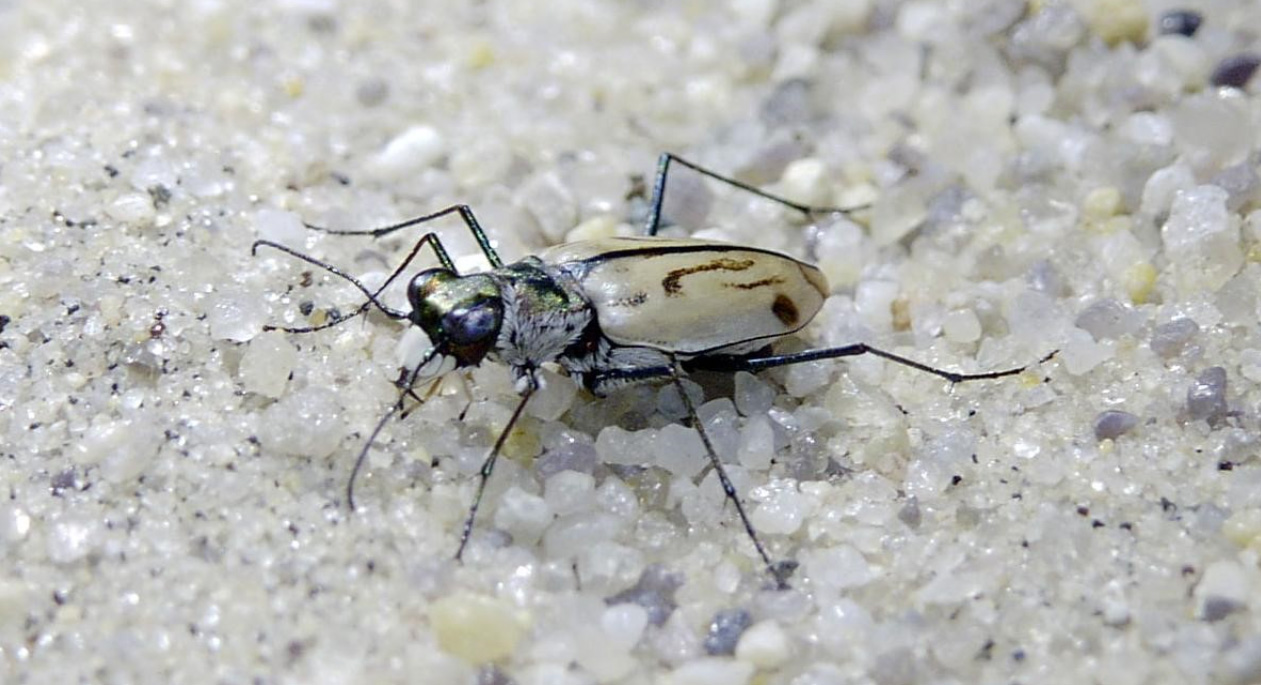
Certain guilds of tiger beetles are known to be at elevated risk for extirpation or even extinction. Population declines have been documented in many species of tiger beetles associated with ocean beaches, including two Northeast RSGCN, the federally listed Habroscelimorpha dorsalis dorsalis and its southern counterpart Habroscelimorpha dorsalis media. Beach-nesting tiger beetles have been found to be sensitive to compaction of sands resulting from human disturbance (Cornelisse 2009), a factor that has probably contributed to the widespread decline of Habroscelimorpha dorsalis. Whereas other beach-dependent species such as piping plover (a shorebird) leave Delaware’s beaches during the winter, tiger beetles spend their entire lives in this habitat and are vulnerable to vehicular use at all seasons. Habroscelimorpha dorsalis dorsalis was federally listed as Threatened in 1990, with a Recovery Plan drafted in 1994 (USFWS 1994).
Delaware’s SGCN tiger beetle list could potentially be expanded, and populations of conservation importance located, with additional survey effort. For example, the tiny pine barrens specialist Cicindelidia abdominalis is found at relatively few sites across the entire Northeast but has large populations in the New Jersey Pine Barrens and occurs on the Maryland portion of Delmarva. This species has been looked for by J. Davis and K. Heckscher in Sussex County, without success, but further inventory is warranted.
| Common Name | Scientific Name | Tier |
|---|---|---|
| A Firefly | Photuris versicolor | Assessment Priority |
| Marsh Diver Firefly | Pyractomena palustris | Assessment Priority |
| Marsh Imp Firefly | Pyractomena lucifera | Assessment Priority |
| Say's Firefly | Pyractomena angulata | Assessment Priority |
| A Firefly | Photuris mcavoyi | Tier 1 |
| Belted Firefly | Photuris cinctipennis | Tier 1 |
| Bethany Beach Firefly | Photuris bethaniensis | Tier 1 |
| Confusing Firefly | Photuris tremulans | Tier 1 |
| Dot-dash Firefly | Photuris pensylvanica | Tier 1 |
| Florida Sprite | Photinus floridanus | Tier 1 |
| Keel-necked Firefly | Pyractomena ecostata | Tier 1 |
| Mysterious Lantern Firefly | Photuris mysticalampas | Tier 1 |
| Pyralis-mimicking Firefly | Photuris pyralomima | Tier 1 |
| Salt Marsh Firefly | Photuris salina | Tier 1 |
| A Firefly | Photuris frontalis | Tier 2 |
| Cattail Flash-train Firefly | Photinus consimilis | Tier 2 |
| Long-range Firefly Beetle | Pyractomena dispersa | Tier 2 |
| A Glowworm | Photinus ignitus | Tier 3 |
The study of fireflies has a rich history in Delaware, thanks largely to pioneering work by Frank A. McDermott, a chemist who spent his retirement studying this family and, in the process, became one of only a few North American experts on the taxon. McDermott discovered a new firefly species near the town of Bethany Beach in 1946 and named it Photuris bethaniensis, the Bethany Beach Firefly (McDermott 1953). This species was petitioned for listing under the ESA in 2019 and was proposed for listing as threatened under the ESA in 2024. Once thought to be a Delaware endemic, Jason Davis, DFW biologist and biologists from the USFWS and Maryland DNR discovered the Bethany Beach firefly at Assateague Island National Seashore in 2020. In 2021, Virginia Natural Heritage staff discovered it at Chincoteague National Wildlife Refuge, Wallops Island, and False Cape State Park near Virginia Beach.
Three genera of nocturnal bioluminescent fireflies are widespread in North America: Photuris, Photinus, and Pyractomena. Of the three, the Photuris are the best understood in Delaware, largely because of the work of McDermott, Heckscher, and Davis, while elsewhere more is known about the distribution and abundance of Photinus than Photuris.

The Mysterious Lantern Firefly, Photuris mysticalampas, was discovered and described by Christopher M. Heckscher in 2013 (Heckscher 2013). Like Photuris bethaniensis, its range has expanded outside of Delaware and into Maryland due to increased survey effort. The recently described Photuris mcavoyi was first observed while searching for Bethany Beach Firefly in interdunal swales by James Lloyd in 1968. Lloyd named it Bethany BBB. It was later re-discovered by Hecksher in 1998, but it wasn’t until 2024 that Hecksher described this species and named it Photuris mcavoyi after Bill McAvoy, the Delaware state botanist. Due to its history as an epicenter for the study of North American fireflies, the distribution and abundance of many Delaware species are well known.
From the collections of McDermott, Pyractomena dispersa was described from the wetlands of the Beaver Valley of the upper Brandywine watershed (Green 1957). In addition, Photuris bethaniensis and Photuris mcavoyi were first described from Bethany Beach and Photuris mysticalampas and Photuris eliza from Phillips Landing. Photuris pennsylvanica is thought to have been first collected and described from the marshes of Wilmington, Delaware (McDermott 1967). Thus, six species have their type locality in Delaware: Pyractomena dispersa, Photuris bethaniensis, Photuris mysticalampas, Photuris pennsylvanica, Photuris mcavoyi, and Photuris eliza.
Most fireflies are associated with wetlands, as the soft-bodied larvae, better known as glowworms, might otherwise be susceptible to desiccation. Soil chemistry, microclimate (e.g., humidity, temperature), or prey items, might also limit the distribution of some species. Due to their affiliation with various threatened wetland types, several species are of high conservation concern. Photuris bethaniensis and Photuris mcavoyi are restricted to rare and threatened interdunal wetlands that occur within the back dunes along Delaware’s Atlantic coast (Heckscher and Bartlett 2004). Interdunal swales are threatened by sea level rise, climate change, coastal development, succession to woody plant species, and invasive plant species. Photuris mysticalampas and Photuris eliza are associated with forested peatland floodplains of high ecological quality in Sussex County (Heckscher 2013). Photuris pennsylvanica is associated with freshwater emergent and shrub wetlands that are usually tidally influenced (Heckscher 2010). All tidal freshwater wetlands are becoming increasingly threatened by sea level rise. Photuris salina and Pyractomena ecostata are both restricted to salt and brackish coastal marshes and therefore may be threatened by sea level rice, adulticides used for mosquito control, and the spread of the invasive Phragmites australis (Heckscher 2010; Heckscher and Lloyd 2015). All fireflies are suspected of being sensitive to pesticide application including those that occur in urban areas. Light pollution is a major threat to insects, especially fireflies, as it can obscure flashing used to communicate for mating. Studies show that light pollution can decrease occurrence, alter behavior, and decrease reproduction of mating fireflies. In general, many species seem to be in regional decline, especially representatives of the genus Pyractomena (Heckscher and Lloyd 2015). Seventeen species of fireflies were identified as SGCN in Delaware.
| Common Name | Scientific Name | Tier |
|---|---|---|
| Bifid Water Scavenger Beetle | Helocombus bifidus | Assessment Priority |
| Rasped Predaceous Diving Beetle | Agabetes acuductus | Assessment Priority |
| A Predaceous Diving Beetle | Hoperius planatus | Tier 1 |
| Seth Forest Scavenger Beetle | Hydrochus spangleri | Tier 1 |
Four species of freshwater beetles were identified as SGCN in Delaware. Water beetles reach high levels of diversity in isolated wetlands, especially vernal pools and Coastal Plain seasonal ponds. With a high density of these habitat types, Delaware, and the Delmarva Peninsula as a whole, are likely a “hotspot” for water beetle diversity. The absence of fish is a major factor influencing community composition and abundance of water beetles in pond habitats (Fairchild et al. 2000).
The Seth Forest Water Scavenger Beetle (Hydrochus spangleri), a globally critically imperiled beetle known from a single wetland in Maryland since the 1970s, was subsequently found to inhabit a handful of similar sites in the northern part of the Delmarva peninsula, including New Castle County, Delaware (Steiner et al. 2003). Surveys by McIntosh and Short (2012) revealed the continuing occurrence of the species in two small and densely forested vernal pools in northern Delaware.
The primary threat to water beetles is the residential and commercial development of the unprotected, isolated wetlands in which they occur, as well as the surrounding forest matrix. In addition, climate change may affect these species due to their reliance on a shallow, ephemeral wetland habitat combined with apparently very limited dispersal ability. Many species are attracted to lights, so light pollution may be an additional threat for populations in fragmented habitats near residential and commercial areas.
| Common Name | Scientific Name | Tier |
|---|---|---|
| American Burying Beetle | Nicrophorus americanus | Extirpated |
| Giant Stag Beetle | Lucanus elaphus | Tier 1 |
Two other species of beetles were identified as SGCN in Delaware. These two species historically occurred in Delaware but there are no recent records. American burying beetle (Nicrophorus americanus) is listed as Threatened under the federal ESA and was once widespread throughout eastern North America but has declined precipitously because of habitat changes.
Considerable concern has been expressed about the conservation status and population trends of native pollinators across North America. Available evidence indicates that certain pollinator species have been declining in the U.S., and flower-visiting insects account for 50% of all known insect extinctions (NRCS 2007). Reduced pollinator populations can result in decreased pollination of plant species that require pollinators for fertilization and reproduction. Twenty-five of Delaware’s approximately 300 species of bees were identified as SGCN in Delaware. This list could likely be expanded with increased knowledge of the distribution and conservation status of bees and wasps in the state.
| Common Name | Scientific Name | Tier |
|---|---|---|
| A Cellophane Bee | Colletes ciliatus | Assessment Priority |
| George Eickwort's Sweat Bee | Lasioglossum georgeickworti | Assessment Priority |
| Norton's Alkali Bee | Nomia nortoni | Assessment Priority |
| A Cuckoo Bee | Nomada rubicunda | Tier 2 |
| A Leafcutter Bee | Trachusa dorsalis | Tier 2 |
| A Mining Bee | Protandrena abdominalis | Tier 2 |
| A Sweat Bee | Lasioglossum nymphale | Tier 2 |
| A Yellow Masked Bee | Hylaeus floridanus | Tier 2 |
| Marine Metallic-Sweat Bee | Lasioglossum marinum | Tier 2 |
| Pearly-banded Bee | Nomia maneei | Tier 2 |
| Pickerelweed Longhorn Bee | Melissodes apicatus | Tier 2 |
| Placid Cuckoo Nomad Bee | Nomada placida | Tier 2 |
| A Cellophane Bee | Colletes aestivalis | Tier 3 |
| A Mason Bee | Osmia chalybea | Tier 3 |
| Golden Alexanders Miner Bee | Andrena ziziae | Tier 3 |
| Goldenrod Plasterer Bee | Colletes solidaginis | Tier 3 |
| Common Name | Scientific Name | Tier |
|---|---|---|
| Lemon Cuckoo Bumble Bee | Bombus citrinus | Assessment Priority |
| American Bumblebee | Bombus pensylvanicus | Tier 1 |
| Ashton Cuckoo Bumble Bee | Bombus ashtoni | Tier 1 |
| Rusty Patched Bumble Bee | Bombus affinis | Tier 1 |
| Southern Plains Bumble Bee | Bombus fraternus | Tier 1 |
| Variable Cuckoo Bumble Bee | Bombus variabilis | Tier 1 |
| Yellow Bumble Bee | Bombus fervidus | Tier 1 |
| Black-and-gold Bumble Bee | Bombus auricomus | Tier 3 |
| Half-black Bumble Bee | Bombus vagans | Tier 3 |
| Common Name | Scientific Name | Tier |
|---|---|---|
| A Spider Wasp | Psorthaspis mariae | Tier 1 |
| A Spider Wasp | Psorthaspis sanguinea | Tier 1 |

Pollen specialist bees rely on specific plant species, plant genus, or a narrow range of plant species’ pollen to provision to their young. Approximately 25% of the roughly 770 native species of bees in the eastern U.S. are pollen specialists (Fowler 2016). In Delaware, at least 48 of the approximately 300 known species to occur or once known to occur are pollen specialists. These species are especially vulnerable to the loss of host plant availability which is exacerbated by the myriad threats facing insect populations and their habitats. One example, Protandrena abdominalis, is an extremely rare bee species that provisions its young with pollen from a single plant species, Horsemint Bee Balm (Monarda punctata). This bee species was not collected or observed along the east coast in well over 100 years until its discovery at the Nanticoke Wildlife Area by J. Davis in 2020.
State-wide bee inventory surveys conducted from 2020-2024 by J. Davis with the DFW added a total of 35 species to the state list of bee species. Additionally, these surveys resulted in many new county records of uncommon or rare species. More survey effort is likely to increase the state list of bees as well as the knowledge of native bee distribution and abundance in the state. Older data on Delaware’s native bee fauna is available because of survey work completed by the Delaware Department of Agriculture, Plant Industries Section during the early 2000s. Additional records from museum specimens and the literature were compiled by J. Ascher at the American Museum of Natural History. Parasitic bee groups, including the kleptoparasitic cuckoo bees (Nomada) and the nest parasite cuckoo bumble bees (Bombus subgenus Psithyrus) are now considered especially imperiled due to presumed baseline rarity and declines of their host species.
Although probably not significant pollinators, two Pompilidae (spider wasp) species occur on the SGCN list: Psorthaspis sanguinea and P. mariae. Both species are at or near the northern limit of their distribution and both appear to be dependent on specific edaphic features associated with xeric forests (Heckscher 2014). Psorthaspis sanguinea occurs at Cape Henlopen State Park and this occurrence represents a disjunct population from the North Carolina coast and consequently the only known location in the northeast (Heckscher 2014).
| Common Name | Scientific Name | Tier |
|---|---|---|
| A Caddisfly | Beraea nigritta | Tier 1 |
| A Net-spinning Caddisfly | Hydropsyche hoffmani | Tier 1 |
| A Net-spinning Caddisfly | Hydropsyche impula | Tier 1 |
| A Net-spinning Caddisfly | Hydropsyche opthalmica | Tier 1 |
| A Polycentropodid Caddisfly | Polycentropus chenoides | Tier 1 |
| A Uenoid Caddisfly | Neophylax delicatus | Tier 1 |
| American Spring-loving Caddisfly | Beraea fontana | Tier 1 |
| Bent Forestfly | Ostrocerca prolongata | Tier 1 |
| Spring-loving Psiloneuran Caddisfly | Agarodes libalis | Tier 1 |
| A Caddisfly | Anisocentropus pyraloides | Tier 2 |
| A Hydropsychid Caddisfly | Cheumatopsyche virginica | Tier 2 |
| A Hydropsychid Caddisfly | Cheumatopsyche wabasha | Tier 2 |
| Speckled Snail-case Caddisfly | Helicopsyche borealis | Tier 2 |
Delaware’s aquatic macroinvertebrates have been surveyed extensively during water quality monitoring efforts, but in many cases these immature stages are not identified to species level. Thirteen species of freshwater aquatic insects were identified as SGCN in Delaware.
The Delaware Department of Natural Resources and Environmental Control assesses the water quality in its non-tidal, perennial streams using standard physical, chemical, and biological criteria (Barbour et al. 1999) on a regional basis: Piedmont and Coastal Plain on alternating years. Semiquantitative macroinvertebrate samples are taken during fall low-flow conditions using a D-net (approximately 6 m2 per sample) and subsampled to a 200 count.
Limited species-level survey work on adult caddisflies (Trichoptera) and stoneflies (Plecoptera) was conducted in the early 1980s (Lake 1980, 1984) in Delaware and these published records form the basis for the state lists for those orders.
Aquatic macroinvertebrates have also been separated ecologically into lotic-erosional (running water riffles), lotic-depositional (running water pools and margins), lentic-limnetic (standing water), lentic-littoral (standing water, shallow shore areas), lentic-profundal (standing water, basin), and beach zone groups (Wallace and Anderson 1996).
Several species of hydropsychid caddisflies are some of the most imperiled freshwater invertebrates in Delaware. This family consists of mostly lotic-erosional species (Merritt et al. 2008). The caddisfly diversity of Delaware includes at least 143 species (Lake 1984).
| Common Name | Scientific Name | Tier |
|---|---|---|
| Broad-headed marsh fly | Helophilus latifrons | Assessment Priority |
| Short-spurred Swamp Fly | Anasimyia distincta | Assessment Priority |
| Sterling Quicksilver | Hadromyia aepalius | Assessment Priority |
Hoverflies, also known as flower flies, are named for their ability to hover or remain motionless in flight and because they are commonly found on flowers. As their name suggests, they are in the order Diptera (flies) and family Syrphidae, which is why they are sometimes also referred to as Syrphid flies. These beneficial insects, as adults, are important pollinators of native flowering plants and are known to pollinate many agricultural crops. As larvae, they are beneficial in that many hoverfly species prey upon pest insects such as aphids and scales, some can help filter water by recycling sewage, and some assist in the decomposition of compost and plant material. Some species are bioindicators for assessing habitat quality. While many are mimics of bees or wasps, they do not sting or bite. Many hoverflies are colorful and identifiable in the field or from photographs, but some are harder to identify and need to be collected and looked at under a hand lens or microscope. While photograph-based website databases such as iNaturalist compiles observational data that now likely far exceed the hoverfly specimens that end up in collections, the accurate identification of some species is best achieved by collecting voucher specimens that can be inspected in hand under a microscope. Additionally, voucher specimens will likely be needed for DNA barcoding, resolving future taxonomic issues, and other research needs.
There are over 6200 species of hoverflies described worldwide and over 812 described in the United States and Canada (Miranda et al. 2013). Statewide baseline surveys conducted by DFW in Delaware from 2019-2025 identified at least 80 species of hoverflies occurring in the state. Each year, through baseline surveys, more species have been discovered in the state. In addition, several non-native hoverfly species have been introduced into the United States, with some occurring in Delaware. Currently, three species of hoverflies are identified as SGCN in Delaware. One hoverfly species considered an assessment priority species, Helophilus latifrons, is thought to have declined significantly throughout its range. (Skevington et al. 2019). The hoverfly SGCN list could likely be expanded through continued survey efforts in the state. Increased knowledge of which species occur, their distribution, and abundance will help guide the conservation of this important group of pollinators in Delaware and likely throughout their range.
| Common Name | Scientific Name | Tier |
|---|---|---|
| Brook Floater | Alasmidonta varicosa | Extirpated |
| Dwarf Wedgemussel | Alasmidonta heterodon | Tier 1 |
| Eastern Lampmussel | Lampsilis radiata | Tier 1 |
| Eastern Pondmussel | Ligumia nasuta | Tier 1 |
| Tidewater Mucket | Atlanticoncha ochracea | Tier 1 |
| Triangle Floater | Alasmidonta undulata | Tier 1 |
| Yellow Lampmussel | Lampsilis cariosa | Tier 1 |
| Alewife Floater | Utterbackiana implicata | Tier 2 |
| Creeper | Strophitus undulatus | Tier 2 |
| Eastern Elliptio | Elliptio complanata | Tier 2 |
| Northern Lance | Elliptio fisheriana | Tier 2 |
The ecology and habitat associations of North American freshwater mussels were recently reviewed by Haag (2012). As some of the least mobile and longest-living freshwater aquatic organisms, mussels provide a lens to evaluate long-term trends and conditions (Grabarkiewicz and Davis 2008). As filter-feeding bivalves, they are important links in the food chain, filtering bacteria and suspended materials from the water. Their reproduction is complex, relying on species-specific host fish for successful completion of the life cycle.
The RSGCN list for the northeastern states includes 31 freshwater bivalves, including nine taxa that are high regional responsibility as well as high or very high conservation concern. Six of the RSGCN species are or were present historically in Delaware: Dwarf Wedgemussel (Alasmidonta heterodon), Brook Floater (Alasmidonta varicosa), Yellow Lampmussel (Lampsilis cariosa), Tidewater Mucket (Leptodea ochracea), Eastern Pondmussel (Ligumia nasuta), and Triangle Floater (Alasmidonta undulata).
Freshwater bivalves are highly imperiled in Delaware. Of the thirteen species known from the state, eleven are considered SGCN and seven species are listed on the Delaware Endangered Species List.
Dwarf Wedgemussel (Alasmidonta heterodon) was federally listed as Endangered in 1990 and a Recovery Plan developed in 1993 (USFWS 1993).
A few of the Delaware’s freshwater mussel species are closely associated with riverine habitats, including Brook Floater (Alasmidonta varicosa), Dwarf Wedgemussel (Alasmidonta heterodon), and Creeper (Strophitus undulatus). These three species are long-term brooders, requiring suitable spawning conditions in the summer and fall, and access to host fish in the spring and early summer. Host fish include darter, sculpin, and minnows. Dwarf Wedgemussel occurs in small rivers, major tributaries, and on the mainstem near islands on low gradient reaches (Cole et al. 2008).
These species include Alewife Floater (Anodonta implicata), Triangle Floater (Alasmidonta undulata), Yellow Lampmussel (Lampsilis cariosa), and Eastern Elliptio (Elliptio complanata). They are found in a variety of habitats, including small streams, large rivers, and lakes. Yellow Lampmussel and Eastern Elliptio are associated with larger-bodied, mobile host fish. Alewife Floater is also associated with highly mobile host fish, possibly including American Shad and Blueback Herring, in addition to Alewife (Nedeau et al. 2000). Because their host fish are highly mobile, species recruitment is directly related to longitudinal connectivity. Alewife Floater populations have expanded in direct response to the installation of fish passage (Smith 1985).
Freshwater mussels have declined due to the cumulative impact of numerous threats, including dams, pollution, and declines in host fish populations. Future concerns include potential water temperature and oxygenation effects of climate change, as well as physical impacts of floods and increased severe precipitation events. Some species will be subject to increased salinities from saltwater intrusion related to SLR.
The Partnership for the Delaware Estuary (PDE) hosts a Volunteer Mussel Survey Program, aimed to find, identify and report freshwater mussels in the Delaware Estuary. DFW has conducted freshwater mussel surveys, finding the state’s highest species diversity in the Chesapeake drainages of Deep Creek (Nanticoke River watershed) and the Choptank River (Heckscher and Bennett 1999).
| Common Name | Scientific Name | Tier |
|---|---|---|
| Coastal-plain Ambersnail | Oxyloma effusum | Tier 1 |
| Coastal-plain Tigersnail | Anguispira fergusoni | Tier 1 |
| Rust Glyph | Glyphyalinia picea | Tier 1 |
| Snowhill Ambersnail | Catinella hubrichti | Tier 1 |
| Angular Disc | Discus catskillensis | Tier 2 |
| Armed Snaggletooth | Gastrocopta armifera | Tier 2 |
| Black Gloss | Zonitoides nitidus | Tier 2 |
| Crested Vertigo | Vertigo pygmaea | Tier 2 |
| Flamed Tigersnail | Anguispira alternata | Tier 2 |
| Glass Spot | Punctum vitreum | Tier 2 |
| Gray-foot Lancetooth | Haplotrema concavum | Tier 2 |
| Hairy Slitmouth | Stenotrema hirsutum | Tier 2 |
| Northern Threetooth | Triodopsis tridentata | Tier 2 |
| Obese Thorn | Carychium exiguum | Tier 2 |
| Ovate Vertigo | Vertigo ovata | Tier 2 |
| Pyramid Dome | Ventridens intertextus | Tier 2 |
| Swamp Vertigo | Vertigo teskeyae | Tier 2 |
| Toothed Hive | Euconulus dentatus | Tier 2 |
| White-lip Dagger | Pupoides albilabris | Tier 2 |
| Winding Mantleslug | Philomycus flexuolaris | Tier 2 |
| Honey Vertigo | Vertigo tridentata | Tier 3 |
From 1997 to 2001 then Delaware Museum of Natural History Curator of Mollusks Dr. Tim Pearce conducted research (funded by the National Science Foundation) on land snails of Delmarva, compiling an unpublished preliminary list of 75 species for Delaware (Pearce, pers. comm.). Twenty-one species of land snails were identified as SGCN in Delaware.
Land snail species richness is significantly higher in high-base sites (Nekola 2005), and it is likely that Delaware land snails are disproportionately diverse in basic mesic forests, as was the case in the coastal Carolinas in Nekola’s study. Species within a region also cluster at the landscape scale according to habitat type, soil surface architecture, geography, moisture levels, and presence of anthropogenic disturbance (Nekola 2003). Land snails are not included in the Species-Habitat Associations compiled in the Delaware Wildlife Action Plan database to insufficient knowledge of their habitat relationships in Delaware. However, most land snails are associated with natural, forested habitats.
| Common Name | Scientific Name | Tier |
|---|---|---|
| Carolina Physa | Physella carolinae | Tier 2 |
| Henscomb Hydrobe | Littoridinops tenuipes | Tier 2 |
| Slender Walker | Pomatiopsis lapidaria | Tier 2 |
| Flexed Gyro | Gyraulus deflectus | Tier 3 |
| Sharp Sprite | Promenetus exacuous | Tier 3 |
Twenty-one species of freshwater gastropods are known from Delaware based on work by Dillon et al. (2013). Of the 21 species known to occur in the state, 5 were included as SGCN in this revision.
Robert T. Dillon visited the Dover laboratories of DNREC in January of 2013 and reviewed macrobenthic samples from three years: 2006 (Piedmont), 2010 (Coastal Plain), and 2011 (Piedmont). Approximately 40-50 sites were sampled each of these years, yielding a total of 198 freshwater gastropod records. Supplementing this were specimens from the following institutions: U.S. National Museum in Washington, the Academy of Natural Sciences of Philadelphia, the Carnegie Museum of Natural History in Pittsburgh, and the Delaware Museum of Natural History in Wilmington and personal collections made by the authors within Delaware.
| Common Name | Scientific Name | Tier |
|---|---|---|
| Northern Quahog | Mercenaria mercenaria | Assessment Priority |
| Eastern Oyster | Crassostrea virginica | Tier 1 |
| Horseshoe Crab | Limulus polyphemus | Tier 1 |
| Atlantic Ribbed Mussel | Geukensia demissa | Tier 2 |
| Blue Crab | Callinectes sapidus | Tier 2 |
| American Lobster | Homarus americanus | Tier 3 |
| Blue Mussel | Mytilus edulis | Tier 3 |
| Channeled Whelk | Busycotypus canaliculatus | Tier 3 |
| Knobbed Whelk | Busycon carica | Tier 3 |
Benthic marine habitats of the Mid-Atlantic Bight contain over 2,000 species of invertebrates such as marine worms, sponges, shrimp, crab, clams, scallops, snails, sea stars, and anemones (Mid-Atlantic Regional Council on the Ocean (MARCO)). The invertebrate fauna of the Delaware Bay is also highly diverse. Only a small number of well-known or economically important estuarine and marine invertebrates have received conservation attention. Nine species of estuarine and marine invertebrates were identified as SGCN in Delaware.
The Horseshoe Crab is perhaps Delaware’s most iconic invertebrate as the waters of Delaware Bay are home to the largest population of Horseshoe Crabs in the world. Horseshoe Crabs (Limulus polyphemus) concentrate in the Delaware Bay to spawn on the sandy beaches fringing their shorelines. The vast quantities of eggs the crabs deposit on these beaches serve as an important food resource for migrating shorebirds. Horseshoe Crab population indices in the Delaware Bay declined dramatically (by approximately 90%) from the early 1990s to the mid-2000s (Niles et al. 2009). ASMFC has worked via an adaptive management framework to set harvest limits on bait harvest of Horseshoe Crabs in Delaware Bay for several years (generally an annually-set, male-only harvest quota apportioned by state), resulting in steady increases in previously depleted Horseshoe Crab populations for the last decade. The most recent Delaware Bay Horseshoe Crab population estimates have been reported at 40.3 million males and 16.1 million females (ASMFC 2024).
Blue Crabs (Callinectes sapidus) are a ubiquitous, ecologically and commercially important species found throughout the waters of the estuary. Blue Crab abundance in Delaware Bay has decreased over the last few years to just below long-term median levels according to the latest stock assessment (Wong and Wasserman 2024). Eastern Oysters (Crassostrea virginica) play an important role in the bay, both as filter-feeders and as an essential habitat for numerous other estuarine species. In recent years the abundance of harvest-sized adult oysters has declined, however there have been good sets of spat (young-of-year juvenile oysters) and higher abundance of oysters too small to legally harvest (DNREC 2025).
The filtration capacity of Ribbed Mussels (Geukensia demissa) in Delaware Bay tidal marshes has been estimated to exceed that of oysters and other native bivalves. Ribbed Mussels are foundation species in salt marshes, helping the marsh edge resist erosion and generating waste accumulations that help the marsh build elevation.
Knobbed and Channeled Whelk fishery landings are increasing, and evidence suggests that low fecundity and long development time of these species may be cause for conservation concern as fishing pressure increases (Peemoeller et al. 2013). On May 6, 2014, Governor Jack Markell signed House Bill No. 199, making the shell of the Channeled Whelk (Busycotypus canaliculatus) the official state shell of the State of Delaware. The bill states that the channeled whelk shell “contributes to the beauty of our seashores, as well as to the marine economy of the State of Delaware.”
Related Topics: action plan, conservation, draft, fish and wildlife, habitat, plan, species, wildlife
Delaware's Governor
State Agencies
Elected Officials
General Assembly
Delaware Courts
State Employees
Cities & Towns
Delaware State Code
State Regulations
Business First Steps
Phone Directory
Locations Directory
Public Meetings
Voting & Elections
Transparency
Health Insurance
Tax Center
Personal Income Tax
Privacy Policy
Weather & Travel
Contact Us
Corporations
Franchise Tax
Gross Receipts Tax
Withholding Tax
Delaware Topics
Help Center
Mobile Apps
E-mail / Text Alerts
Social Media


Built by the Government Information Center
©MMXXVI Delaware.gov