DNREC Menu
Blue-green algae blooms may occur during warmer months in Delaware’s ponds, lakes and other slow-moving freshwater areas such as the upper parts of rivers.
While there have been no reported illnesses in humans or animals in Delaware, blue-green algae blooms can have harmful effects, so it is important to be aware.
For more information, please contact the DNREC Recreational Water Program, at 302-739-9939.
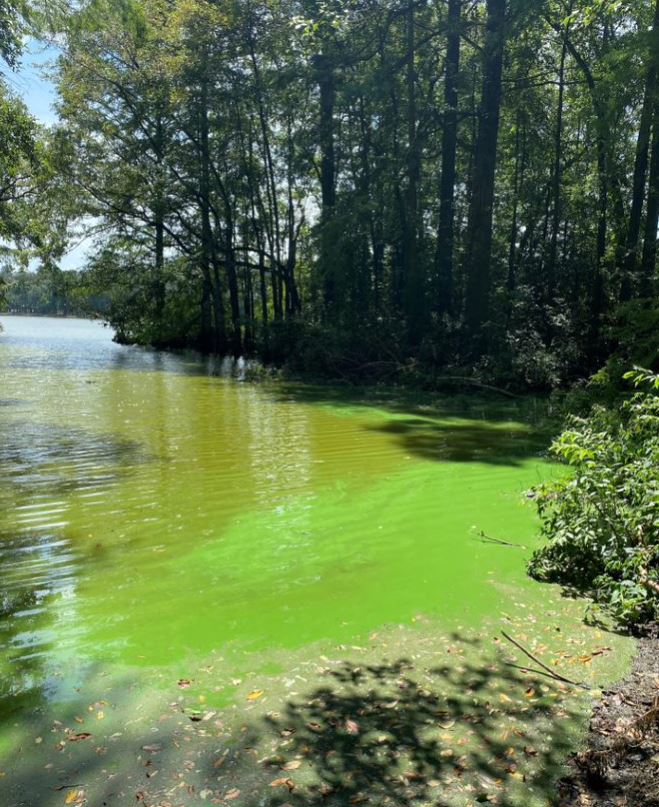
Blue-green algae (also called cyanobacteria) are naturally occurring microscopic organisms. They increase in density, or “bloom” under certain environmental conditions.
Blooms happen most often when there is an oversupply of nutrients and warm water temperatures. In Delaware, this can begin during the summer and intensify in early autumn.
Blue-green algae blooms can form dense mats on the water surface, giving the water a murky appearance; sometimes it forms a paint-like scum. It is typically pea-green in color but can also exhibit combinations of several colors, including blue-green, white, brown or red. Blooms may emit a swampy or musty odor. Moist or dried scum may be present along the shoreline.
Blooms can cover large areas of a pond or only appear along the shorelines that are more protected from wind and wave action.
Dense blooms can contribute to reduced dissolved oxygen in the water, leading to fish kills.
When the algae blooms die and decay, the water can appear multi-colored.

Certain strains of blue-green algae can produce toxins that can be harmful to people or animals if they are exposed though skin contact, swallowing or inhaling water droplets.
If water has a blue-green algae bloom or visible scum:
Human health effects from skin contact can include rashes, hives and blisters, most commonly on lips and under swimsuits. Irritation of the eyes and nose may also occur.
Less frequent reactions, reported in people who have inhaled water droplets containing high concentrations of blue-green algae toxin, include runny eyes and nose, sore throat or asthma-like symptoms.
Swallowing water that contains the toxin can cause diarrhea and vomiting, stomach cramps, fever and muscle weakness. In extreme cases, liver and kidney damage may occur.
Children are generally more vulnerable than adults because they are more likely to swallow water when playing and because they may put their fingers in their mouths without washing.
Because of their lower weight, exposure to smaller amounts of toxins may result in adverse effects in children. Senior citizens may also have greater risk due to underlying health conditions.
Pets may have the same reactions as humans, including lethargy, loss of appetite, vomiting, seizures and convulsions. Dogs may also be susceptible if scum attaches itself to their fur, then is swallowed during self-cleaning.
Animals should be prevented from drinking or contacting water experiencing a blue-green algae bloom. If contact does occur, they should be washed or rinsed off promptly. If a pet swallows scum or water, call your veterinarian.
There may be potential health risks from eating fish caught in waters affected by a blue-green algae bloom.
While there have been no reports of people getting sick from eating fish from affected waters, more research is required to understand the potential impacts to human health. It is likely that the fish muscle (filet) tissue is less affected by algae toxins than the organs and skin.
If you decide to eat fish from affected waters, it is recommended that you do so in moderation as a precaution. Remove the fat, skin and organs, being careful not to cut into the organs. Before cooking or freezing, rinse the filets with clean water.
Learn more about fish consumption advisories issued by DNREC and the Department of Health and Social Services.
Once blue-green algae blooms begin to occur, there is no quick, easy or guaranteed remedy to control them. Efforts to reduce the occurrence of blooms will be long-term and require the participation of the entire community in the watershed.
Since blue-green algae blooms are caused by an overabundance of nutrients (such as nitrogen and phosphorus), management focuses on reducing the amount of nutrients that run off the land into the water.
Municipalities and neighborhoods can reduce the amount of stormwater runoff from their areas.
Farmers, golf courses and lawn care companies can develop and implement nutrient management plans and routinely monitor the application of nutrients and chemicals.
Homeowners can:
DNREC: You Can Help Protect Delaware’s Waterways
DNREC: Protecting Our Waterways
Delaware Livable Lawns: Healthy Lawns & Clean Waterways
CDC: Harmful Algal Bloom (HAB)-Associated Illness
NOAA: What is a harmful algal bloom?
EPA: Learn about Harmful Algae, Cyanobacteria and Cyanotoxins
EPA: Harmful Algal Blooms (HABs) in Water Bodies
Cornell University – College of Veterinary Medicine: Blue-green algae poisoning: Cyanobacteria toxicosis
Related Topics: algae, assessment, blue-green algae, Health and Safety, outdoors and recreation, recreational, water quality, watershed stewardship
Delaware's Governor
State Agencies
Elected Officials
General Assembly
Delaware Courts
State Employees
Cities & Towns
Delaware State Code
State Regulations
Business First Steps
Phone Directory
Locations Directory
Public Meetings
Voting & Elections
Transparency
Health Insurance
Tax Center
Personal Income Tax
Privacy Policy
Weather & Travel
Contact Us
Corporations
Franchise Tax
Gross Receipts Tax
Withholding Tax
Delaware Topics
Help Center
Mobile Apps
E-mail / Text Alerts
Social Media


Built by the Government Information Center
©MMXXVI Delaware.gov