DNREC Menu

Authorization from the DNREC Wetlands and Waterways Section is required for activities in tidal wetlands or in tidal and non-tidal waters in the State of Delaware. The section issues various types of authorizations depending upon the location and type of activity proposed.
The section oversees permitting and related regulatory activities that include Wetlands and Subaqueous Lands Permits, Water Quality Certifications, Statewide Activity Approvals, Subaqueous Lands Leases, Marina Permits and Jurisdictional Determinations and Map Changes.
The Section has created an interactive wetlands permitting wizard to help applicants identify which authorizations they need and which forms to use.
For more information, please contact the Wetlands and Waterways Section, at DNREC_Wetlands_Waterways@delaware.gov or 302-739-9943.
Any person or organization seeking a permit, lease or other authorization from the Department must complete the Wetlands and Subaqueous Lands Permit Application Form and any appropriate appendices from the list below.
In addition to the application form and appropriate appendices, applicants must submit a map showing the location and boundaries of the proposed project, a scaled plan and section view drawings of the proposed project, a certified copy of the deed, a property survey, the application fee and any other supporting information required by the Department.
The US Clean Water Act requires states to certify that the discharge of dredged or fill material into waters of the United States, including wetlands, that is authorized by the federal government, will not violate the State Water Quality Standards.
A project-specific application for Water Quality Certification is generally required for all projects requiring an individual permit from the U.S. Army Corps of Engineers, as well as for certain projects that qualify for a Corps Nationwide Permit but are located in environmentally sensitive areas.
Applicants can use the Wetlands and Subaqueous Lands Permit Application Form for projects that require this type of Water Quality Certification review. Contact the Wetlands and Waterways Section, at DNREC_Wetlands_Waterways@delaware.gov or 302-739-9943, for assistance.
General permits have an abbreviated processing procedure to authorize less environmentally impactful project types in a timely manner.
This General Permit authorizes the addition of only one floating dock and/or one boat lift or one kayak float within an existing slip on permitted or validly leased docking structures within tidal subaqueous lands of Delaware.
Statewide activity approvals have an abbreviated processing procedure and can be used for various activities which have been determined to have minimal adverse impacts.
This activity approval applies to work, including repairs, in tidal or non-tidal waters, bank stabilization, construction in lagoons, aids to navigation, fish habitat enhancement and attraction devices, scientific measurement devices and survey activities.
To be eligible for structure repairs using this authorization, the existing structure must be serviceable and it must be replaced in the exact footprint of the current structure.
This activity approval authorizes the construction of shoreline stabilization projects that preserve, enhance and/or restore valuable ecological functions in tidal and non-tidal subaqueous lands jurisdiction.
A lease (renewable on a 10-year term) is required for the placement of any structure (dock, pier, pipeline, shoreline stabilization, etc.) or any fill placed in underwater lands channelward of the mean low water line. Projects that involve fill below the mean low water line are also subject to an annual lease fee.
All tidal underwater lands within the State of Delaware below the mean low water line, except those underwater lands specifically granted by the State to a private owner, are considered to be Public Subaqueous Lands held in trust by the State of Delaware for all Delaware citizens.
Use the Jurisdictional Determination and Map Change Request Form to request a stream Jurisdictional Determination, a Mean High Water Determination or a Wetland Map Change.
Once an application is received, it is assigned to a Wetlands and Waterways Section scientist who will review the application.
General Permits and Statewide Activity Approvals are generally processed within one to four weeks. Applicants receive updates on the process by email at each step.
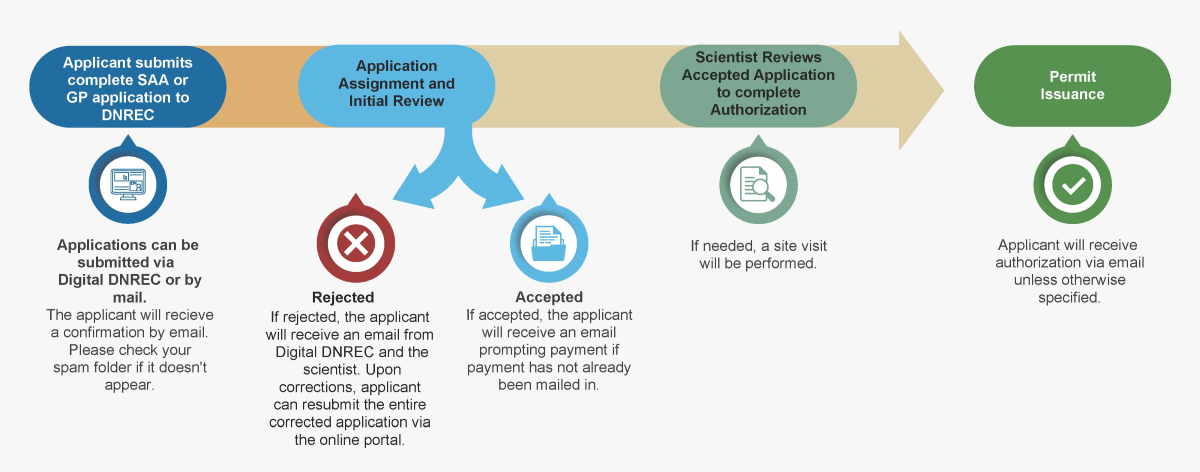
Applications can be submitted through the Digital DNREC ePermitting system or by mail. Applications are given an initial review and either accepted for further processing or sent back to the applicant for corrections and resubmission.
Once accepted for processing, the application is reviewed by a DNREC scientist to complete the authorization. In some cases, a site visit may be required. When the General Permit or Approval is issued, the applicant will receive an email (unless otherwise specified).
Projects of more complex scope using the basic application and appendices are subject to public process, including public notice and a more in-depth review.
The time required to issue authorizations varies depending on the complexity of the project. Projects requiring public notice typically take longer to process.
Public notice is required for most projects using the basic application and appendices. This consists of advertising a basic project description in the newspaper and on the DNREC website and waiting for a period of twenty days to receive public comments or requests for public hearings.
Statewide Activity Approvals, General Permits, Jurisdictional Determinations, and Letters of Authorization do not require a public notice period and thus have an abbreviated processing time.
Once the 20-day comment period has passed, the project is given a final review by the staff scientist. This will include public comments and concerns the Department may have. For Subaqueous Lands Permits and Water Quality Certifications, a final permit decision is made. If the project is approved, the Permit and/or Certification is prepared and issued.
Major new marinas or substantial marina alterations involve a more complex review, including two separate public notice periods, and may take several months to complete.
If a public hearing is requested, additional time will be needed to accommodate the hearing and review process.
For projects requiring a Subaqueous Lands Lease, the lease is first sent to the applicant to be signed and notarized and is then returned to the Department for the Cabinet Secretary’s signature.
Once the final lease document is signed by all of the parties, it must be recorded at the Recorder of Deeds Office in the appropriate county in order to be considered valid.
Contractors working on any projects authorized or permitted by the DNREC Wetlands and Waterways Section must submit a Post-Construction Completion Report, now available for completion online.
Related Topics: authorization, clean water, permitting and regulation, subaqueous, subaqueous lands, water, waterways, wetlands
Delaware's Governor
State Agencies
Elected Officials
General Assembly
Delaware Courts
State Employees
Cities & Towns
Delaware State Code
State Regulations
Business First Steps
Phone Directory
Locations Directory
Public Meetings
Voting & Elections
Transparency
Health Insurance
Tax Center
Personal Income Tax
Privacy Policy
Weather & Travel
Contact Us
Corporations
Franchise Tax
Gross Receipts Tax
Withholding Tax
Delaware Topics
Help Center
Mobile Apps
E-mail / Text Alerts
Social Media


Built by the Government Information Center
©MMXXVI Delaware.gov