DNREC Menu

The Galman Group installed four electric vehicle charging stations at its Claymont property with the help of DNREC’s Electric Vehicle Charging Equipment Rebate Program and has approval for funding four chargers at four additional properties in Newark and New Castle.
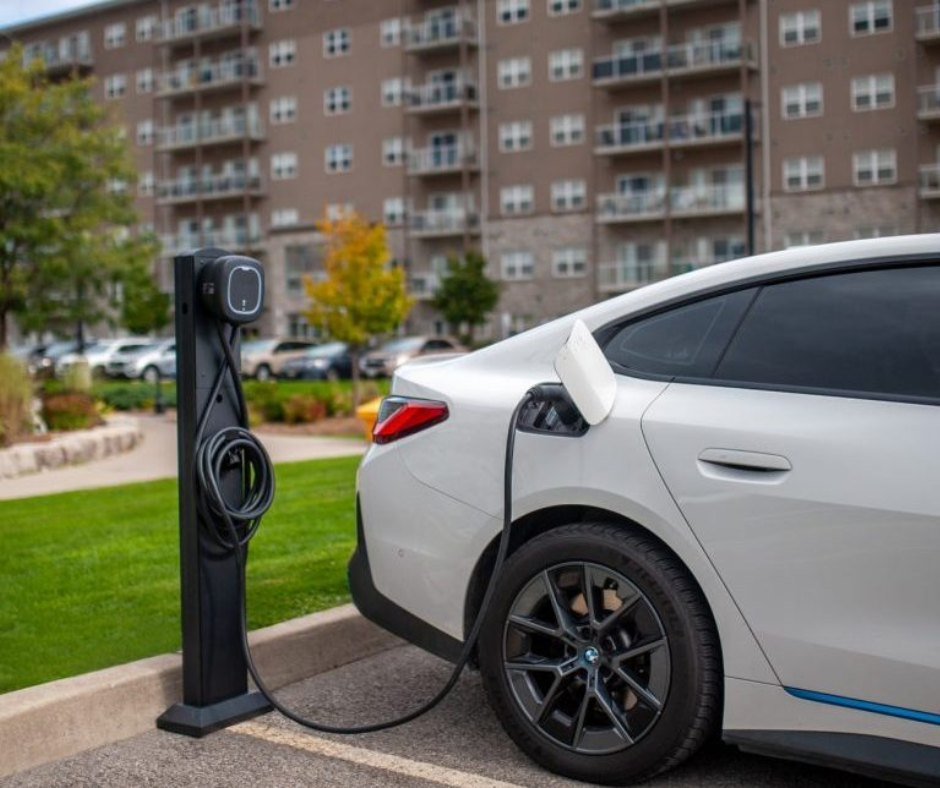
Linc Slipakoff, asset manager for the Galman Group, which manages the apartment and townhome complexes, said adding the amenity for existing residents, as well as providing it as an incentive for potential new residents, went into the company’s considerations when deciding to add them to the apartment and townhome complexes located in New Castle, Claymont and Newark.
“A few residents have thanked us, both EV owners and non, just to say it’s a great amenity to have,” he said.
Across the state, more than 90 apartment complexes have taken advantage of funding through the program and have installed EV charging for their residents. Charging at home is cost effective and convenient, and this program aims to make sure people who live in apartments, townhomes or condos can benefit from the EV life.
Breanne Preisen, Clean Transportation Program Manager with the Climate and Sustainability Section of DNREC’s Division of Climate, Coastal and Energy, said the program is a win-win.
“As Delaware works to increase accessibility to electric vehicle charging stations, partnering with businesses makes sense,” she said. “The funding helps reduce costs for businesses, while at the same time it moves us forward in growing the state’s charging network at a time when more people are considering or have already purchased an electric vehicle.”
DNREC’s Electric Vehicle Charging Equipment Rebate Program applies to multi-family, public access, fleet and workplace charging.
Preisen said 80% of EV owners are homeowners who charge their vehicles at home. Residents of multi-family dwellings or apartment complexes in most cases do not have that option.
The program provides for enhanced incentive levels of up to 90% of eligible purchase and installation costs for multi-family dwelling projects in areas identified as priority areas — disadvantaged and/or underserved areas where eliminating barriers to electric vehicle adoption is especially important.
“In the early days of electric vehicles, the focus was on growing charging networks as a way to address ‘range anxiety’ among EV owners,” she said, referring to the worry some EV owners had about being able to find a public charging station if they needed one. “Today’s EVs have much longer ranges, and states have prioritized adding charging stations to historically underserved areas and major travel routes.”
Slipakoff said The Galman Group did resident surveys prior to planning each site.
“While the percentage [of resident EV owners] is low relative to number of units, they do get used and are available to our residents as well as the public,” he said.
DNREC’s incentives focus on charging stations for public places, commercial and multi-family residences and do not include single-family residences. Energize Delaware, however, offers financial assistance for Delawareans looking to install a charger at their private residence.
As the number of electric vehicles on the road continues to grow, ensuring that Delaware’s charging infrastructure keeps pace will be key. The state’s plan incorporates strategies centered on equity, reliability, education and evaluation to work toward and achieve that result.
Preisen said Delaware’s electric vehicle transition will be gradual but consistent.
“Full EV transition will take many years due to how long cars stay on the road before being retired,” she said. “This will allow us to grow our charging network and implement changes to policies and programs to provide Delawareans and visitors to the First State the peace of mind that comes with knowing that you will easily be able to find a charger when you need one.”
Related Topics: climate coastal energy, electric vehicle, ev charging, sustainability, transportation
Delaware's Governor
State Agencies
Elected Officials
General Assembly
Delaware Courts
State Employees
Cities & Towns
Delaware State Code
State Regulations
Business First Steps
Phone Directory
Locations Directory
Public Meetings
Voting & Elections
Transparency
Health Insurance
Tax Center
Personal Income Tax
Privacy Policy
Weather & Travel
Contact Us
Corporations
Franchise Tax
Gross Receipts Tax
Withholding Tax
Delaware Topics
Help Center
Mobile Apps
E-mail / Text Alerts
Social Media

Built by the Government Information Center
©MMXXVI Delaware.gov