DNREC Menu

Outdoor Delaware is the award-winning online magazine of the Delaware Department of Natural Resources and Environmental Control. Articles and multimedia content are produced by the DNREC Office of Communications.
Shorebirds mill around on a beach along Mispillion Harbor, unaware of the tumult that’s about to erupt from a handful of people watching nearby. A person says the word and a loud boom erupts, startling the birds.
But before most of them can fly away, a net is descending upon them. Fired from a cannon-like device set up on the beach hours before the birds arrived, the net settles over hundreds of shorebirds, leaving them at the mercy of the nearby humans.
Fortunately, these individuals don’t seek to harm the birds — quite the opposite, in fact. They are scientists and volunteers with the Delaware Department of Natural Resources and Environment Control studying migrating shorebirds as part of the Delaware Shorebird Project. Now decades in the making, the project provides useful information about a key ecosystem and helps reveal trends that can even offer useful lessons to humanity.
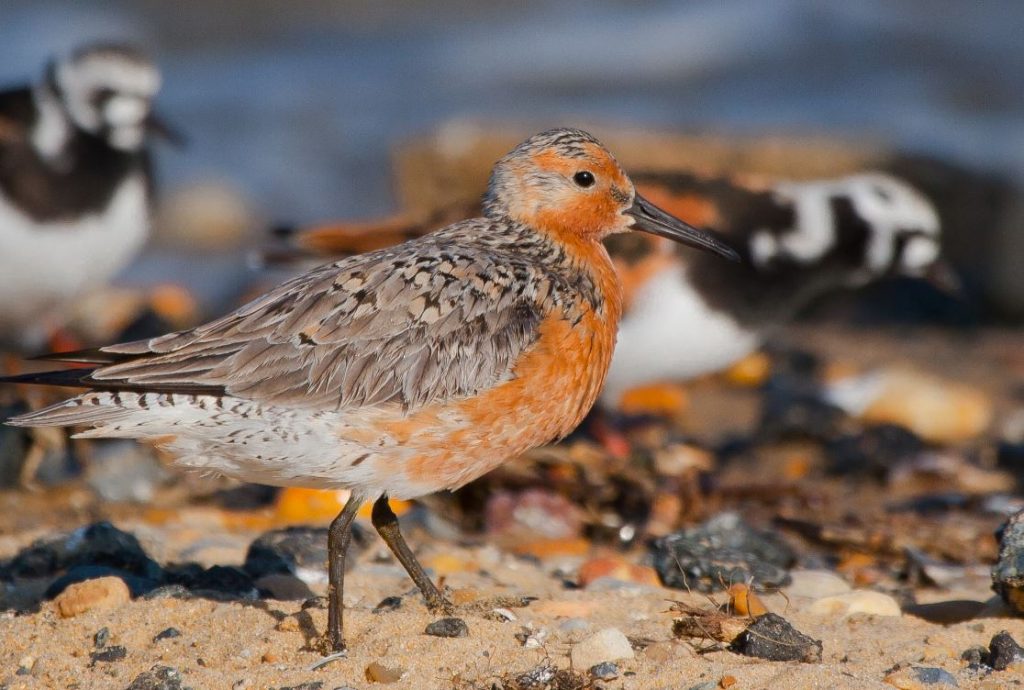
Every year, huge numbers of shorebirds like red knots, ruddy turnstones and sanderlings stop in the Delaware Bay as they migrate north. These birds, traveling north to the Arctic in the hundreds of thousands, hail from the Caribbean and South America. Some fly as many as 9,000 miles, starting in Tierra del Fuego at the southern tip of Argentina and Chile and ending in Greenland or the Canadian Arctic Archipelago, where they will mate before eventually heading south again by September.
They begin arriving in Delaware around the beginning of May and continue through the end of the month, using the First State and its large estuary as a rest stop.
What makes Delaware so special for these birds?
As it happens, the Delaware Bay is home to the largest horseshoe crab spawning ground in the world. Thousands upon thousands of horseshoe crabs crawl onto Delaware’s beaches over the course of roughly a month during the spring, coinciding perfectly with the shorebirds’ long migration north to mate.
Collectively, the birds consume almost unimaginable numbers of horseshoe crab eggs. One single bird can eat more than 20,000 eggs in a day, according to Nigel Clark, an ornithologist with the Wash Wader Research Group.
While 20,000 of anything is generally a lot, a single horseshoe crab can lay 100,000 eggs in a season. Additionally, a horseshoe crab egg is small, even tinier than a grain of rice, so 20,000 eggs isn’t quite an unfathomably large as it seems.

Still, a shorebird can easily double in weight during the week-and-a-half or so it stays here. The average ruddy turnstone, for instance, goes from about 75 grams to 150 grams as a result of gorging itself on horseshoe crab eggs.
Really, the birds can be forgiven for stuffing themselves. You try flying (OK, walking) thousands of miles in a matter of days.
Although DNREC has been surveying shorebirds annually for about 40 years, the initiative took on a new urgency around the turn of the millennium. Scientists noticed a concerning decline in the shorebird population in the Delaware Bay, which could be partially traced back to overharvesting of horseshoe crabs.
Migrating shorebirds are basically skin and bones by the time they arrive here after flying thousands of miles with little to no rest, making it all the more important the horseshoe crab population remains robust.
New laws and regulations have since been put in place to ensure there are still plenty of horseshoe crabs in the Delaware Bay, but shorebird numbers haven’t entirely recovered — something that likely reflects general climate change and development impacts throughout the Americas. Annual aerial surveys of the bay showed an initial increase in average red knot peak counts across seasons after management changes in the mid-2000s, but since 2021, three-year average peak counts have been at or below 20,000 birds, about half of what they were in the 1990s.
While noting the decline is slower and more stable compared to a few decades ago, Kat Christie, a coastal waterbird biologist with the DNREC Division of Fish and Wildlife, expressed disappointment and curiosity as to why populations have not recovered as much as initially hoped.
For decades, DNREC scientists have gathered in the Delaware Bay every May along with a large team of volunteers, many of them from the Wash Wader Research Group. The group, a conservation-focused nonprofit, studies shorebirds in the Wash, a large estuary in eastern England. Some of its members, such as Clark, have been coming to Delaware every spring (save for 2020) since the 1990s.
The partnership between DNREC and the Wash Wader Research Group really intensified a few years into the survey when a downward trend in the shorebird population was observed.

“We brought that group in as these experts in cannon netting because that’s what they do in their ecosystems year-round, whereas we really only have flocks big enough to do that for about three weeks a year, so they’re kind of the experts in that large-scale banding operation,” DNREC’s Christie said.
The banding is a key part of the initiative that helps participants track the birds and thus gather useful data. (The state also has populations of breeding shorebirds, which either reside here year-round or migrate to Delaware to lay eggs and are studied in separate research projects. A recent DNREC collaboration in fact helped rehabilitate the piping plover Nomad before releasing him back into the wild to potentially mate with other members of his species, though not as part of the shorebird stopover research.)
All captured birds receive a metal band containing a unique numerical code to help track them. However, a bird wearing a leg band like this must be recaptured to view the code. That’s why DNREC also uses plastic “flags,” larger leg bands that extend out and contain a unique code capable of being spotted at a distance when a bird is walking or flying.
Because these flags are more time-consuming to apply and participants are under a strict four-hour time limit to release captured birds, they’re only used for a few target species that researchers want to prioritize: red knots, ruddy turnstones, sanderlings and for the first time this year, short-billed dowitchers. Those four are all designated as top-tier Species of Greatest Conservation Need in Delaware.
Fortunately, the flags provide large quantities of data, producing in May 2025 alone more than 18,000 resighting records, a total that includes multiple sightings of the same bird.
Christie’s team also captured 2,640 birds in 2025, including previously banded individuals the team can now collect additional data on that will be linked to their initial records through collaborative databases.
Birds are generally captured by cannon net, a specialized device carefully set up on a beach where birds are expected to gather later in the day to feast on horseshoe crab eggs. After the birds arrive, scientists and volunteers will fire the net, being careful about its trajectory to ensure no birds are injured. They then quickly gather the trapped birds and put them in boxes.
From there, the boxes are transported to a nearby home base, typically a shaded area set up out of sight of the net. In this case, the destination was the covered patio area of a house about a mile away that the team rented to ensure members were not stuck outside handling birds in excessive heat or rainy weather.
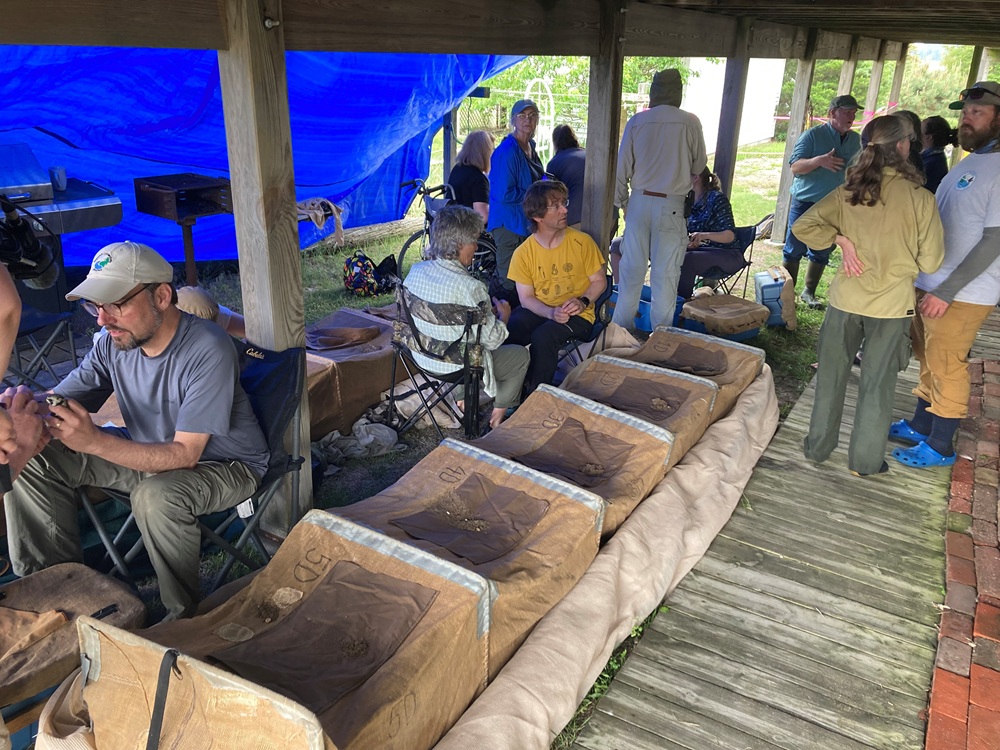
Participants set up a veritable assembly line outside in the shade, with different individuals responsible for flagging, measuring and weighing the birds before they are carefully released. Through it all, they know they’re on a strict timetable to avoid placing too much stress on the birds.
“The birds go from foraging, having their little lunch, to covered in the net to back out doing their thing in less than four hours,” Christie said.
The depth of the project means DNREC has a sizable set of data that can be used to look for patterns. A steep decline in shorebird population or in the average weight of birds measured by DNREC, for instance, could spell bad news for us.
Ecosystems are connected, and knowing how natural systems are working enables experts to spot problems early on and work to address them before they become unmanageable, Christie noted. And because the Delaware Bay is such a hotspot for these migrating creatures, it’s a rich survey environment that attracts attention from conservation organizations based elsewhere in the country or even on the globe.
“Pretty much anywhere else you could go look for them you’d be lucky to see a couple dozen or a couple hundred or a couple thousand birds, whereas here reliably for three weeks every May you can go into Mispillion Harbor and see 10,000 of some of these birds,” Christie said. “It’s a very reliable dense and efficient place and time to collect data about these species and look at year-over-year trends and put on these individual markers that then can be resighted from Argentina to Canada.”
Related Topics: animals, birds, conservation, fish and wildlife, outdoor delaware, research, shorebirds
Delaware's Governor
State Agencies
Elected Officials
General Assembly
Delaware Courts
State Employees
Cities & Towns
Delaware State Code
State Regulations
Business First Steps
Phone Directory
Locations Directory
Public Meetings
Voting & Elections
Transparency
Health Insurance
Tax Center
Personal Income Tax
Privacy Policy
Weather & Travel
Contact Us
Corporations
Franchise Tax
Gross Receipts Tax
Withholding Tax
Delaware Topics
Help Center
Mobile Apps
E-mail / Text Alerts
Social Media


Built by the Government Information Center
©MMXXVI Delaware.gov