DNREC Menu

Outdoor Delaware is the award-winning online magazine of the Delaware Department of Natural Resources and Environmental Control. Articles and multimedia content are produced by the DNREC Office of Communications.
In northern New Castle County, a tiny population of North America’s smallest turtle is receiving a lift thanks to efforts from the Delaware Department of Natural Resources and Environmental Control.
Historically, Delaware was home to populations of bog turtles at roughly 20 different sites, but by the turn of the millennium, only about five wetland environments contained the species. Today, there are just two groups of bog turtles in our state.

Both sites are located in northern New Castle, with the exact location known to DNREC biologists but kept secret to protect the turtles from both well-meaning admirers and poachers. After all, there are only around 20 adult bog turtles in Delaware, meaning the species, which is listed as threatened by the federal government and as a species of greatest conservation need by DNREC, is at risk of dying out in the First State absent human intervention.
In 2022, DNREC began a monitoring program aimed at boosting the species’ numbers in the First State. Biologists from the DNREC Division of Fish and Wildlife collected eggs and took them to the Brandywine Zoo. There, the eggs were carefully watched and kept warm until they were ready to hatch.
Ultimately, 10 babies emerged from eggs and were released into the wild. The following year, 21 eggs hatched, with some being released while others were kept at the zoo to allow them to grow to a larger size to keep them from falling prey to hungry predators.
Right now, there are 36 youngsters being raised at the zoo after another successful hatching in 2024.
The long-term goal, according to Dr. Nathan Nazdrowicz, the Division of Fish and Wildlife’s herpetologist, is to have five separate sites with 40 adults each in about 20 years.
Some locations, such as marshes, that were historically home to turtles may not have any currently but would be able to support a population if some bog turtles were re-introduced there.
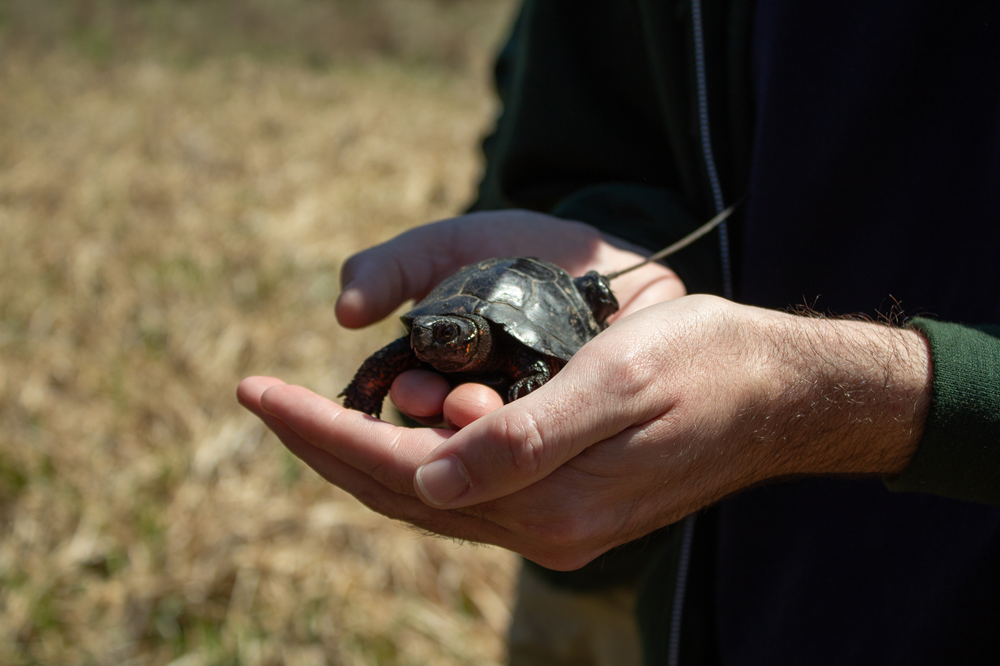
The species, which reaches a maximum size of about 4 inches, is native to the Eastern United States. Bog turtles expanded their range during colonialism as clearcutting enabled the tiny reptilians to spread beyond their traditional environment. But, while this initially helped the turtle, a later transition from using land for farming to development proved detrimental, and populations began declining throughout their range.
Currently, the species is basically split into two populations: one around western North Carolina and eastern Tennessee and the other centered on eastern Pennsylvania, northeastern Maryland, parts of New Jersey and the Hudson Valley and around Lake Ontario in New York.
Bog turtles like shallow wetlands that allow them to spend time both on land and submerged in the mud. They prefer spots without many trees that can block out the sun and prevent plants like tussock sedges and rushes turtles use to rest or lay eggs in from thriving.
In June, females lay clutches of about four eggs, which then hatch in August or September. Come November, the species goes into hibernation, with bog turtles burying themselves in dense vegetation, under tree roots and in muskrat burrows, re-emerging around April.
The tiny critters are omnivorous, relying on aquatic plants, seeds, berries, earthworms, slugs, insects and more. Mostly a dark brown to black color, they have yellow-orange patches by their ears, as well as similar flecks of color elsewhere on their head, neck, limbs or shell.
While bog turtles can live around 50 years, they do face threats in the form of raccoons, snakes, birds, shrews and snapping turtles, as well as diseases like mycoplasmosis, ranavirus and the herpes virus.
Humans also can be harmful to the species’ population: Bog turtles are popular on the black market, and encroaching development limits the number of places they can live in the wild.
But DNREC is working hard to monitor the population, including controlling predators, using cameras to keep a close eye on the two sites that have populations and planting native plants in hopes of counteracting invasive flora that’s popped up in the bog turtles’ habitats.
Most notably, the Department has been tagging bog turtles in the wild with radio transmitters like those used on Delmarva fox squirrels reintroduced to Delaware.
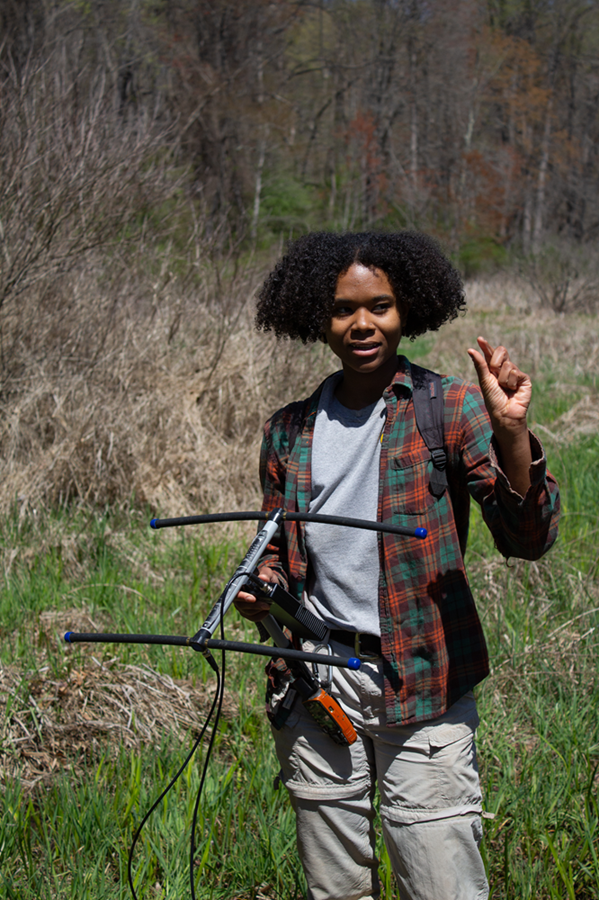
Once a turtle has been tagged, it can be found again with the aid of a tracking device. Basically a large antenna that searches for radio signals within about a third of a mile, the tool enables biologists to better monitor the species, including locating any eggs they may have laid.
DNREC checks in on the turtles at the two sites in the wild frequently during the summer months to ensure the population remains stable. Nazdrowicz and his team carefully weigh and measure each turtle they find, noting if it has any signs of disease or injury. So far, so good, DNREC biologists are pleased to report.
As one might expect, a few DNREC scientists have had a lot of contact with the tiny turtles during the course of this project. That’s included carefully gathering members of the species, placing them in buckets and then driving them to the lab for the transmitter attachment. Biological aide Maya Walker has spent significant amount of time transporting bog turtles, and she’s made a surprising (though perhaps a tad anecdotal) observation: Bog turtles seem to enjoy jazz music the most out of the various genres she’s played in her car.
Related Topics: animals, conservation, fish and wildlife, nature, outdoor delaware, science, turtles
Delaware's Governor
State Agencies
Elected Officials
General Assembly
Delaware Courts
State Employees
Cities & Towns
Delaware State Code
State Regulations
Business First Steps
Phone Directory
Locations Directory
Public Meetings
Voting & Elections
Transparency
Health Insurance
Tax Center
Personal Income Tax
Privacy Policy
Weather & Travel
Contact Us
Corporations
Franchise Tax
Gross Receipts Tax
Withholding Tax
Delaware Topics
Help Center
Mobile Apps
E-mail / Text Alerts
Social Media


Built by the Government Information Center
©MMXXVI Delaware.gov