DNREC Menu

Delawareans and visitors are plagued by a familiar foe every summer — the mosquito. Mosquitoes are not only a nuisance but can also threaten our health because they may transmit diseases to humans, domestic animals and wildlife.
The Delaware Department of Natural Resources and Environmental Control’s Division of Fish and Wildlife has a unit dedicated to managing the mosquito population. Our Mosquito Control Section seeks to limit mosquitoes in an environmentally compatible way without harming people or domestic animals. To do this, we monitor the populations of many types of mosquitoes. If they pose a disease transmission threat or become a nuisance, Mosquito Control uses different methods to reduce or eliminate them. This monitoring process includes applying insecticide at their breeding sources.
Mosquito Control also provides public outreach and education to inform Delawareans of our efforts and ways everyone can help reduce the number of mosquitoes in Delaware.
We focus on large-scale breeding habitats, including saltmarshes, forested wetlands, stormwater ponds, flooded fields and roadside ditches. Not surprisingly, mosquitoes around people’s homes can’t be effectively monitored because of their sheer numbers. That means controlling them in your backyard falls to you — with help from us if needed.
Mosquito-breeding sites are not only a problem because of their proximity to people but also because of their ability to produce two mosquito species of concern.
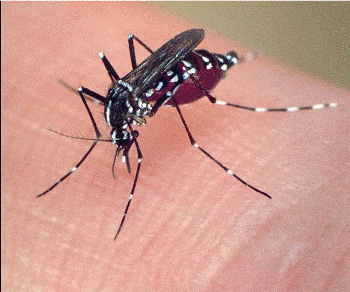
One of these is the Asian tiger mosquito, which was accidentally introduced to the United States in the early 1980s. Since then, it has become well established in Delaware and elsewhere and is the top nuisance mosquito in our backyards. This small pest is easily identified by the vivid white markings on its black body, the single white stripe on its thorax (upper back) and its white-striped legs.
The tiger mosquito is an aggressive human biter, often targeting our lower legs. It bites during the daytime and doesn’t move more than a few hundred yards from where it hatched.
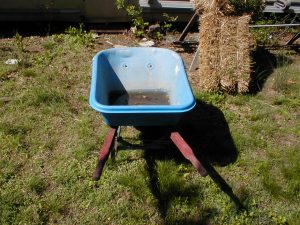
Any item or area that can collect and retain water for five to seven days can produce numerous biting mosquitoes. These include
everything from kids' toys to flat roofs to hollows in trees. Reclaim and enjoy your backyard again by eliminating water-holding areas and containers that breed mosquitoes. You’ll be glad that you did!This attribute has led mosquito control professionals to coin the phrase, “if you breed them, you feed them,” meaning that if their breeding habitat is in your yard, they are likely to find and feed on you first. We can mainly control it by simply reducing or eliminating its breeding habitats in our backyards and communities.
The second problematic backyard mosquito is the common house mosquito. It, too, prefers stagnant water. Like the Asian tiger, it can also be found in backyard containers, as well as in stormwater ponds, street storm drains and similar habitats. These largely night-time mosquitoes feed mainly on birds but will also readily bite humans.
This fact is important to know because not only can they amplify or increase viruses like West Nile by passing them from bird to bird but may also transmit pathogens to us while taking in a blood meal. In fact, the common house mosquito is the main amplifying vector for West Nile virus in Delaware.
Stay inside when most mosquitoes are active — at dawn, dusk and at night.
If you must be outside, wear light-colored, long-sleeved clothing or apply insect repellent containing active ingredients like 20-30% diethyltoluamide (DEET) or products containing picaridin, oil-of-lemon eucalyptus, para-menthane–diol or ethyl butylacetylaminopropionate (IR3535). All these products have been found to be safe and effective. Be sure to follow all label instructions.
If you are outside without long-sleeved clothing or repellent, try to avoid vigorous activity or exercise, since mosquitoes are attracted to body heat, sweat and skin odor.
Avoid wearing colognes, body sprays, perfume and dark-colored clothing. These items make you more attractive to mosquitoes.
Use small handheld devices that utilize heat to disperse repellent to create a zone of protection from mosquitoes. These devices are powered by a small butane cartridge that heats a mat saturated with repellent.
Treating your backyard with certain residual insecticides can be effective in reducing mosquitoes in some locations if done safely and appropriately. Many commercial pest control companies now offer this service for a fee. However, there are some concerns regarding possible adverse impacts to other insects and non-target organisms from this type of treatment. Until more is known about these possible side effects, DNREC’s Mosquito Control Section remains ambivalent about this approach.
Forget bug zappers. They kill far more non-targeted insects than mosquitoes, many of which are harmless or beneficial.
More information about mosquito control, including a video of common backyard mosquito breeding habitats, can be found on DNREC’s mosquito control webpage. You can also call one of our two field offices to request mosquito control services. The Newark office covers the northern half of Delaware, including the Dover area, and can be reached at 302-836-2555. Our Milford office serves the remainder of the state south of Dover. That number is 302-422-1512. General information about the mosquito control program is also available by calling the central Dover office at 302-739-9917.
Editor’s note: This article was published in 2021 and updated in 2026.
Related Topics: animals, conservation, education, fun, health, mosquito, outdoor delaware, science
Delaware's Governor
State Agencies
Elected Officials
General Assembly
Delaware Courts
State Employees
Cities & Towns
Delaware State Code
State Regulations
Business First Steps
Phone Directory
Locations Directory
Public Meetings
Voting & Elections
Transparency
Health Insurance
Tax Center
Personal Income Tax
Privacy Policy
Weather & Travel
Contact Us
Corporations
Franchise Tax
Gross Receipts Tax
Withholding Tax
Delaware Topics
Help Center
Mobile Apps
E-mail / Text Alerts
Social Media


Built by the Government Information Center
©MMXXVI Delaware.gov