DNREC Menu

The word “sentinel” can call to mind several different images, from an island in the Indian Ocean to mutant-hunting robots, but most likely it makes you think of a lone soldier standing guard. What, then, are sentinel chickens?
No, these aren’t birds dressed in tiny suits of armor carrying miniature swords as they watch over the henhouse. But sentinel chickens do play an important role in protecting public health in Delaware.
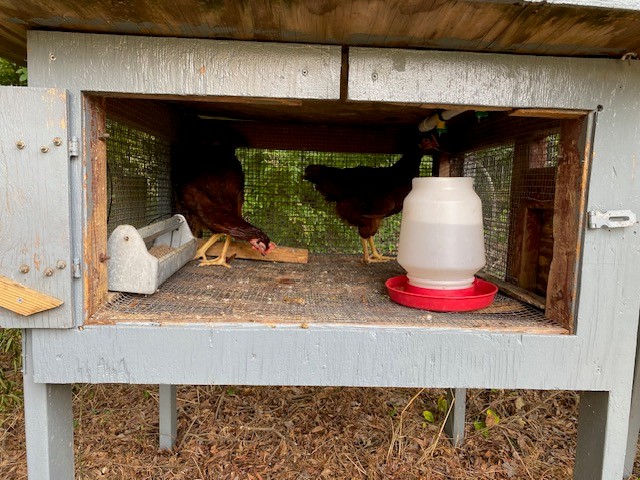
The Delaware Department of Natural Resources and Environmental Control maintains flocks of chickens in 20 locations across the state as part of its efforts to detect two viruses that can be transmitted to humans by mosquitoes. These chickens serve as the canary in the coal mine for West Nile virus and eastern equine encephalitis (EEE).
And, thankfully, the chickens are unaffected by both EEE and West Nile — part of the reason poultry are so useful for detecting these viruses.
Most people who catch West Nile are asymptomatic, and many of those who do get sick end up with relatively mild flu-like symptoms, such as fever, body aches and nausea. EEE is much rarer, affecting just 11 people in the United States on average annually. However, it is more serious, capable of causing flu-like symptoms as well as neurological issues and possibly even death.
There are no human vaccines for either disease, though there is one for each for horses.
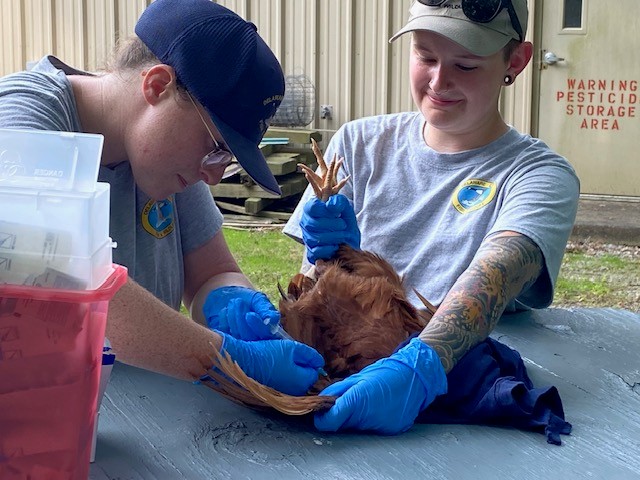
For more than 40 years, Delaware has used chickens to detect West Nile and EEE, taking blood samples weekly during the summer and early fall when mosquitoes and the viruses are most active. A positive test result lets DNREC’s Mosquito Control Section know a virus is circulating in the area. Because the chickens are caged, they can only have picked it up from a mosquito that stopped there to feed.
Upon receiving positive results from the state’s Public Health Laboratory, DNREC then conducts additional surveillance in the area, including setting traps. The goal is to determine what mosquito species are present, as only about a third of the 57 in the state are a concern due to being nuisance biters, transmitters of disease or amplifiers of disease cycles in nature.
After further investigation, DNREC will typically then spray the area with one of its fog trucks in hopes of killing as many mosquitoes as possible.
Mosquito season in Delaware generally starts in May and runs through October, with the likelihood of a human contracting the virus increasing as summer progresses. In 2025, the first positive test here for West Nile came in August.
“The reason for that, if you think about it, is it’s older mosquitoes that have taken multiple blood meals that possibly have picked up a pathogen — in this case, a virus — to transmit to a human, and it takes until at least halfway through the summer for all that to happen,” said Tom Moran, the administrator of DNREC’s Mosquito Control Section.
Mosquitoes typically become carriers after feeding on wild birds that have one of the viruses and transmit them to mammals or other birds when they feed again.
The First State adopted sentinel chickens in the early 1980s to help it detect eastern equine encephalitis. Beginning in the early 2000s and lasting roughly a decade, DNREC experts kept track of and tested dead birds for West Nile. However, this method did not account for birds that resided in neighboring states and caught the virus there but then crossed over to Delaware and died here. By 2010, surveillance of dead birds had lost its utility as a tool for detecting West Nile.
DNREC has explored other options at times, including polymerase chain reaction (PCR) tests, which require capturing mosquitoes, creating “pools” consisting of dozens of the insects, grinding them up and then testing for the presence of viruses in their DNA.
PCR tests are used by some other jurisdictions around the country, but although DNREC has tried them on a few occasions over the past quarter-century, the Department has found sentinel chickens to be a more reliable method capable of detecting more virus activity.
Keeping sentinel chickens represents a straightforward way of detecting the viruses, although it does require additional manpower to check up on and test the fowl regularly. There’s also a potential lag of up to about two weeks between when the chicken is bitten and when it tests positive.
The flocks are deployed up and down the state, including a few that were placed near coastal marshes, which are more likely to have mosquito species that transmit EEE. Some groups of chickens are kept on public lands like wildlife areas or state forests, but others live on private property, as a handful of volunteers have allowed DNREC to use their land to keep the birds.
“They have a little ownership of it, if you will,” Moran said. “Not that they’re doing care but they’re keeping an eye on it, so if something happens they can call us.”
West Nile is typically detected here just about annually, whereas EEE only pops up every three to five years, Moran noted.
Thanks to this rigorous detection system, DNREC is able to limit the public health risk.
“If we spray to reduce number of those older mosquitoes that are the ones doing the virus transmission and amplification in nature, that helps to try to break the cycle,” Moran said.
But government action alone isn’t enough. An important part of preventing mosquitoes is taking steps to avoid being bitten and to reduce places on your property where they can breed. DNREC experts also recommend:
Stay away from bug zappers though — they end up killing far more harmless and even beneficial insects than mosquitoes.
Perhaps the most crucial step you can take is eliminating standing water in your yard. Even something as small as a tiny puddle of rainwater in a toy bucket your child left out can serve as a breeding ground for these flying pests. Other sources can include bird baths, uncovered trashcans, clogged gutters, open rain barrels and unused swimming pools, to name a few.
Many of these steps apply to horses as well, such as spraying horse-safe repellents, keeping horses inside during peak mosquito hours and cleaning water buckets and troughs every few days.
You can also call DNREC Mosquito Control at 302-836-2555 (for New Castle County and northern Kent County) or 302-422-1512 (for Kent south of Dover and Sussex County) to have your mosquito problem investigated and treated.
Contact the Mosquito Control central office at 302-739-9917 for general questions about mosquitoes and the Delaware Department of Agriculture Poultry and Animal Health Section at 302-698-4500 for questions about mosquitoes as they pertain to animals. Potential West Nile and/or EEE virus cases should be reported to the Delaware Department of Health and Social Services’ Office of Infectious Disease Epidemiology at 888-295-5156.
Related Topics: chickens, eastern equine encephalitis, fish and wildlife, health, mosquito control, outdoor delaware, science, West Nile virus
Delaware's Governor
State Agencies
Elected Officials
General Assembly
Delaware Courts
State Employees
Cities & Towns
Delaware State Code
State Regulations
Business First Steps
Phone Directory
Locations Directory
Public Meetings
Voting & Elections
Transparency
Health Insurance
Tax Center
Personal Income Tax
Privacy Policy
Weather & Travel
Contact Us
Corporations
Franchise Tax
Gross Receipts Tax
Withholding Tax
Delaware Topics
Help Center
Mobile Apps
E-mail / Text Alerts
Social Media


Built by the Government Information Center
©MMXXVI Delaware.gov