DNREC Menu

Every week, thousands of tons of paper, glass, plastic, cardboard and aluminum make their way to a large facility sitting between Interstate 295 and Interstate 495 in New Castle near the Delaware River.
This is the Materials Recovery Facility, commonly referred to by the acronym MRF. Operated by the Delaware Solid Waste Authority in partnership with Republic Services, the 64,000-square-foot site processes much of Delaware’s recyclables. There, discarded goods are separated into piles based on the type of material before being shipped away and reused.
Who knows — some of the items that come through the MRF may have been there before or may pass through again one day, continuing the life cycle of recyclables.

Aluminum, for instance, is infinitely recyclable. Unlike many other materials, it doesn’t degrade when it is recycled. An aluminum can is capable of being recycled and turned back into a new can on store shelves within 60 days.
In Delaware, waste haulers are required to provide a separate container for recyclables to every customer paying for curbside trash pickup. Delaware has had a single-stream recycling program since 2007, meaning for the past 18 years all recyclables can be placed in one container, picked up by a hauler and then sorted at the MRF.
Haulers use separate trucks to pick up recyclables as opposed to trash. These trucks either go to a DSWA transfer station where the material is consolidated into a tractor trailer, or they go directly to the MRF.
In 2024, Delaware produced about 1.43 million tons of solid waste, or 6.5 pounds per resident per day. That’s equal to roughly 690,000 cars.
Turns out people generate a lot of trash!
Slightly more than 36% of our waste, or about 2.5 pounds per person per day, was recycled in 2024. From 2006 to 2023, the First State saw about 7.6 million tons of recyclables diverted from landfills.
While education has always been an important component of what DSWA and DNREC do, efforts have been increasing lately. Motivated partially by a stagnation in the state’s recycling rate, DNREC is taking steps to ensure applicable laws are being followed by all entities, such as schools, apartment complexes and restaurants. Its experts are meeting with numerous business representatives around the state, and the Department has produced educational materials like postcards that spell out key rules and provide resources should people have questions.
Delaware’s small size makes it feasible to have a unified program with the same rules applicable everywhere, and as a result, our recycling program is consistent from Delmar to Claymont.
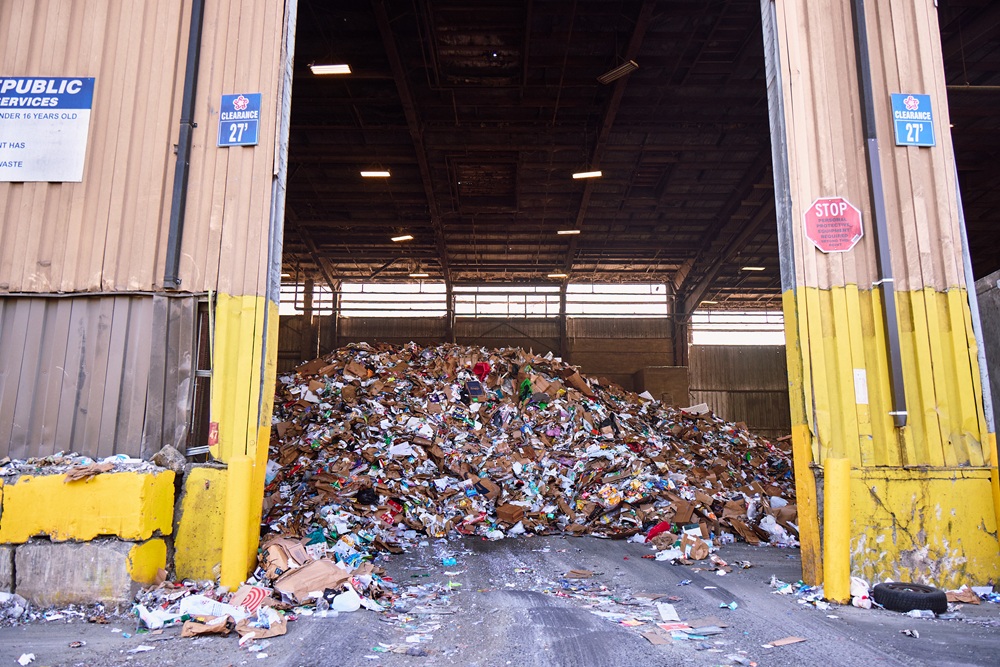
These days, the MRF handles about 115,000 tons of recyclables every year. That may sound like a lot, and in many respects it is, but it’s less than a third of all diverted recyclables and only about 10% of all municipal solid waste generated by Delawareans in a year.
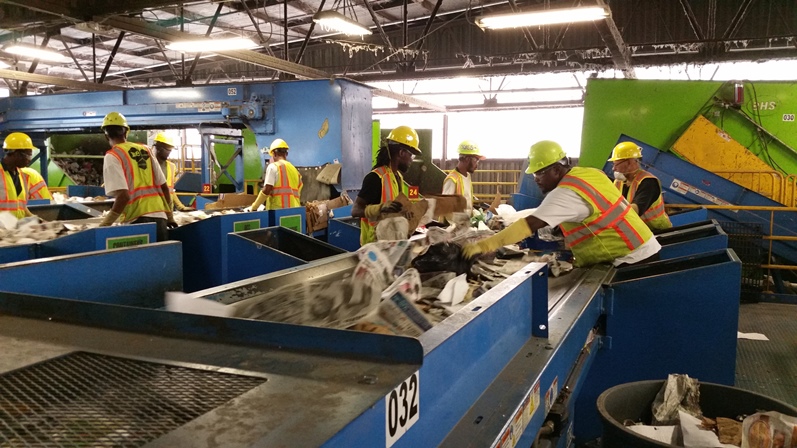
Still, the MRF plays a crucial role in helping DNREC carry out its duties of protecting Delaware’s natural resources. The facility uses a combination of human labor and advanced technology to sort material and ensure trash is kept out of the items that will be recycled.
The hundreds of tons of collected waste brought to the facility each day are weighed upon arriving. Trucks carrying materials earmarked for recycling drive over a scale, then dump their load on the tipping floor before being weighed again to determine how much material they transported to the MRF.
From there, a large wheel loader like the kind used for construction scoops up huge clumps of materials and dumps them on a conveyor belt. Workers then manually sort many of the items, separating trash from recyclables. Some goods, such as scrap metal, can damage the facility’s complex machines, while food waste can contaminate recyclables.
Glass is crushed by machines, enabling the tiny particles to slip through a sifting screen while other items simply move on through, and rotating discs help separate cardboard as magnets pull tin, aluminum and steel cans away. The facility also uses advanced optical sorters, basically infrared cameras, to identify plastic, with automated bursts of air sending plastic containers to a different chute.
This thorough process combining manpower and machinery helps isolate the different categories of material, ensuring bales of recyclables are not contaminated by organic waste or other items.
The final bales are held together by steel wire and can weigh more than a ton. They’re loaded onto trailers and shipped out, potentially to be sent around the globe, although most of this material will be reused and end up back in stores within six weeks.
Trash, meanwhile, is bailed and taken to a landfill, where it’s crushed and buried.
So, how does this impact you, and what should you know about recycling in Delaware?
Well, for starters, if you’re not already recycling, you should. Most of your neighbors do. Recycling — and subsequently reusing — items is better for the Earth than simply throwing them in a landfill. It reduces greenhouse gas emissions, saves energy (according to the U.S. Environmental Protection Agency, recycling 10 plastic bottles provides enough energy to power a laptop for a full day) and keeps waste out of landfills. And, on top of all that, recycling has clear economic benefits. Think of your recyclables like a valuable commodity rather than trash.
It’s easy too, especially with DNREC’s Recyclopedia, an online tool that allows you to search for hundreds of different kinds of waste to see what can be recycled and what should go in the trash. It is important Delawareans only send recyclable material that the MRF has the capability to sort for and that there is an end market to sell the material to.
If you have items that are still in good shape but are no longer needed, we encourage you to sell or donate those items rather than throw them out. This allows them to be used by someone else and keeps them out of the landfill.
A few key things to remember are to ensure your recyclable are loose. Recyclables placed in trash bags can’t be sorted properly. Make sure your recyclables are empty and rinsed. Food and liquids contaminate the valuable paper and cardboard. Finally, avoid placing plastic bags and plastic film in your recycling bin with other materials. Thin plastic can get tangled in the MRF’s machines, requiring the entire facility to be shut down while they’re removed.
Fortunately, this doesn’t mean you’re out of options when it comes to grocery bags and plastic film. Large retail stores are required to have bins to collect plastic bags and film and then recycle them. The next time you make a trip to the grocery store, take that load of old bags. The store will often have a labeled bin by the front of the store, but you can also ask an employee where you can recycle your bags.
While important, recycling is not the answer to all our waste disposal issues. Reducing the amount of trash you generate and reusing what you have are great ways to help conserve natural resources. Composting your food scraps and yard waste helps keep valuable material out of the landfills and can produce soil rich with nutrients that can be used to help grow flowers, grass or other plants.
And, always choose to purchase items made from recycled material. Doing so helps incentivize manufacturers to reuse materials. Make sure all the effort you take to recycle doesn’t go to waste!
Editor’s note: This article was published in 2020 and updated in 2025.
Related Topics: conservation, outdoor delaware, recycling, science, waste and hazardous substances
Delaware's Governor
State Agencies
Elected Officials
General Assembly
Delaware Courts
State Employees
Cities & Towns
Delaware State Code
State Regulations
Business First Steps
Phone Directory
Locations Directory
Public Meetings
Voting & Elections
Transparency
Health Insurance
Tax Center
Personal Income Tax
Privacy Policy
Weather & Travel
Contact Us
Corporations
Franchise Tax
Gross Receipts Tax
Withholding Tax
Delaware Topics
Help Center
Mobile Apps
E-mail / Text Alerts
Social Media


Built by the Government Information Center
©MMXXVI Delaware.gov