DNREC Menu

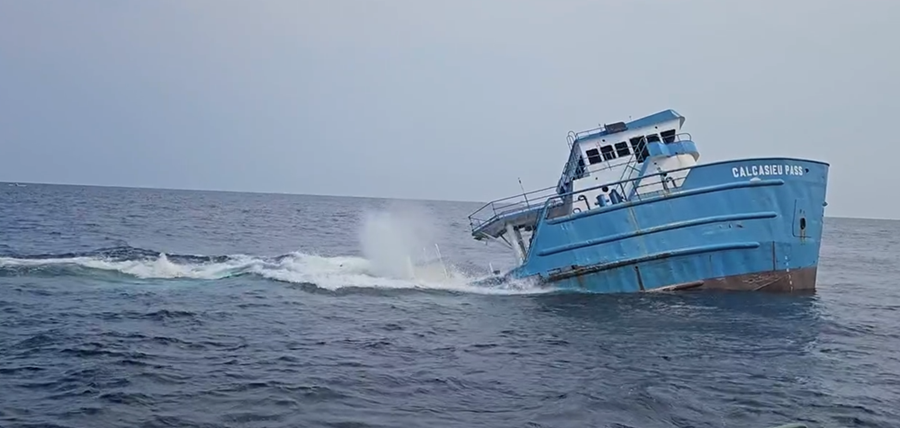
It took about two-and-a-half hours for her to go under. She went down bow first in 88 feet of water. But the 180-foot-long ship, The Reedville, wasn’t caught in a storm. She was purposely and carefully sunk in the summer of 2020, just another addition to the renowned Delaware Artificial Reef Program.
The Reedville joined a multitude of New York City subway cars on the bottom of the ocean at Redbird Reef about 16 miles off the Indian River Inlet. The reef, which covers 1.3 square miles of the ocean floor, is specifically designed to provide fish habitat, opportunities for angling, SCUBA diving and other activities for ocean dwellers and sea lovers alike.
Delaware’s 14 reef sites are located along the coast from Augustine Beach to 55 miles offshore along the edge of the continental shelf. Most are still numbered, but three sites have been named, including Redbird Reef, which contains more than 700 retired and repurposed “Redbird” subway cars from New York.
Over the past 20 years, the Delaware Department of Natural Resources and Environmental Control’s Artificial Reef Program has used recycled materials for reef development. These materials include more than 2 million tons of rock, 100,000 tons of concrete, 86 tanks and armored personnel carriers, upwards of 1,350 retired subway cars and 32 retired vessels ranging from 40 to 653 feet long.
The latest vessel sunk, measuring 180 feet in overall length with a 40-foot beam, was sent to the bottom in August 2026. Originally constructed in 1982 by Bay Shipbuilding Corporation in Panama City, Florida, for the Zapata Haynie Corporation as an offshore oil field supply vessel, the ship was originally named the Judy V and supported offshore oil field operations until 1989, when it was converted into an Atlantic menhaden fishing vessel and renamed the Calcasieu Pass. It now resides in the Atlantic Ocean about 35 miles east of the Delaware beaches at the site known as the Del-Jersey-Land Reef.
The 2026 sinking was carried out by contractor Coleen Marine, which has handled numerous reef deployments over the DNREC reef program’s existence. As with all other vessels DNREC has deployed onto the artificial reef system, the most recent ones were sunk only after having been certified for environmental cleanliness and safety.
“The seafloor off Delaware’s coast primarily consists of featureless sand and mud,” said Colt Williamson, an environmental scientist in the DNREC Division of Fish and Wildlife who oversees the initiative. “The addition of hard structures through the Artificial Reef Program gives many marine species the habitat they require to thrive. Delaware’s recreational anglers and divers are then able to enjoy the unique experiences the reef sites provide.”
(Delaware DNREC)
Artificial reefs mimic the functions of coral reefs. They provide durable, stable manmade structures on specially permitted sites. They are located so they will attract fish but not interfere with navigation or other uses.
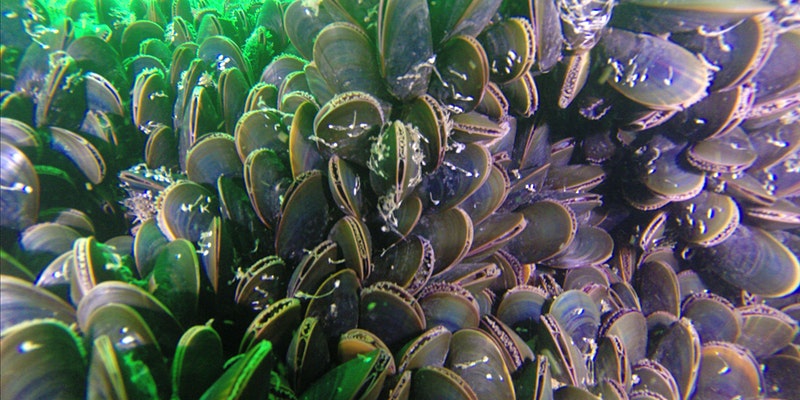
A rich and unique invertebrate community, including blue mussels and oysters, attach to the surfaces of our artificial reefs. These creatures provide up to 400 times more food for fish as the bare ocean floor. The three-dimensional reefs also provide protection for fish from predators, tides and storms.
Once the fish arrive, so do anglers. But overfishing is avoided by placing size limits for tautog, black sea bass and summer flounder, the fish usually caught on Delaware’s reefs.
Artificial reefs are considered most important in the mid-Atlantic region because of the limited natural rock, unlike New England or south Florida with its tropical coral reefs. In Delaware, artificial reefs alone provide this kind of enriched habitat.
Artificial reef development first came about in 1985 under the direction of the National Artificial Reef Plan, written by the National Oceanic and Atmospheric Administration. DNREC dedicated a federal aid project to artificial reef development in 1992 and began deploying reef materials in 1995. Funding for the artificial reef program comes from federal taxes on fishing and boating equipment. No state funding is used.
The First State’s artificial reef system grows bigger every year. Vessels are bought and prepared for reefing by a marine contractor with a shipyard near Delaware. Due to the high cost of towing, all reefing candidates must originate locally. Marine contractors perform many types of jobs including towing, and salvage and marine repair. DNREC use a marine contractor specializing in reef development.
The reef program is conducted under a federal permit from the U.S. Army Corps of Engineers with oversight by the U.S. Environmental Protection Agency for toxics removal, and the U.S. Coast Guard for elimination of petroleum and floatables. As a result, the reef program is environmentally sound.
For a small coastal state, Delaware has an active and well-funded reef program. The fish and anglers are benefitting, and so is our economy. DNREC’s monitoring of angler use shows that fishing on the reefs results in a $7 million annual boost to the coastal economy. This benefit is based on angler spending for food, lodging, bait, tackle and boating. In 2025, Delaware’s artificial reefs received more than 18,000 boat trips from anglers.
Delaware will continue to build artificial reefs and provide increasing opportunities for anglers and divers.
Related Topics: boating, conservation, education, fisheries, fishing, Fishing and Hunting, fun, health, nature, outdoor delaware, outdoor recreation, recycling, reefs, science
Delaware's Governor
State Agencies
Elected Officials
General Assembly
Delaware Courts
State Employees
Cities & Towns
Delaware State Code
State Regulations
Business First Steps
Phone Directory
Locations Directory
Public Meetings
Voting & Elections
Transparency
Health Insurance
Tax Center
Personal Income Tax
Privacy Policy
Weather & Travel
Contact Us
Corporations
Franchise Tax
Gross Receipts Tax
Withholding Tax
Delaware Topics
Help Center
Mobile Apps
E-mail / Text Alerts
Social Media


Built by the Government Information Center
©MMXXVI Delaware.gov