DNREC Menu

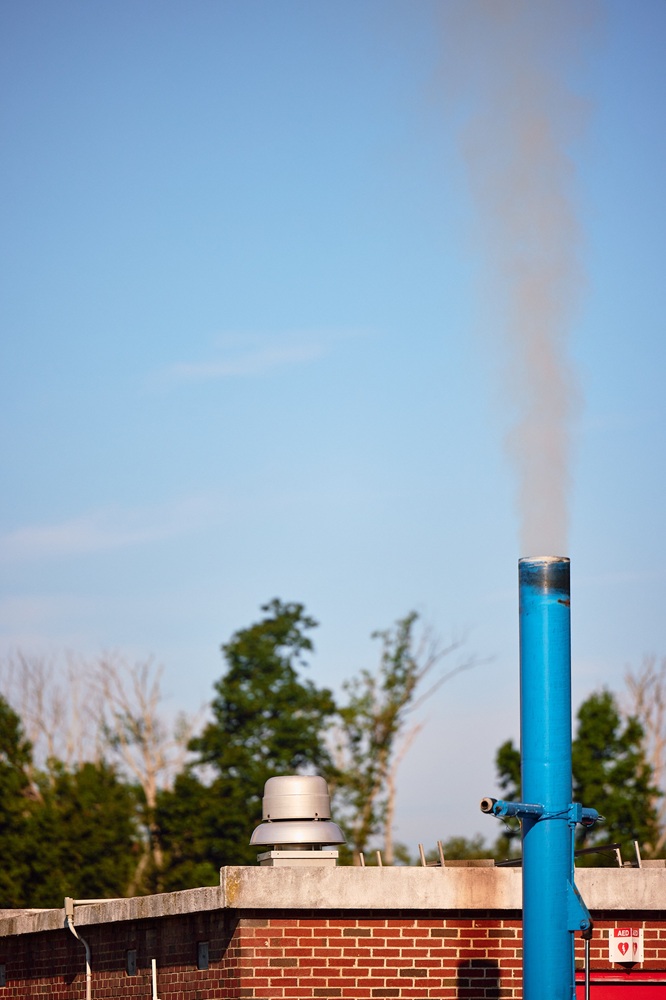
Not all smoke is created equal. Smoke can vary greatly in color, smell, wetness, velocity and thickness. And with special training, individuals can use some of those traits to assess an emission source’s compliance status.
For years, engineers in the Delaware Department of Natural Resources and Environmental Control’s Division of Air Quality have gone to “smoke school” twice a year to learn how to read smoke based on the opacity, or how much light is visible through it.
While there are several different companies that train personnel on smoke, DNREC has relied on Eastern Technical Associates for decades. ETA travels around the country teaching federal, state and local government agencies to understand the thickness of smoke and what it means.
“It’s a compliance tool,” said Jordan Matthews, an engineer in the Division of Air Quality. “Our goal there is to calibrate our eyes on that day.”
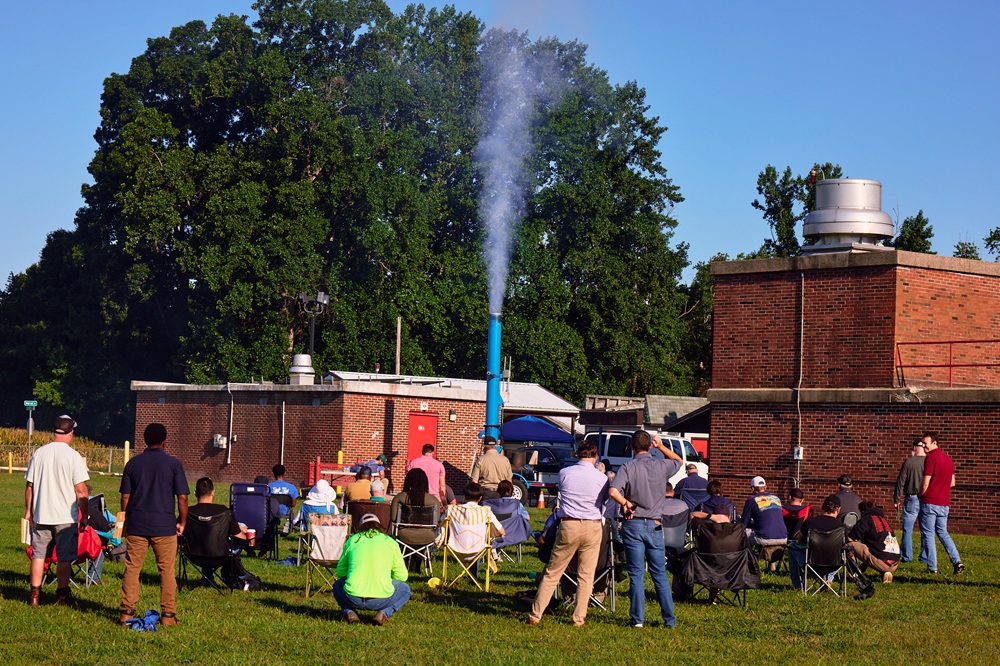
Dozens of participants gather at the Delaware State Fire School every year around the beginning of spring and the end of summer to undergo a rigorous day of training and testing.
Passing smoke school means you’ve achieved visible emission observation certification under U.S. Environmental Protection Agency Method 9, which is required for certain regulatory work around stationary emission sources.
Before the test begins, attendees are given demonstrations of different levels of opacity: 25%, 50% and 75%. To achieve certification, participants must pass a test based on correctly identifying the levels for both white and black smoke over a series of test runs that can range from 0% to 100% opacity.
If the opacity is 0%, the smoke is invisible. At 100%, nothing can be seen beyond the smoke. While most emission sources are on the lower end of this range, this test ensures DNREC’s air quality professionals are prepared for all possibilities.
(Delaware DNREC)
So, how do you determine the opacity?
Using special equipment somewhat similar to a fog machine, the instructor releases a smoke plume of varying opacity. Participants position themselves with the sun at their back and a clear background behind the machine to contrast the smoke against. They then take mental notes of each level of opacity when it’s presented to them.
“Maybe there’s a tree branch or something in the background,” Matthews said. “What does it look like at 25%? How defined is it, how much can I tell the color, what do the edges of the smoke plume look like at 25%? And then you do it at 50% and 75%.”
While this would just be a neat parlor trick for most, it’s an invaluable skill for those working in the air quality field.
Engineers in the Division of Air Quality can use this knowledge as they inspect facilities large and small, from the Delaware City Refinery to a cement plant or grain-handling facility. Certification means they are able to quickly determine if a source like a generator is working properly based on how the smoke looks. They can then use this knowledge to ensure a site is complying with its permit, which may impose conditions consistent with state regulations such as forbidding producing smoke in excess of 20% opacity for more than three minutes every hour.
Matthews recalled instances where he spotted smoke arising from an area he knew was a permitted facility and recognized there was an issue by how it looked. That discovery enabled him to quickly notify the site, thus limiting pollution and ensuring the issue was addressed.
“Sometimes — not often but sometimes — you’re driving by a source, and you can see a problem from half a mile away,” he said.
It’s not just government employees who are looking out for smoke either. Personnel for the regulated community are among those who receive biannual certification alongside DNREC engineers to help them quickly analyze smoke and ensure continuous compliance.
Matthews emphasized that just because you see what appears to be smoke spreading into the sky doesn’t mean there’s anything wrong. Not all plumes are actually smoke, for one — they may simply be steam.
Most inspections, in fact, are straightforward and do not identify any issues. Ones that do stick in inspectors’ minds do so because of malfunctions, negligence and other problems. When it comes to air quality, business as usual is a good thing.
But for those rare instances where work doesn’t go as expected, being able to assess a situation by glancing at a plume of smoke is a valuable skill indeed.
Related Topics: air quality, outdoor delaware, science, smoke
Delaware's Governor
State Agencies
Elected Officials
General Assembly
Delaware Courts
State Employees
Cities & Towns
Delaware State Code
State Regulations
Business First Steps
Phone Directory
Locations Directory
Public Meetings
Voting & Elections
Transparency
Health Insurance
Tax Center
Personal Income Tax
Privacy Policy
Weather & Travel
Contact Us
Corporations
Franchise Tax
Gross Receipts Tax
Withholding Tax
Delaware Topics
Help Center
Mobile Apps
E-mail / Text Alerts
Social Media

Built by the Government Information Center
©MMXXVI Delaware.gov